
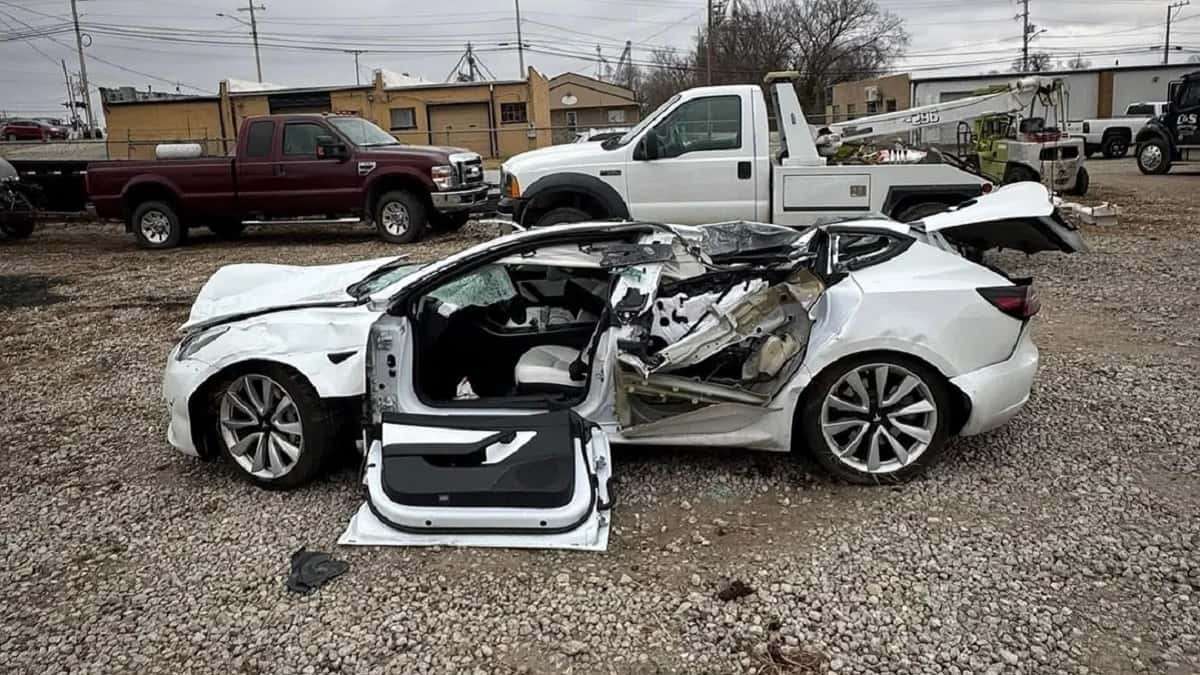

In the United States, automobile crashes claim over 40,000 lives every year, making them one of the leading causes of death. We often talk about heart disease and cancer, but behind the wheel, the danger feels invisible, until it's not. Social media is full of dramatic post-crash photos and stories. All of these incidents are tragic, but we should learn from them and understand which vehicles provide the most safety.
Here’s a recent post on Reddit by BasicallyCool about surviving a nasty accident in his Tesla Model 3 and coming out unscathed:
“I’m okay! I think.
The car flipped and rolled 5 times, during the rolling it hit the metal fence/barrier upside down.”
SnitGTS responded with:
“I’d like to know how many lives the strength of the roof has saved. That video of a tree falling on a Tesla is crazy, it would have killed them in virtually any other car.”
Enragedocelot added:
“It makes me happy to see the webbing of the roof. I thought that stuff would shatter if I flipped.”
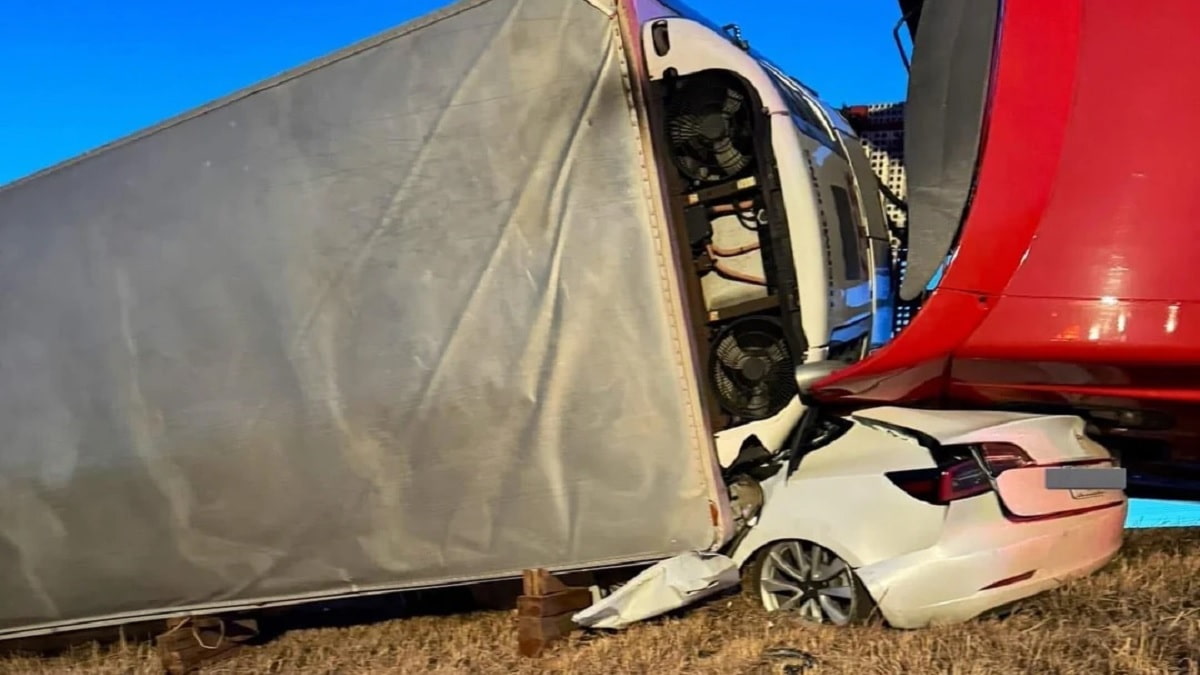
How Do We Know Which Cars Are Safe?
Have you ever wondered how we know which cars are the safest in a crash and which ones could use some improvement? The U.S. National Highway Traffic Safety Administration, or NHTSA, has been working to keep drivers and passengers safe since 1970. As a federal agency, its main job is making sure our roads are safer by setting vehicle safety standards and running crash tests.
Through its New Car Assessment Program, NHTSA puts vehicles through tough tests that mimic real-world crashes, including front-end collisions, side impacts, and rollovers. These tests use crash-test dummies and high-speed cameras to measure how well a car protects its occupants. Over the years, NHTSA has tested thousands of vehicles, and its 5-star safety ratings have become a trusted tool for shoppers and a benchmark for automakers. Car companies pay close attention to the results, often using them in advertising and design decisions.
The Tesla Model 3 received five stars in every single category and subcategory making it one of the safest cars NHTSA has ever tested. It’s not just that it passed, but it redefined what top-tier safety can look like.
As the first SUV ever to achieve 5 stars in every NHTSA crash category which demonstrates an extremely low probability of injury, the Tesla Model X added to the Tesla brand safety.
Why Are Tesla Cars so Safe?
Their safety is a result of numerous design choices. Tesla’s approach to vehicle design is rooted in a concept called first principles thinking, which means “reimagining” each part of a car from the ground up rather than following industry norms.
One example of this is their use of expansive glass roofs, which are often seen as a stylistic choice but also serve a structural purpose. Tesla engineers design the entire roof system to distribute crash forces efficiently, using reinforced glass and strong supporting frames to maintain rigidity and safety. This combination of innovation and engineering precision allows Tesla vehicles to deliver panoramic visibility, high safety ratings, and additional headroom. That’s a real design hat trick.
What Can You Do to Make Cars Safer?
It’s hard to believe now, but for decades many car companies and industry groups pushed back against life-saving safety measures like seatbelts and airbags. They argued it would cost too much, scare customers, or hurt sales.
For example, the National Association of Automobile Dealers (NADA) often sided with automakers in opposing federal safety measures, worried that visible safety equipment like seatbelts or padded dashboards would hurt car sales or suggest that driving was inherently dangerous.
In the 1950s, Volvo became one of the first automakers to take a stand, installing seatbelts in its vehicles and even giving away the patent for the three-point seatbelt so everyone could use it. Volvo’s decision to prioritize seatbelts, gave the company a long-lasting reputation as a safety pioneer. That identity became central to the brand and remains a key reason many people choose Volvo today.
Years later, in the early 1970s, General Motors was the first to offer airbags in a limited number of models.
It took government pressure, public demand, and years of resistance to make these basic protections standard. It's a powerful reminder that progress in safety often comes slowly and requires sustained political pressure.
When exercising your constitutional right to vote, please research and consider candidates who have or are likely to support legislation that will make vehicles safer.
Please Drop Your Thoughts in the Comments Below
Have you or someone you know ever walked away from a serious crash because of a car’s safety features?
What laws or regulations would you like to see passed to make driving safer for everyone?
Chris Johnston is the author of SAE’s comprehensive book on electric vehicles, "The Arrival of The Electric Car." His coverage on Torque News focuses on electric vehicles. Chris has decades of product management experience in telematics, mobile computing, and wireless communications. Chris has a B.S. in electrical engineering from Purdue University and an MBA. He lives in Seattle. When not working, Chris enjoys restoring classic wooden boats, open water swimming, cycling and flying (as a private pilot). You can connect with Chris on LinkedIn and follow his work on X at ChrisJohnstonEV.
Image sources: Reddit contributor
Set Torque News as Preferred Source on Google
Follow us today...



Comments
What they don't tell us is…
Permalink
What they don't tell us is how well Tesla's 'autonomous driving' feature worked; might have something to do with the accident.
FSD has a lifetime gaurantee…
Permalink
In reply to What they don't tell us is… by Garry Coffman (not verified)
FSD has a lifetime gaurantee,, might be 10 years, might be 10 minutes.....