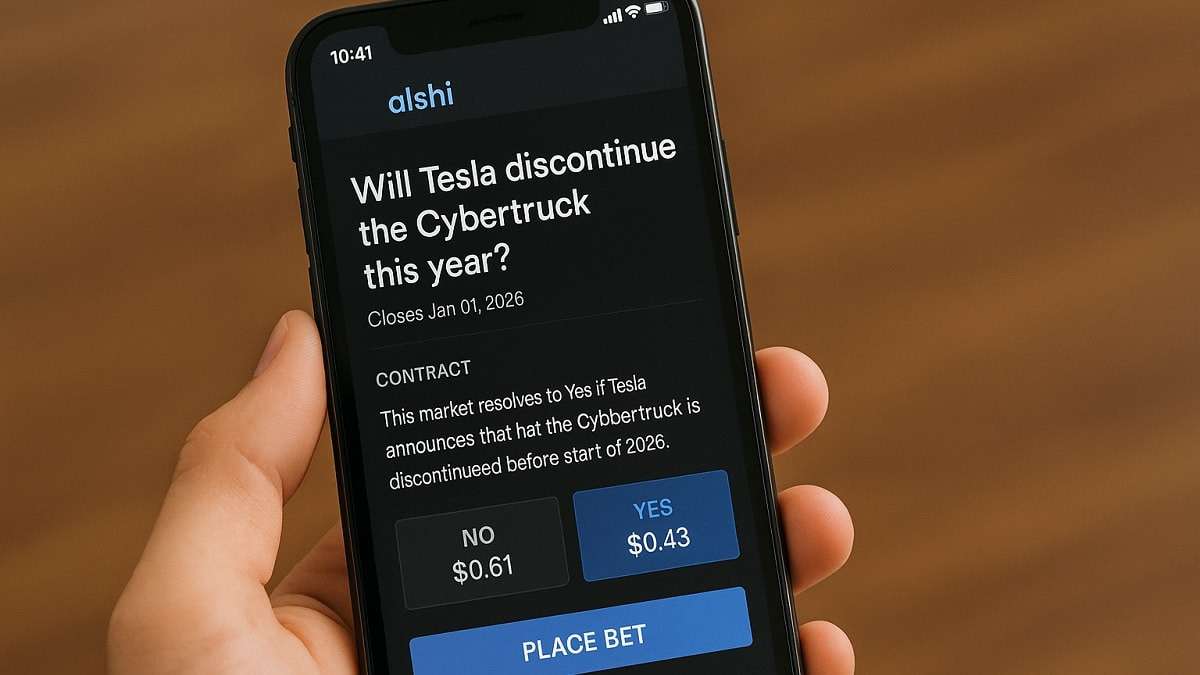

You can legally place “bets” on almost anything in the U.S. on federally regulated exchanges. The “bets” are called “trades” or “event contracts.” They are financial contracts that pay out based on the outcome of real-world events like elections, specific business outcomes, economic indicators, and sports. Instead of trading stocks, users buy and sell contracts based on whether they believe an event will happen or not. The exchanges are legally classified as derivatives markets, not gambling, which allows it to operate nationwide under federal regulation by the Commodities Futures Trading Commission (CFTC). The two most popular event contract exchanges are Kalshi and Polymarket.
Across social media, we see some crazy automotive-related event contracts. For those of us that follow the automotive industry, it’s a fun way to follow trends and sentiment. Here’s a recent Twitter/X post by Kalshi about Tesla’s Q3 2025 delivery numbers:
“JUST IN: Our traders forecast Tesla to have delivered 510,000 cars in Q3.”
@SawyerMerritt responded with:
“Optimistic! My estimate is 480,000. Despite the loss of the Fed EV credit, I don’t think Tesla delivered an all-time high amount of vehicles in Q3, but I hope I’m wrong!”
@Karurtedd replied:
“Very unlikely although I don’t think car deliveries will be a good metric on the value of the company soon anyway.”
How Prediction Markets Are Changing the Way We Do Business
Event contract exchanges such as Kalshi and Polymarket are nudging people to treat business questions like tradeable opinions with price tags. Instead of only reading analyst reports, investors can see real money odds on concrete events. For example, Kalshi lists contracts on Tesla’s quarterly deliveries, including one that pays out if Tesla delivers at least 43,0000 vehicles in Q4 2025, which tracks expectations for the company very closely. Kalshi also offers a contract on whether Tesla will discontinue the Cybertruck before 2026, which turns product strategy into something people can trade.
These markets can help businesses and observers learn faster. Prices update instantly as new information arrives, which creates a live crowd sourced forecast for key milestones. Polymarket, for example, hosts markets on whether Tesla will launch a fully driverless robotaxi service by specific deadlines, including October 31st and the end of 2025, as well as a market focused on California. Traders recently pushed those odds sharply higher after regulatory moves, a shift that signals rising confidence in autonomous ride hailing plans. Automotive companies can watch these signals as another form of customer and investor feedback.
There is a darker side to this new way of engaging with business. Event contracts can encourage people to treat serious topics like a prediction game, especially when the subject involves safety, layoffs, or controversial technologies. Markets on robotaxis, unsupervised self-driving, and the Tesla Cybertruck survival can amplify drama around every headline, which may fuel polarization instead of rational thinking. Regulators also worry about gambling like behavior and the possibility that insiders might trade on privileged information. Society gains sharper forecasts, yet also faces new ethical questions about what should become a bet.
What Do We Lose if the Tesla Cybertruck Is Cancelled
The Cybertruck incorporates cutting edge design choices that raises the bar for durability, efficiency, and manufacturing simplicity. These innovations may not guarantee a long production life for the Cybertruck, but they will strongly influence how future electric vehicles are designed. We list out what we see as the Tesla Cybertruck’s most innovative features below.
Long Term Durability and Materials
The Cybertruck’s stainless steel body panels represent a major step away from planned obsolescence. These panels resist corrosion and never require paint, which supports the idea of a million-mile chassis. Skipping paint also cuts environmental impact, since paint shops require enormous buildings, strict climate control, heavy robotics, and complicated filtration. Eliminating these steps reduces energy use, water consumption, and harmful emissions while also lowering manufacturing costs.
Electrical Architecture and Efficiency
The shift from a traditional 12-volt system to a modern 48-volt architecture required significant engineering work and supplier coordination. Most automotive components are built around 12 volts, so Tesla had to resolve safety concerns, electrical noise, and sourcing gaps. The move pays off because higher voltage reduces current, lowers heat loss, and increases overall efficiency. Thinner wire can replace heavy copper strands, which lightens the vehicle, lowers cost, and improves power stability for steer by wire, brake by wire, and autonomy systems.
Manufacturing Innovation Through Giga Castings
Large high pressure aluminum die castings, known as giga castings, form the front and rear structures in just two pieces. This replaces over one hundred and seventy smaller stamped and welded components. The simplified approach removes welds, fasteners, and long quality inspection steps. Production becomes more efficient, since fewer robots are needed and labor and tooling can be cut by meaningful margins. These castings also create a more rigid structure that supports better crash performance and easier manufacturing scale up.
Steer By Wire and Driving Dynamics
The Cybertruck is the first production truck to use steer by wire. This system removes the physical steering connection and relies on sensors and actuators to translate driver input instantly. Steering feels tight and responsive during parking, then more relaxed at highway speeds. Rear wheel steering gives the large truck the agility of a smaller vehicle. The design reduces mechanical parts and opens the door to advanced off-road features and future autonomy. Tradeoffs remain, since the system requires strong backups in case of power loss and some drivers still prefer the familiarity of a mechanical steering feel.
What Do You Think?
What do you think about people legally “betting” on whether the Tesla Cybertruck gets cancelled? Do you see it as smart forecasting or a sign that prediction markets are going too far?
How accurate do you believe event contract exchanges like Kalshi and Polymarket really are when it comes to Tesla predictions such as quarterly deliveries or Cybertruck survival odds?
Chris Johnston is the author of SAE’s comprehensive book on electric vehicles, "The Arrival of The Electric Car." His coverage on Torque News focuses on electric vehicles. Chris has decades of product management experience in telematics, mobile computing, and wireless communications. Chris has a B.S. in electrical engineering from Purdue University and an MBA. He lives in Seattle. When not working, Chris enjoys restoring classic wooden boats, open water swimming, cycling and flying (as a private pilot). You can connect with Chris on LinkedIn and follow his work on X at ChrisJohnstonEV.
Photo credit: Provided by the author
Set Torque News as Preferred Source on Google
Follow us today...