
Even though increasingly more new cars are shipping without spare tires, it’s catching buyers by surprise. It includes both gas-powered cars and EVs. Some specific EV models that don’t ship with spare tires include the Tesla Model Y, Hyundai Ioniq 5, Kia EV6, and the Toyota bZ. Frustration can be seen across social media car communities. Here’s a recent comment from Reddit:
“I’m planning to buy a Tesla Model Y. The only thing that concerns me is not having a spare tire. Personally, there were a couple of times over years that I had to change the spare tire on my own while on the curb of a highway.”
The first response was:
“Unfortunately, I had a blowout less than a year into ownership of my Tesla Model Y, and it sucked. I was able to get a tow truck out with a press of a button on screen but it took about an hour. The service center had me back on the road within 15 minutes though.”
The next response had a useful suggestion:
“My 2017 Accord Hybrid didn’t have a spare, just an air pump that pumped fix-a-flat. It was absolutely useless for a blow out, so I bought a donut and jack kit off of eBay. There are places in TX where you can’t even get cell service, and if you could, good luck with roadside assistance getting there anytime soon.”
The Disappearance of Spare Tires
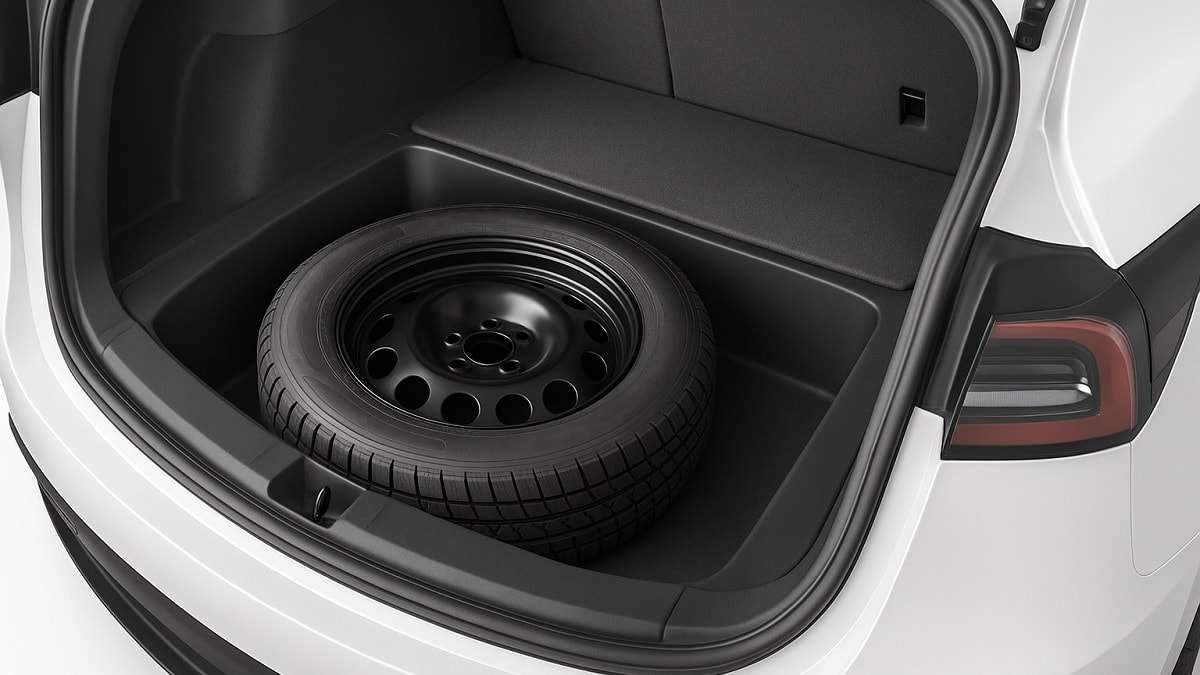
For many decades, spare tires were standard equipment in nearly every type of vehicle. They usually sat under the trunk floor or were mounted on the back of SUVs and trucks. In recent years, more new cars have rolled out of the factory without them. Some cars include a repair kit or a small air compressor instead, while others offer nothing. AAA estimates that close to one third of new vehicles no longer include a spare tire at all.
Fuel Efficiency Pressures
Automakers face strict fuel economy and EV range standards, which means every pound of weight matters. A spare tire, jack, and associated tools add 30 to 50 pounds to a vehicle. Removing them helps improve fuel efficiency and battery range, even if only slightly. That tiny improvement becomes significant when applied across hundreds of thousands of cars, so manufacturers treat it as a simple way to help reach efficiency targets.
The Search for More Space
Space inside vehicles is more valuable than ever. Designers prioritize roomy cabins, sleek styling, and improved aerodynamics. Electric and hybrid vehicles have the added challenge of fitting large battery packs, which often leaves no room for a spare tire. Even gasoline cars are designed with tighter packaging, and dropping the spare gives manufacturers flexibility to use that space for audio equipment, batteries, or additional cargo room.
Advances in Tire and Repair Technology
Modern vehicles often come with run flat tires that can travel short (typically about 50 miles) distances even after losing air pressure. Many others come with sealant and compressor kits meant to handle small punctures. These tools can help drivers avoid an immediate breakdown, although they only work in limited situations. A sidewall tear, a large gash, or wheel damage still requires professional assistance, which leaves the driver stranded despite the technology.
Cost Savings for Automakers
Removing spare tires also reduces manufacturing costs. Tires, jacks, and wrenches require materials, storage, and installation. Cutting these items lowers expenses, even if those savings rarely show up in the sticker price of the car. Manufacturers often frame the decision as a design improvement or efficiency upgrade, but it is also a financial benefit for them.
Real World Problems for Drivers
The lack of a spare tire can quickly become a major inconvenience. Many drivers find themselves stranded when a repair kit fails or when they are in areas with no cell service. Millions of drivers each year experience breakdowns that could have been resolved with a simple spare. Many people do not realize their new car lacks a spare until they need one, which adds stress and sometimes extra cost if professional service is required.
Safety Concerns and Lack of Awareness
Repair kits are unfamiliar to many drivers and can be confusing to use for the first time in an emergency. Run flat tires and sealants often require repair at a shop rather than a simple DIY fix. This creates an inconvenience for drivers who were once able to change a spare in a few minutes. The shift from self-sufficiency to dependence on roadside assistance can create unsafe situations, especially at night or in remote locations.
The Tesla Model Y
The Tesla Model Y is an electric compact crossover SUV that launched for production in early 2020, following its reveal in March 2019. It stands out for offering impressive all-electric range, rapid acceleration, and the convenience of Tesla’s Supercharger network. It has been among the first choices for buyers who want a modern, tech-forward vehicle with crossover SUV practicality. What sets it apart from other EVs is its combination of everyday usability, ample cargo and cabin space alongside Tesla’s software-centric features and frequent over-the-air updates. In short, if you’re looking for an EV that blends everyday family-friendly utility with high-end tech and broad charging infrastructure, the Model Y hits that sweet spot.
Bottom Line
The move away from spare tires stems from several factors that include fuel economy requirements, space limitations, advances in tire technology, and cost savings for manufacturers. These choices benefit automakers and help achieve environmental goals, but they leave many drivers less prepared during emergencies. Anyone shopping for a new car should check whether a spare is included, and if not, consider buying one separately. A simple spare tire can prevent a stressful or unsafe situation and can make all the difference when technology fails or signals drop.
What Do You Think?
Have you ever been stranded because your car didn’t come with a spare tire, and how did that experience change what you expect from a new vehicle?
Would the lack of a spare tire stop you from buying a Tesla Model Y or any other EV, or do you feel comfortable relying on repair kits and roadside assistance?
Chris Johnston is the author of SAE’s comprehensive book on electric vehicles, "The Arrival of The Electric Car." His coverage on Torque News focuses on electric vehicles. Chris has decades of product management experience in telematics, mobile computing, and wireless communications. Chris has a B.S. in electrical engineering from Purdue University and an MBA. He lives in Seattle. When not working, Chris enjoys restoring classic wooden boats, open water swimming, cycling and flying (as a private pilot). You can connect with Chris on LinkedIn and follow his work on X at ChrisJohnstonEV.
Photo credit: Provided by the author
Set Torque News as Preferred Source on Google
Follow us today...