
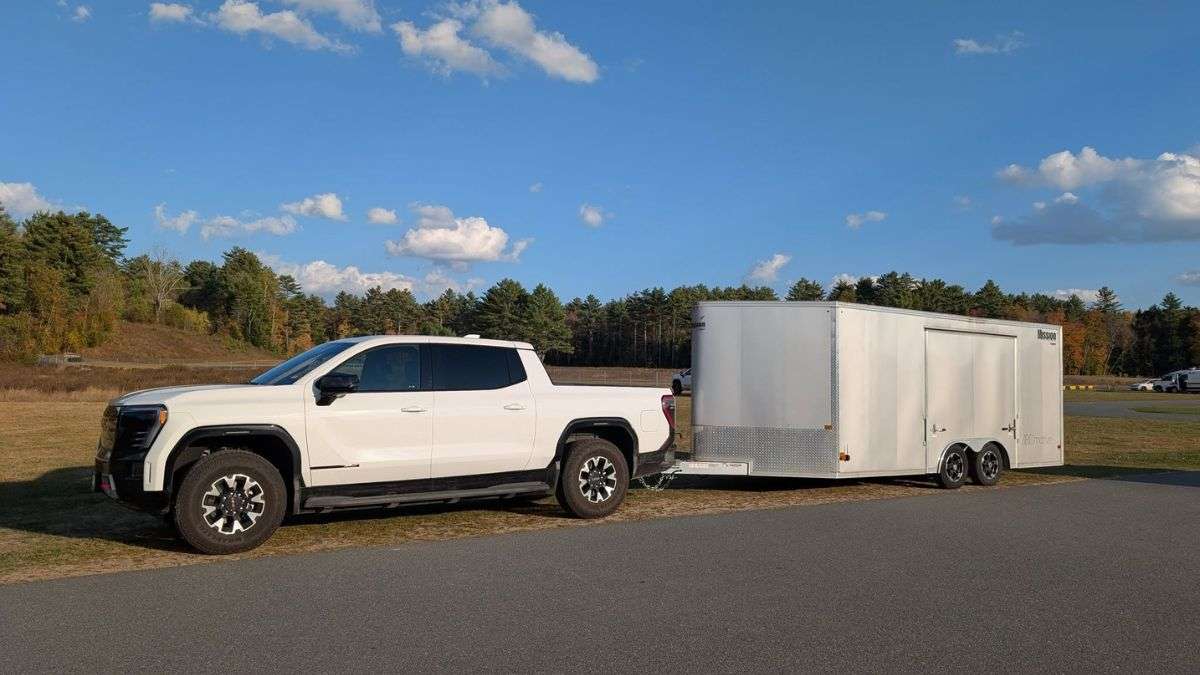

Every electric truck owner eventually faces a reality check of the moment where the numbers on the screen stop being theoretical and start defining whether you’ll actually make it home. It’s the kind of moment that separates expectations from reality and shows what living with an EV really looks like beyond brochures and marketing talk. This evening, while scrolling through the “GMC Sierra EV Group” on Facebook, I came across a story that perfectly captured that reality from a real owner’s perspective. For Josh Pollak, this moment came during his first towing trip in his GMC Sierra EV AT4 Extended Range, a truck he bought specifically to replace his Chevrolet Silverado 3500HD. What started as a confident 120-mile trip through rural New Hampshire quickly became a nerve-testing exercise in energy management, trip planning, and trust in new technology.
“I used the truck for towing for the first time. It's an AT4 Extended Range. I bought it specifically for this purpose to replace my 3500HD Silverado.
I had to go 120 miles and was only able to get up to 87% charge when I left. The truck showed 366 miles before the trailer was plugged in and 201 after I plugged it in. No problem I thought, as 80 miles of range to spare is great.
As I drove the range estimate started to plummet, and about halfway there I was going to arrive with 40 miles to spare. 3/4 of the way there I was going to arrive with 5 miles to spare. This was at night in an unpopulated area of New Hampshire so there were no chargers around, especially no pull through fast chargers.
Thankfully, on the map, I spotted a short cut off the highway that shaved 20 miles off the route at the expense of some twisty roads and a few miles of dirt road. I took the chance and made it to my destination with 17 miles to spare, which went up to 35 when the trailer was disconnected. A few miles from my destination, the ‘charge soon’ warning came on the dash.
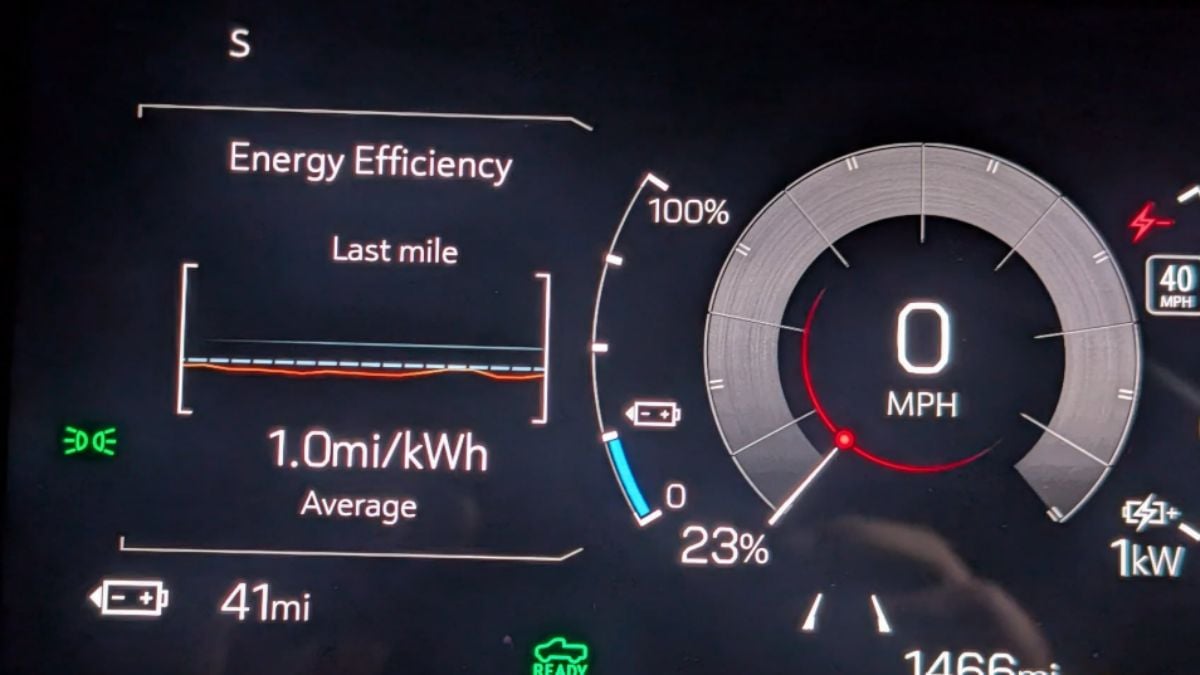
I was able to charge to 95% for the trip home, and the truck estimated 180 miles of range. I guess it learned a bit. I took a different route home that was slightly shorter and made it home with 23% charge and 41 miles to spare with the trailer plugged in.
Looks like I averaged about .9mi/kwh on the way there and 1.0mi/Kwh on the way back, which isn't great but the trailer is tall. The truck reminds you to put it in tow/haul mode but doesn't do it for you automatically which is silly. I forgot to do it on the way back, and I wonder if it would have been more efficient if I had. If anyone knows best how to find pull through chargers please let me know.”
It’s a story that perfectly illustrates the trade-offs of switching from diesel to electric for towing. Josh’s Sierra EV performed admirably in terms of torque and control, but the rapid drop in range shows the kind of planning required for long hauls. He ended his post with a question about locating pull-through chargers, which is an issue that many EV truck owners continue to face.
Community Reactions
Shea Styer offered a helpful suggestion regarding the charger issue: “Plugshare has a filter for pull-through/trailer friendly chargers. I definitely recommend it when planning out longer trips where you may need to charge.”
It’s a reminder that preparation tools are evolving right alongside electric vehicle technology. These new tools are transforming towing into a smarter, more data-driven process that empowers drivers to make better decisions before they ever leave the driveway.
Joshua Bukoffsky chimed in next, asking, “How heavy was the trailer?” Josh responded that it was around 5,000 to 5,500 pounds, adding that “range is more about wind resistance I think.”
His observation makes perfect sense. While weight affects efficiency, aerodynamic drag is often the biggest factor in how quickly an EV’s range disappears. Taller, box-shaped trailers create significant air resistance, forcing the battery to work harder to maintain speed. As I discussed in another story about a driver who switched from a 3500HD to a Sierra EV Max Range, electric trucks can be incredibly efficient under the right conditions, but towing tall loads at highway speeds quickly changes that equation.
Cordell Spinner added some realistic perspective: “Yea it’s not a replacement for a 3500 but somewhat of an option depending on distance of towing obviously. It also doesn’t have nearly the towing capacity, but I think short runs are cool to do.”
Cordell’s point is valid too. The Sierra EV AT4 may offer impressive torque and instant response, but it can’t match the long-range hauling strength of a diesel 3500HD. That’s why many owners who tow frequently are still balancing the benefits of EV refinement and torque delivery against the range anxiety that comes with heavier trailers. In another discussion, a GMC Sierra EV owner mentioned being hesitant to switch from a Ram 2500 but was won over by the truck’s instant torque and towing capability, showing how each owner’s needs shape their perception of what “better” really means.
What Really Affects Towing Efficiency in EVs
Towing with an electric truck is a completely different science compared to gas or diesel. The truck doesn’t just pull weight, as it must also overcome aerodynamic resistance, manage heat, and maintain battery stability over time. Josh's efficiency numbers, which were around 0.9 to 1.0 mi/kWh, reflect how much energy aerodynamic drag consumes. At highway speeds, drag increases exponentially, meaning doubling your speed can quadruple the resistance. When you add elevation changes and cold nighttime temperatures, that energy drain becomes even more noticeable.
That’s why EV owners towing trailers are learning that trip planning and energy awareness are just as important as the specs on the brochure. Apps like PlugShare, A Better Routeplanner, and Electrify America’s network locator have become essential tools. Without them, even a simple trip can turn stressful fast. In Josh’s case, it wasn’t about poor performance but about the Sierra EV adapting to a new towing profile and recalibrating efficiency expectations in real time.
At the end of the day, stories like Josh’s are crucial to understanding what EV ownership really looks like today. These trucks are capable and surprisingly refined, but they require a shift in how we approach driving and planning. Watching the range drop doesn't necessarily signify a failure. It’s the truck communicating limits that other gas or diesel owners rarely have to consider. For me, what stands out is how EVs like the Sierra AT4 show both promise and progress. They’re not perfect replacements for heavy-duty diesels but they’re clearly evolving fast. And for early adopters like Josh, these experiences help shape the roadmap for everyone coming next.
Key Takeaways
- EV towing range depends heavily on aerodynamics. A tall trailer creates massive drag, significantly reducing efficiency.
- Trip planning tools like PlugShare are essential for long-distance towing with an EV.
- GMC’s Sierra EV AT4 isn’t a 3500HD replacement, but it's great at shorter tows with instant torque and smooth control.
- Owner feedback drives progress. Each real-world experience adds to the collective knowledge improving EV towing performance.
- Understanding limitations leads to smarter ownership, not disappointment.
As we've seen in previous stories about owners losing trust in their Sierra EVs after buyback denials under state lemon laws, transparency about both strengths and flaws is what keeps these discussions honest, and that’s what pushes the technology forward.
What Do You Think?
Would you feel comfortable towing long distances with a GMC Sierra EV if it meant careful planning and slower pacing along the way?
Or do you think electric trucks still have a long way to go before they can fully replace gas/diesel for heavy hauling?
Let me know what you think in our comments below.
Aram Krajekian is a young automotive journalist bringing a fresh perspective to his coverage of the evolving automotive landscape. Follow Aram on X and LinkedIn for daily news coverage about cars.
Image Sources: The “GMC Sierra EV Group” public Facebook group.
Set Torque News as Preferred Source on Google
Follow us today...







Comments
Hard pass. I'll stick to my…
Permalink
Hard pass. I'll stick to my 2017 Chevy Silverado 3500hd with the 6.0L gas to pull my 11,000lb 5th wheel. I have better range and no anxiety.
This story is just plain…
Permalink
In reply to Hard pass. I'll stick to my… by RichD2025 (not verified)
This story is just plain silly. I own a F150 Lightning and I have a F250 Superduty diesel for towing. DO NOT use your EV for towing. EVs are wonderful day drivers and are are great replacements for 95% of daily needs - but everyone knows that they are not good at towing. Keep a diesel for that. And who tows with a gas engine??
Really?
Amen. I mean I two with my…
Permalink
In reply to This story is just plain… by Anthony Richens (not verified)
Amen. I mean I two with my Silverado 1500 but that is once in a blue moon (not even that often really) and my gas mileage is horrendous when I do but I don't go posting about how it doesn't tow as well as a dedicated tow rig.
Who buys a EV pickup truck…
Permalink
In reply to This story is just plain… by Anthony Richens (not verified)
Who buys a EV pickup truck just to drive around and then a diesel to tow? Who tows with a gasoline pickup? I do with no problem. I guess Ford gasoline engines are inferior and can't handle it? I guess the answer to that don't buy crappy Ford gasoline fueled pick ups from what you are saying
The Tesla Semi, is more…
Permalink
In reply to Hard pass. I'll stick to my… by RichD2025 (not verified)
The Tesla Semi, is more practical, for Towing large, bulky, or heavy loads, routinely, because it was built and tested for that.
Unfortunately, there is no "Standard" for what "Towing" ratings Measure!
Personally, I believe the tests should be with 6+ Load Types, and a Rating for each:
1) Low light loads (Below Tailgate Height, under 2,000 Lbs)
2) Low Medium loads (Below Tailgate Height, over 2,000 Lbs, under 4,000 Lbs)
3) Low Heavy loads (Below Tailgate Height, over 4,000 Lbs)
4) Medium Height Light Loads (Lower that Cab Height, Below 2,500 Lbs)
5) Medium Height Medium Loads (Lower than Cab Height, between 2,500 & 4,500 Lbs)
6) Medium Height Heavy Loads (Lower than Cab Height, over 4,500 Lbs)
7) Tall Height Light Loads (Taller than Cab, below 3,000 Lbs)
8) Tall Height Medium Loads (Taller than Cab, between 3,000 Lbs & 5,000 Lbs)
9) Tall Height Heavy Loads (Taller than Cab, over 5,000 Lbs)
*10) Unenclosed Loads: Lumber, Building Materials, Heavy Equipment (Crawler Excavators, Tractor - Loader - Backhoes, Cranes, Buckets, Scissor Lifts, Boom Lifts, etc.)
This list of "Testing Types", with Range Ratings for Each, would go a long way to present Clear and Relevant Information & Data for Use and Comparison.
There may be other factors, to include, like Temperature, Incline Grades, Total Elevation Climbed, as well as Cab Loads, Season, etc.
Basically, we need far more information to properly determine usability fairly for our typical use case! With Towing, so many new factors come into play, compared to the bare vehicle experience!
THERE'S AN OLD SAYING THAT…
Permalink
In reply to Hard pass. I'll stick to my… by RichD2025 (not verified)
THERE'S AN OLD SAYING THAT IF YOU FORGET HISTORY, YOUR BOUND TO REPEAT IT... ELECTRIC VEHICLES ARE TRASH... THEY TRIED USING THEM 100 YEARS AGO AND FOUND OUT THAT THEY WERE NOT GOING TO WORK.... WHAT NEXT, BRING BACK THE STANDLY STEAMER ??? ELECTRICITY IS FINE RUNNING THE HOME, POWER EQUIPMENT ETC...FOR YOUR CAR, TRUCK NO!!!
I tow frequently in quite…
Permalink
I tow frequently in quite rural areas where a charging station is unheard of. There is also the fact I don't have to refill my tank every 100 or so miles, I can tow my trailer 350 miles on one tank full. Hard no for me to get an ev truck.
This was this guys first…
Permalink
This was this guys first time towing- relative inexperience is a factor
Always charge to 100% before towing distances. Baby the acceleration, go slow. Your “estimated range” will vary greatly depending on how the trucks been driven recently, too. Bear that in mind!
I own an f150 lightning and find these stories way overblown. Range issues are so few and far between, esp considering the rapid expansion of super chargers.
PlugShare is a game changer fyi. Don’t let one nervous experience you read about prevent you from trying an EV out! I’ll never go back if I can help it
I think this story is…
Permalink
I think this story is crickets of BS...oh I found a short cut...sure you did! If not then the story is over and nobody reads your articles again! Internet is just full of lies! Why? Because you can!
News flash: Pickup gets half…
Permalink
News flash: Pickup gets half the range when towing.
Anyone who tows knows this. EV or gas, physics doesn't care.
I think the range is fairly…
Permalink
I think the range is fairly comparable if you were to try to pull that with a half ton (I said half ton) gasser (I said gasser), especially if you were to start with 87% of a full tank which is what the story teller said they did with their starting charge level.
But since we're all talking about why we wouldn't buy one, I'm all about payload and I need a longer bed. And I'm talking about the bed outside of the cab.
If it ain't broke don't fix…
Permalink
If it ain't broke don't fix it. My AT4 isn't "fuel efficent" per se, but it will go at least 3 times further on a tank of gas and I can't remember a time when I had to worry about a place to refill it.
EV's are a long way from…
Permalink
EV's are a long way from meeting the needs for long distance towing. Not sure why this owner had a 3500 HD to pull a 5000lb trailer. Massive overkill. I also think many owners towing trailers for weekend recreation wouldn't call 120 mi long distance. I tow an enclosed car trailer to races in the southeast that weighs around 7500 lbs. I pull with a Chevy Silverado 1500 3.0l Duramax. The half ton truck with the baby diesel is perfect for under 10000lbs. 30mpg without the trailer and about 12 to 14 mpg with the trailer. Most tracks are 3 to 5 hours away. I only have 1 track that is under 150 miles away. Every competitor is pulling a trailer. An EV could not do the job for any of them. Same story in the camping community. Very few trips are under 150 miles.
WOW! I can't imagine towing…
Permalink
WOW! I can't imagine towing my 12,000# 5th wheel camper with one of these. Often times I pull another trailer behind my 5th wheel adding another 3000#. I usually travel about 600-800 miles a day at about 60-70 mph. How long does it take to charge one of these beasts? From this article it looks like a charge lasts about an hour.
Quick question, why the fk…
Permalink
Quick question, why the fk would you replace your ferrari with a van to race on a track? You're trying to tell me this homie bought a EV to replace his 1 ton HD truck specifically for towing? Darwin of the year award winner guarenteed
Truck designed to move its…
Permalink
Truck was designed to move its weight plus cargo bed and some additional weight in trailer. Very difficult to accurately design and/or predict for trailer shapes, loading, hills, road surfaces etc. If instead of pulling a trailer, load bed up with lead or sand to desired total allowable weight. Your best max range would be result. Real world with trailer would be a lot less. No decent pilot would plan a flight that used 99 gallons out of 100. Always plan conservative. EE class of 72.
I will never own an ev truck…
Permalink
I will never own an ev truck, let alone car. Worst idea ever. My 6.7 Cummings is good for me.
EV owner here. Duh! EV…
Permalink
EV owner here. Duh! EV trucks are stupid as hell if you plan to do “truck stuff” with them. At least for now, solid state batteries may fix that because they’ll allow for longer range but you’ll still get 300 miles of towing on a charge where you should get 500.
This article completely…
Permalink
This article completely misrepresents the science of towing efficiency somehow being different for an EV than it is for ICE or Diesel trucks. You generally lose about 50% of your efficiency due to increased drag (Road load) on the system. Your fuel economy in a gas or diesel powertrain also does the same. This is a range anxiety skewed biased editorial. Because there is a perception that you “can’t make it” and have to stop to charge for a period of time longer than it takes to fill up the tank or perceivably can’t find adequate charging conveniently along your route, it has worse efficiency…?
Just like gas and diesel…
Permalink
Just like gas and diesel vehicles, towing cuts your range in half.
I’m really very tired of…
Permalink
I’m really very tired of reading articles that were written by somebody who has bought their first EV and they do not understand how these things work. And yet you’re writing articles about how they perform and you have no idea what they do what they’re capable of and how to manage them. You left in the middle of the night with 87% on your clock and you’re driving, ending up in the middle of the night with no idea how we went to charge. You also have no idea how to drive a truck that big and tow it. You also failed to use The momentum available to you, or take into consideration, the topography of your trip., Which are shown on many of the EV apps, especially PlugShare, as has been pointed out to you, I’ve been driving Ev’s and I have towed 5000 pounds with my Chevy Silverado EV. I live in the mountains of Colorado and by using regeneration coming downhill, with the energy needed to slow down a truck and a trailer weighing in total between 15 and 20,000 pounds and you seem to have no idea how to take advantage of that benefit, of electric vehicles, that have been in existence since the first Toyota Prius. I’ve been driving electric vehicles since 2016 with a Ford focus running a 30 to 35 kW battery. That equals all of 75 to 80 miles in the longest I ever got was 90 miles. If you had nerves driving your brand new 2020 GMC Sierra EV, then you just don’t know how to handle the stress and it shows your extreme and experience. You shouldn’t be writing articles like this.
Based on your writings, I just wonder how I can write these articles to correct, again to correct almost every single article. I’ve read on managing distance with electric vehicles. Hint hint, try some
Hyper mileage
techniques. I’d be glad to give you some pointers.
I live in rural New…
Permalink
In reply to I’m really very tired of… by John Verderame (not verified)
I live in rural New Hampshire, and he obviously did zero research before going or buying. The tow doesn't have as much about wind resistance and more about weight. Don't blame the area you go to if you don't do research and planning.
We hear this “gotcha” story…
Permalink
We hear this “gotcha” story all the time about reduced EV range when towing something. Yes, you lose range when you add loads to EV’s. In the EXACT same way they you lose gas mileage when you do the same thing to an ICE vehicle
Wait till Winter, and you…
Permalink
Wait till Winter, and you are towing plus using your heater.
You really thought you could…
Permalink
You really thought you could replace a 3500 with an EV? ROFL! Have you ever read anything about electric trucks before?
So I need two $120,000…
Permalink
So I need two $120,000 trucks now?
A tiny 20HP portable range…
Permalink
A tiny 20HP portable range extender solves range anxiety. Turn it on at the start of your trip (waiting for the battery to drain is insane). The worst case scenario is having to slow down a tad.
Short range EVs with portable range extenders are far superior to long range EVs. They're way lighter, far cheaper, and they do far less damage to roads and the environment. Plus they eliminate range anxiety
What speed was the trip…
Permalink
What speed was the trip taken at? 60 mph or 80?
Whole story is about range and air resistance but no mention of speed?
Slow down, I only lose about 25% range when towing trailer max and usually around 15%.
My 2500 has a range of 550…
Permalink
My 2500 has a range of 550 MI without a trailer when I hook a trailer to it the range drops to approximately 350 MI my 2025 Denali extended range EV has a 460 Mi range that when pulling a trailer drops to 275 the only difference between them is diesels easier to find Drive smart plan ahead
Obviously a lot of people…
Permalink
Obviously a lot of people who don't actually tow much or don't track actual fuel usage. So many comments saying all vehicles lose half range when towing.
My '03 1500HD averages 11-12mpg on the highway. tow regularly up to 12k lbs on the highway and the lowest I've gotten was 7mpg. well above half range and that was only across the deep south when it got over 100° and sunny outside.
Diesels don't lose half their mileage when towing either.
yes they lose range, but EV is definitely affected more at this point. probably partially because they try to make them so aerodynamicly slick to begin with so you have further to fall but in the end they lose more range.