
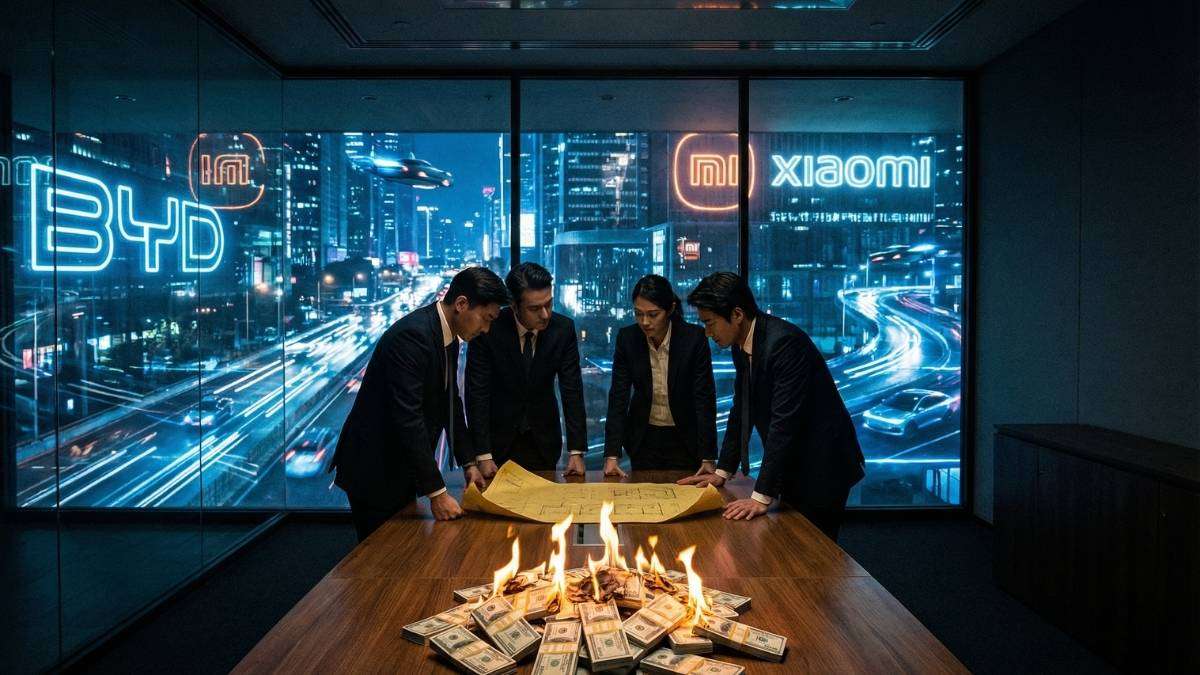

The smoke rising over Detroit this February isn't coming from a new assembly line; it’s the smell of a $53 billion "bonfire" fueled by scrapped plans and broken promises. In a collective move that has sent shockwaves through the global automotive industry, the "Big Three"—Stellantis, Ford, and General Motors—have now officially written off more than $53 billion in electric vehicle (EV) investments.
Leading the retreat is Stellantis, which recently shocked the market with a staggering $26 billion charge, admitting it vastly "overestimated the pace of the energy transition." Ford has followed with a cumulative **$19.5 billion write-off**, while GM has taken a $7.6 billion hit. This pivot back to hybrids and internal combustion engines (ICE) is being framed as a "prudent realignment" with American consumer demand. But in the context of global competition, it looks less like a pivot and more like a surrender.
The Chinese Juggernaut and the "Hybrid Trap"
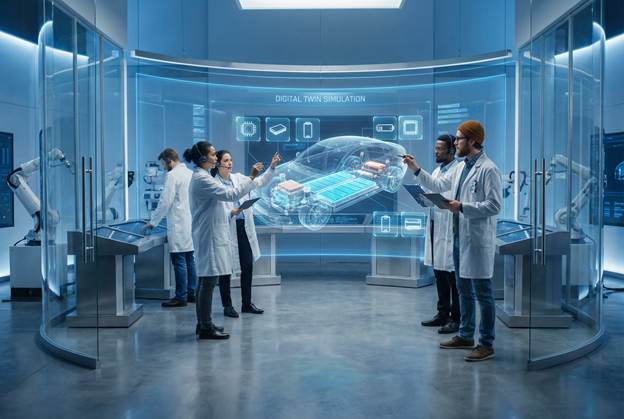
While Detroit settles back into the comfort of the hybrid, Chinese manufacturers are accelerating into a future the Americans are currently abandoning. In 2025, BYD officially surpassed Tesla as the world’s top EV seller, and they aren't slowing down. The success of Chinese EVs like the Xiaomi SU7 or the BYD Seagull isn't just a result of subsidies; it is a result of radical efficiency and a "software-first" mentality.
By retreating to hybrids, the Big Three are walking into a "Hybrid Trap." Battery technology is on the cusp of a revolution. With solid-state batteries entering early commercialization phases and high-density LFP (Lithium Iron Phosphate) prices plummeting, the "cost parity" between EVs and gas cars is no longer a distant dream—it’s an impending reality for 2027. If the Big Three are not ready with dedicated EV platforms when this tipping point hits, they will find themselves bringing "knives to a gunfight" against Chinese EVs that are cheaper, more advanced, and more profitable.
The Existential Risk of an Ill-Timed Move
If this retreat turns out to be ill-timed, the consequences will be existential. By cooling their EV R&D, Ford, GM, and Stellantis are effectively ceding the global "Tech Stack" to China. We are already seeing the first signs of this "capability gap." When legacy giants need to launch competitive EVs in overseas markets, they are increasingly turning to Chinese partnerships to license the technology they can no longer build fast enough themselves.
If the U.S. market eventually tips toward EVs—driven by superior performance and lower total cost of ownership—Detroit may find itself in a permanent state of catch-up. They risk becoming "white-label" manufacturers—building the metal shells and seats for cars powered by Chinese-designed software and batteries. This would relegate the once-mighty American giants to low-margin assemblers while the real profits flow to the tech providers in the East.
Reversing the Design Sequence: The Chinese Blueprint
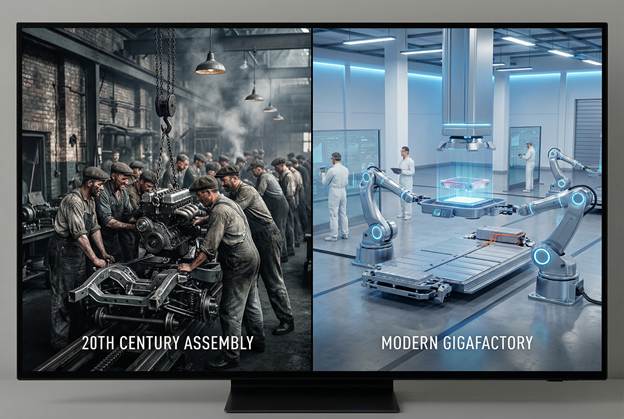
To survive the Chinese threat and the looming reality of trade wars, Detroit must stop designing cars like it’s 1995. The Chinese secret isn't just cheap labor; it’s a reversed design sequence.
Traditionally, American automakers start with the "top hat"—the exterior styling and interior comfort—and try to "cram" the technology in toward the end. The Chinese, led by companies like Xiaomi and NIO, treat the car as a "Software-Defined Vehicle" (SDV). They select the processor, the operating system, and the battery chemistry first, then build the car around that digital core. This allows them to iterate in 18 months, while Detroit still takes 48.
- Tech-First Integration: The Big Three must move technology selection to the absolute beginning of the design process.
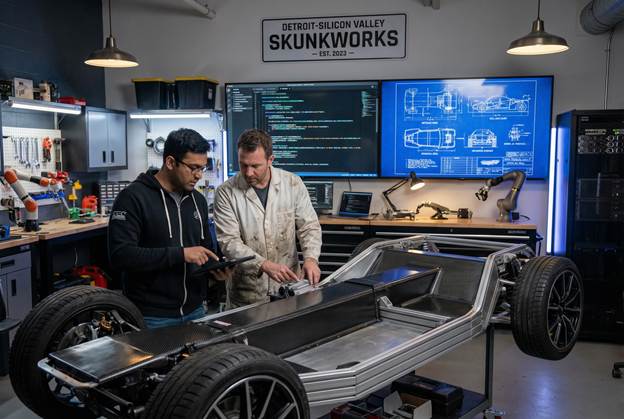
- Radical Tech Collaboration: Detroit needs to stop trying to be "software companies" and instead form deep, integrated partnerships with Silicon Valley. They should operate as tech-auto hybrids rather than legacy manufacturers with a "digital department."
- Vertical Integration: Like BYD, they must own the critical parts of the value chain. Writing off battery plants today is a short-term gain that ensures long-term dependence on foreign suppliers.
Tariffs: A Shield, Not a Solution
Current 125% U.S. tariffs on Chinese EVs provide a temporary shield, but they are a double-edged sword. While they protect Detroit’s domestic sales today, they also breed complacency. Protectionism can quickly turn into "industrial rot" if it isn't used as breathing room to innovate. The tariffs won't stop Chinese companies from setting up shop in Mexico or Canada, and they won't help the Big Three compete in Europe or Southeast Asia, where Chinese cars are already every third vehicle sold.
Wrapping Up
The $53 billion write-off is a painful admission of past failures, but the retreat into the "safe haven" of hybrids is a gamble with the industry's future. While Detroit focuses on the next quarter's margins, China is focusing on the next decade's dominance. To stay relevant, the Big Three must fundamentally overhaul their design philosophy, prioritize technology at the start of the build process, and lean into the very EV future they are currently setting on fire. If they don't, this $53 billion bonfire might just be the funeral pyre of the American auto industry as we know it.
Disclosure: Images rendered by Artlist.io
Rob Enderle is a technology analyst at Torque News who covers automotive technology and battery developments. You can learn more about Rob on Wikipedia and follow his articles on Forbes, X, and LinkedIn.
Set Torque News as Preferred Source on Google
Follow us today...







Comments
Some 11 or 12 years ago, as…
Permalink
Some 11 or 12 years ago, as I was driving home from work I was listening to NPR radio in my car and they were discussing EVs. They had a senior executive from Ford on the radio show. He very poignantly pointed out that EVs were essentially a smart phone on wheels. What a lovely analogy. Our smartphones regularly receive OTA software updates. Tesla and the Chinese EV makers follow this model With Canada pivoting to new trade relations with China after the draconian tariffs imposed on Canada by the current administration, it is only a matter of time. The Chinese are the barbarians at the gates of Rome You can only keep them out for so long and when the do come, they will lay waste to the domestic car makers as did the barbarians when they burned down Rome. Cheers.