
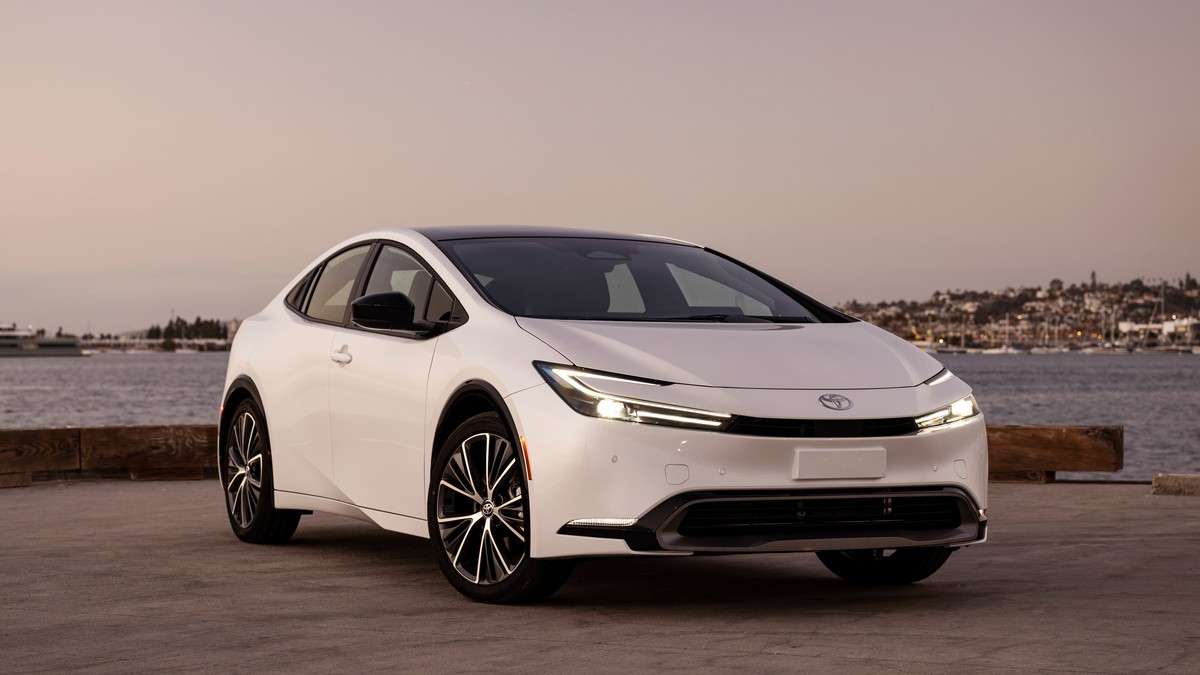

The promise of a certified pre-owned vehicle often brings with it an expectation of reliability and robust warranty coverage, a peace of mind that justifies the premium over a standard used car. However, one Toyota Certified Used Vehicle (TCUV) owner's recent experience with a 2023 Toyota Prius LE challenges this perception, detailing a frustrating saga of denied warranty claims, unresponsive customer service, and a significant repair bill for a "Shift System Malfunction" that surfaced just days before the one-year certified warranty was set to expire. This incident casts a harsh light on the practical application of certified pre-owned programs and the often-opaque nature of warranty exclusions.
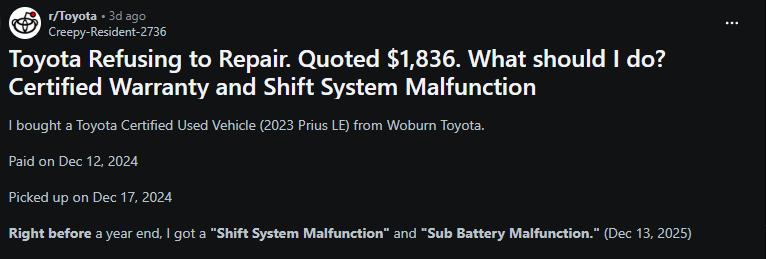
The owner, posting under the username Creepy-Resident-2736, shared their detailed account on social media:
"I bought a Toyota Certified Used Vehicle (2023 Prius LE) from Woburn Toyota.
Paid on Dec 12, 2024
Picked up on Dec 17, 2024
Right before a year-end, I got a "Shift System Malfunction" and "Sub Battery Malfunction" (Dec 13, 2025)
I thought it was a 12V battery fault. I went to the dealer on Dec 16, 2025, and they were going to charge me a 90-dollar diagnostic fee, and my advisor said if it was 12v battery problem, it would not be under warranty. I turn them down and decide to buy a new 12V battery by myself and replace it. I replaced it, but it didn't fix the problem. Then I found out with a deep research and test:
There is a part named the integration control supply, which failed and needs to be replaced. That part powers the transmission if the 12V battery fails during driving.
I went to the dealer and paid 90$ diagnostic fee because this time I was sure it would be under warranty and they would return me that diagnostic fee, but they quoted me 1836.83$ with tax and everything (20 Jan, 2026)
I told them I have an extended warranty, and this part should be either in the power train warranty or the hybrid system warranty. Because "Shift System Malfunction" means transmission malfunction, and it should be under the powertrain warranty, which I have extended.
Or, when you check the DTC code using Techstream, it's under the Hybrid Control System section. So it should be under the Hybrid System warranty then?
(Screenshot is from the Toyota techstream app)
The advisor kept saying no, and I mentioned that I had a Toyota certified warranty for 1 year, and this error came right before 1 year end. He said that I had never had a warranty that would cover this part since I got the car from them. Then I asked this question:
What if I had this problem the next day I purchased the car, would you still charge me 1838 dollar? First, he hesitated to answer. When I ask second time, he said yes, I would have to pay for it. This was the crazy part.
Then I called Toyota customer service (still on 20 Jan, 2026), and the person on the phone opened the case. Also emailed me what warranties I have to inform me:
7-year/100K limited powertrain warranty
8-year/100k-mile factory hybrid vehicle battery
Advertising
Hybrid System Warranty
Hybrid System- 96 months 100k miles
Hybrid Battery 120months 150k miles
(This is from his email)
He told me that somebody from the service will call me in 48 hours. They never did.
I called them back (23 Jan, 2026), and this time they opened another case with a different number and said somebody would call me again. Nobody called
Then, I gave them a bad review on some websites (Feb 5, 2026), 6 hours later, somebody from Toyota called me back. Good timing. He talked to me, and in the end, he said he is going to do his best and help me. He was going to call me that day or the next day, but he never did.
Now it's Feb 14, and I would like to ask what you would do in my case?
When I look it up and see if there are other people who have the same error, many people have that problem, and they were fixed under warranty. But they had lower mileage than me. But what is the point of the Toyota Certified warranty then? Why do they advertise that? I got this car at 48570 miles. The error came around 60k.
I already have a plan for fixing it by myself because I can not afford that money. But still I wanted to ask you what you would do if you were me? Would you still do something or give up?
EDIT: Since I documented my experience with Toyota Woburn here, I want to document more stuff that happened in Toyota Woburn. I actually went there before this problem, a few times.
1- My brake was loose. I had to press almost all the way down to fully stop. I went there, and my smart advisor kept telling me "Ah, my friend, it's normal for the newer cars". They looked at it and said it was normal. I went home and did my own brake fluid bleeding to see if any trapped air was there, I did and it was not loose anymore. They don't want to do anything when I actually had the warranty.
2- Every time I start the car, I heard kicking noise.
I diagnosted by myself and found out it was the part that is lying under the car, the back area. Connected to the fuel line. I used mechanic stethoscope and documented. I went to the dealer, and the same advisor kept telling me **"**Ah, my friend, it's normal for the newer cars." I tried to show him that I already know where it is coming from and needs to be replaced. He didn't really care what I said. He said that his mechanic needs to find out, not me. After 6 hours, they called me to come. I went there again, and they said they could not figure out where it's coming from, and the car needs to stay 1 more day. I told him that I already knew and told you, here is the part, here is the video, etc. He was surprized little bit, and they rented me another Prius for 1 day so they can look at it again. They did not replace or fix anything.
3- When I go reverse and press the brake pedal, I hear a knocking noise. It's like the brake pad area is moving and hitting something. It happens when I go reverse break, and go forward and brake. The brake caliper is not fully fixed, and when I brake, it's hitting something and making noise. I went to the dealer again. The same smart advisor kept telling me again **"**Ah, my friend, it's normal for the newer cars". They checked, and somebody from the service came and told me that he put some lubricant on those areas, and it should be better now. He said it's normal that the brake caliber plays around when I reverse and brake.
4- There was one more thing about the blinker switch. It was sticky. I also mentioned this when I was there, and the same answer "Ah, my friend...." you already know what it is :D
Advertising
Any problem I wrote above, each of them I confirmed it via priuschat forum or somewhere else to check if it's actually normal. I checked with other Prius users. When I was sure that only I had this problem, I went to the dealer.
These are within the first year after I purchased my car. They did their best not to do anything."
The core issue revolves around the "integration control supply" part, which the owner identifies as crucial for the transmission and is linked to the hybrid system. The dealer's refusal to cover this under warranty, despite the owner possessing multiple layers of coverage, including a one-year Toyota Certified warranty (which was still active when the fault occurred), an extended powertrain warranty, and a hybrid system warranty, is perplexing. This situation shows a fundamental disconnect between the advertised benefits of certified pre-owned programs and the reality faced by consumers when a component fails. The dealer's assertion that no warranty would cover the part, even if it failed the day after purchase, borders on the absurd, undermining the entire premise of a certified used vehicle.
Toyota Prius: Hybrid System Integration and Warranty Coverage
- The 2023 Toyota Prius LE, as a hybrid vehicle, relies on a complex interplay of a gasoline engine, electric motors, and a sophisticated hybrid system. The "integration control supply" part identified by the owner is a critical component within this system, responsible for managing power flow to the transmission. Its failure directly impacts the vehicle's ability to shift and operate correctly, revealing its essential role in the powertrain.
- Toyota's certified pre-owned program typically adds a 12-month/12,000-mile limited comprehensive warranty on top of any remaining factory warranty. This coverage is designed to provide peace of mind for major components, including those related to the powertrain and hybrid system, which are often the most expensive to repair. The owner's claim falling within this period should, in theory, trigger coverage.
- The distinction between the 12V auxiliary battery and the main hybrid battery is crucial for warranty claims, as the 12V battery is often considered a wear item. However, the "Shift System Malfunction" points to a deeper issue within the hybrid's power delivery or transmission control, which should fall under the more extensive hybrid system or powertrain warranties. The owner's research into the "integration control supply" suggests a component integral to the hybrid powertrain's function.
- Toyota offers multiple layers of warranty on its hybrid vehicles, including a 7-year/100,000-mile limited powertrain warranty and an 8-year/100,000-mile or 10-year/150,000-mile hybrid system warranty, depending on the component. These warranties are intended to cover significant failures within these complex systems. The challenge often lies in the interpretation of what specific parts fall under which warranty category, leading to disputes like the one described.
One commenter, Middle-Piglet-682, offered a blunt assessment, stating: "That is 100% a 3yr 36000 mile warranty part, not powertrain or hybrid. Sorry, but sometimes shit breaks outside of warranty. Bite the bullet, fix it, and move on." This perspective, while common among some consumers, fails to acknowledge the critical timing of the malfunction. The owner explicitly states the error appeared on December 13, 2025, just four days before the one-year mark from the December 17, 2024, purchase date. To dismiss this as simply "shit breaks outside of warranty" ignores the very purpose of a certified warranty, which is designed to cover such issues within its specified term. It's an inconvenient truth that many consumers are left to navigate the intricate and often self-serving interpretations of warranty agreements by dealerships.
This commenter's take is precisely the kind of defeatist attitude that allows manufacturers and dealerships to evade responsibility. The notion that an issue arising within the certified warranty period should be shrugged off as "sometimes shit breaks" is a disservice to every consumer who pays a premium for that added layer of protection. A certified pre-owned vehicle is not merely a used car; it is a promise of quality and coverage, a promise that appears to be broken in this instance. The fact that the owner diligently documented the fault date and the purchase date makes this a clear-cut case of a warranty claim that should, by all reasonable interpretations, be honored.
The owner's subsequent interaction with Toyota customer service, where they were informed of their extensive warranty coverage, including a 7-year/100,000-mile limited powertrain warranty and various hybrid system warranties, only deepens the mystery and frustration. The repeated failures of Toyota's customer service to follow up, necessitating the owner to resort to negative online reviews to elicit a response, are a damning indictment of their customer care protocols. This pattern of avoidance until public pressure is applied is unfortunately common across industries, but it is particularly egregious for a brand like Toyota, which has built its reputation on reliability and customer satisfaction.
Another commenter, BearFLSTS, suggested a more diplomatic approach: "Ask the service manager at the dealership for warranty GoodWill assistance. Toyota will often cover a portion of the repair; they pay for the part, and you pay for labor. Always remember Polite Persistence. Don’t take no for an answer, but always be nice and polite. If you get angry, they win. If you remain calm and polite but keep asking for the next supervisor up, you will likely get some help." This advice, while well-intentioned, presupposes a level of good faith and willingness to negotiate that the owner's experience suggests is absent. The owner's attempt to invoke "goodwill" was met with the advisor's flat denial that such a concept even exists, which is patently false.
The dealer's outright rejection of "goodwill" assistance, a common practice in the automotive industry for borderline warranty cases, speaks volumes about their commitment to customer retention and brand reputation. Toyota, like all major manufacturers, has mechanisms for goodwill repairs. To deny its existence is either an act of profound ignorance on the part of the service advisor or a deliberate attempt to stonewall the customer. This kind of behavior erodes trust faster than any mechanical failure, turning a brand loyalist into a vocal critic. It is a shortsighted strategy that prioritizes a minor repair cost over the long-term value of a satisfied customer.
Beyond the primary issue, the owner's "EDIT" section reveals a disturbing pattern of previous service encounters with the same dealership, Woburn Toyota. From loose brakes dismissed as "normal for the never cars" to an undiagnosed knocking noise and a sticky blinker switch, each instance points to a dealership service department that either lacks the competence to diagnose basic issues or actively avoids performing warranty work. The owner's diligent self-diagnosis and cross-referencing with online forums, often proving the dealer's initial assessment wrong, paints a picture of a consumer who is more technically astute than the "smart advisor" they encountered.
The repeated dismissals of legitimate concerns with the condescending phrase "Ah, my friend, it's normal for the newer cars" are not just unprofessional; they are gaslighting. For a dealership to consistently tell a customer that palpable issues, like spongy brakes or persistent knocking noises, are "normal" is a dereliction of their duty to properly inspect and service vehicles. This pattern suggests a systemic problem within that specific service department, where the default response to a warranty claim is denial, regardless of the evidence or the customer's legitimate concerns. It's a classic example of a dealership operating under the assumption that most customers will simply give up.
The owner's predicament reveals a critical flaw in the certified pre-owned system when dealerships fail to uphold their end of the bargain. The additional cost for a TCUV is supposed to buy not just a thoroughly inspected vehicle, but also the assurance of manufacturer-backed warranty support. When that support evaporates at the first sign of a significant repair, the entire program becomes little more than a marketing gimmick. Consumers are left holding the bag, facing unexpected expenses and the daunting task of navigating a bureaucratic maze designed to protect the manufacturer, not the buyer.
This case serves as a stark reminder that even with a brand renowned for reliability like Toyota, the consumer experience can be severely undermined by individual dealerships and their interpretation of warranty policies. The owner's detailed account, complete with dates, mileage, and specific component identification, presents a compelling argument that their certified warranty should cover the "integration control supply" failure. The struggle to get a clear answer or resolution from both the dealership and corporate customer service is a blueprint for consumer frustration, showing the urgent need for greater transparency and accountability in the certified pre-owned market.
Image Sources: Toyota Media Center
Noah Washington is an automotive journalist based in Atlanta, Georgia. He enjoys covering the latest news in the automotive industry and conducting reviews on the latest cars. He has been in the automotive industry since 15 years old and has been featured in prominent automotive news sites. You can reach him on X and LinkedIn for tips and to follow his automotive coverage.
Set Torque News as Preferred Source on Google
Follow us today...







Comments
Sometimes it can be better…
Permalink
Sometimes it can be better to play a little dumb-to not act like you know what's going on. The dealership often wants to shoes off superior knowledge and rebels against consumers with above average understanding. The 12 volt battery replacement shows how savy the owner is. Bad batteries often result in codes. If the original complaint just before warranty expiration was documented with a repair order and contained the code, this problem can be solved legally at small claims court after you pay for a repair and sue for the cost of that repair. However if you hire a lawyer to do it, you may not recoup your costs.
The brake noise backing and going forward after stop is normal and can be fixed with pad lubrication or replacement of pad hardware but will reoccur. The rest of their excuses are likely gaslighting. I don't know what to say about the brake bleeding.
There are two types of …
Permalink
There are two types of "Certified Pre -Owned" Sevice Contracts aka "Extended Warranties"
1) "Stated component Coverage"
The following parts are covered.
Any part not listed is not coveted"
2) "Exclusionary Coverage"
We cover ALL mechanical and electrical components installed by manufacturer or dealer, excluding upholstery, weatherstripping, appearance items, emmission control equipment, illumination, and routine maintenance, manual transmission clutch components, brake pads/ brake shoes/brake rotors/drums All excluded components must be specifically listed.
It sounds as if you have "stated coverage".
If you haven't already, I would recommend contacting Toyota USA at 800-331-4331
The paint on my 2010 prius…
Permalink
The paint on my 2010 prius starting falling off 5 years after I bought it. For the next 5 years at every scheduled service call I loudly pointed out to all waiting for their vehicles that pretty soon all the paint would fall off. At year 12 the dealer offered to paint it free under some program because it was bad for their business for me to show up every 6000 miles for a free oil change.
We currently have six…
Permalink
We currently have six Toyotas and one Ford in our extended family. I was considering buying a new or newer Tundra but am glad I found this article. I now know not to pay a premium for a Toyota Certified Used Vehicle. Given the transmission problems with Gen 3 Tundras and the potential need for repairs, I'm now concerned that Toyota won't stand behind the warranty on new Tundras and have also taken those off the table.
To avoid having to go to court to deal with potential product defects, I'll look at Gen 2 Tundras from any sources at the best prices I can find (thus likely not Certified) and at new and used Ford pickup trucks.
Hey Toyota, if you don't treat customers fairly, they won't be YOUR customers anymore.
If you’re in the US, you can…
Permalink
If you’re in the US, you can file a complaint on line with the federal agency regulating cars. They will investigate and get back to you. If you’re in the US, you can take the case to small claims court. Have you tried going to another Toyota dealer?