
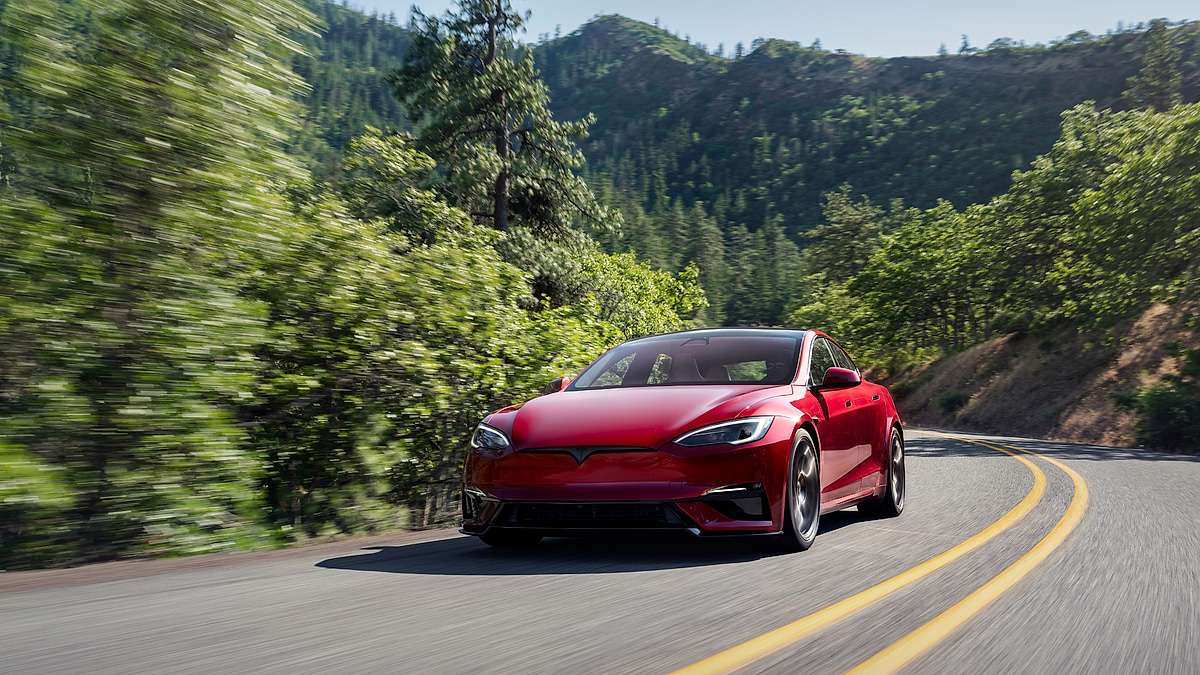

Six of the ten most complained-about vehicles in the United States are gasoline-powered.
Tesla's Model S does lead the rankings at 177.6 complaints per 10,000 vehicles sold. That figure is 47% higher than second place and nearly 3.5 times higher than the Tesla Model 3, which ranks tenth at 51.8 complaints per 10K. But the list, compiled by Vinitel using NHTSA's public database, includes the Jeep Cherokee at number four, the Hyundai Veloster at number five, the Kia Optima at number seven, and the Ford Edge at number nine. All are internal-combustion vehicles.
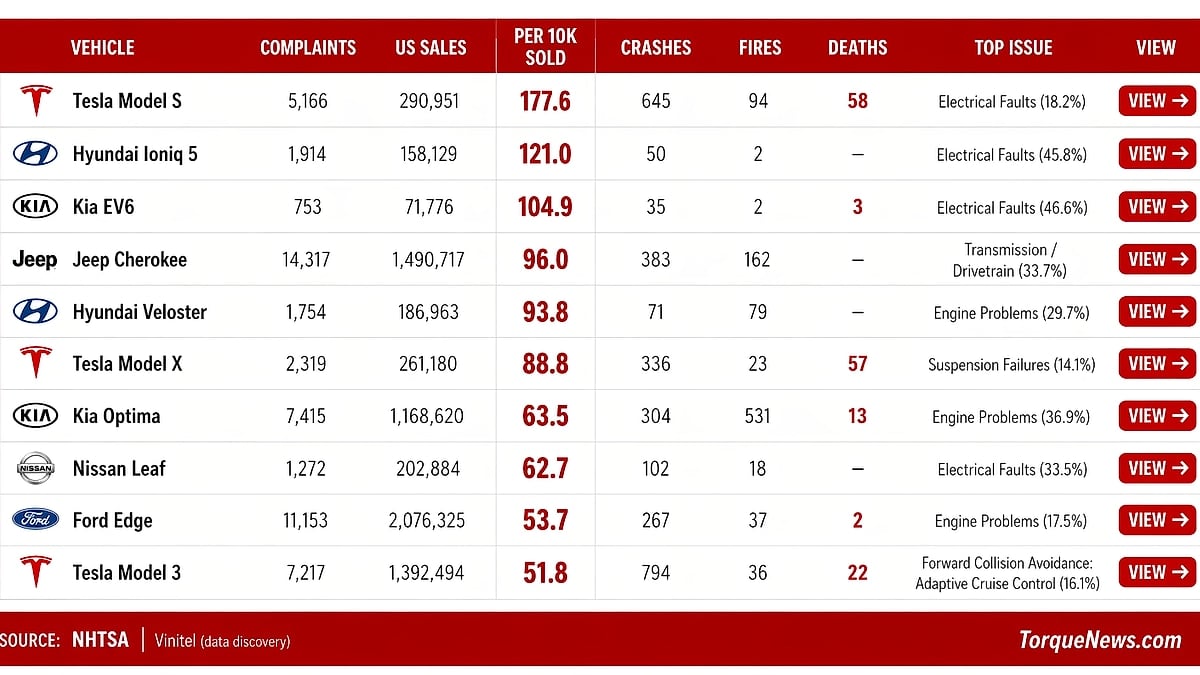
The full top 10 breaks down as follows. The Tesla Model S sits at number one with 177.6 complaints per 10K, followed by the Hyundai Ioniq 5 at 121.0, the Kia EV6 at 104.9, the Jeep Cherokee at 96.0, the Hyundai Veloster at 93.8, the Tesla Model X at 88.8, the Kia Optima at 63.5, the Nissan Leaf at 62.7, the Ford Edge at 53.7, and the Tesla Model 3 at 51.8. Six of those vehicles are electric. Four are not.
The data was normalized by complaints per 10,000 vehicles sold to avoid skewing toward popular models. Raw complaint totals favor vehicles with high sales volume simply because more of them exist on the road. The per-10K metric is the only fair way to compare a niche vehicle like the Hyundai Veloster against a mass-market model like the Ford Edge.
But the metric has limits. The dataset spans 2012 to 2026, a 14-year window. Vehicles on sale longer have had more time for complaints to accumulate. The Model S has been on sale since 2012. The Ioniq 5 and EV6 arrived in 2022. A newer vehicle with a high early complaint rate may look safer in this analysis simply because it has not aged enough for long-term problems to emerge.
NHTSA also does not validate complaints. The database is self-reported by consumers via web, phone, or mail. Anyone can file a complaint, and there is no verification process. NHTSA's own methodology states: "NHTSA neither validates nor invalidates the complaints in the database." This means the data carries selection bias. Owners who are more digitally engaged, more frustrated, or more aware of the complaint system are more likely to file. Owners who simply sell the car and move on are not counted.
Look at the brand concentration. Hyundai-Kia has four vehicles in the top 10: the Ioniq 5, EV6, Veloster, and Optima. Tesla has three: the Model S, Model X, and Model 3. No other automaker has more than one vehicle on the list. If the problem were electric powertrains as a technology, the complaint distribution would mirror EV market share. It does not.
The fire rate data flips the narrative entirely. The Kia Optima, a gas-powered sedan with 1,168,620 sales, reported 531 fires. That is a fire rate of 4.54 per 10,000 sold. The Hyundai Veloster, a gas-powered hatchback with 186,963 sales, reported 79 fires for a rate of 4.22 per 10,000. Both exceed the Tesla Model S, which reported 94 fires from 290,951 sales for a rate of 3.23 per 10,000. The Nissan Leaf, at 0.89 per 10,000, and the Tesla Model 3, at 0.26 per 10,000, have lower fire rates than most vehicles on the list.
The Tesla Model S deserves scrutiny on its own terms. At 177.6 complaints per 10K, it is an extreme outlier. It has 58 reported deaths, 645 crashes, and 94 fires. Its death rate per vehicle sold is roughly 12.6 times higher than the Model 3's, which has 22 deaths from nearly 1.4 million vehicles. NHTSA has opened multiple investigations into Tesla's Autopilot and Full Self-Driving systems that may contribute to those crash figures, a concern TorqueNews previously reported when a Tesla FSD safety investigation examined whether advanced driver assistance systems reduce collision risk even as the agency deepens its oversight.
But the Model S is an outlier, not a representative EV. The gap between the Model S's 58 deaths and the Model 3's 22 deaths, despite the Model 3 selling nearly five times as many vehicles, makes that clear. The Model 3, Tesla's best-selling electric vehicle, sits at the bottom of the top 10 at 51.8 complaints per 10K. The Hyundai Ioniq 5 and Kia EV6, which rank second and third, both have complaint rates driven heavily by electrical fault reports. But "electrical faults" in an EV context include software glitches, charging port issues, and infotainment freezes. That is not equivalent to "engine problems" in a gas car, which means mechanical failure that can strand a driver or cause a roadside breakdown.
NHTSA complaint categories are not weighted by severity. A software update that temporarily disables a backup camera counts the same as a transmission that grenades at highway speed. Both generate one complaint. Both feed into the same per-10K calculation. A Model 3 FSD collision with traffic cones documented the real-world consequences of Tesla's camera-only vision system failing to identify obstacles in the roadway, an incident that would generate one NHTSA complaint despite the repair cost and safety implications.
Hyundai and Kia have well-documented quality control problems that predate their EV push. The Theta II engine, used in multiple Hyundai and Kia models, including the Optima, has been subject to class-action lawsuits and a $1.3 billion settlement over engine failures, oil consumption, and fire risks. Those problems are not related to electrification. They are related to manufacturing tolerances and design decisions made a decade ago. The Veloster's 79 fires and the Optima's 531 fires stem from that same engineering lineage. Service infrastructure has also been a documented pain point for the Korean brands, as Kia service delays were documented when a single dealership turned a minor rodent issue into a months-long ordeal for one EV9 owner.
The Nissan Leaf at number eight, with 62.7 complaints per 10K, presents a more nuanced case. The Leaf is one of the oldest mass-market EVs in the United States, with the first generation debuting in 2010. Many of its complaints relate to battery degradation in early models, which used passive thermal management instead of the liquid cooling systems now standard in modern EVs. The Leaf's complaint rate is a function of age and early technology, not a reflection of current EV reliability.
Jeep Cherokee's presence at number four is a reminder that internal-combustion vehicles have not solved their own reliability problems. The Cherokee has 14,317 total complaints, the highest raw number on the list, with transmission and drivetrain issues accounting for 33.7% of complaints. Its 162 reported fires are the second-highest raw fire count behind only the Kia Optima. And the Ford Edge at number nine, with 11,153 complaints and engine problems as the top category, shows that even mainstream American brands are not immune, a reality that competing truck manufacturers are also navigating as they expand into electrified segments.
If you are shopping for a vehicle and you see headlines claiming that "EVs dominate complaint rankings," you are getting half the story. The data shows that complaint-prone vehicles exist across every powertrain type. The common thread is not the presence of a battery. It is the presence of specific design flaws, manufacturing shortcuts, or aging technology that a particular automaker has not adequately addressed.
For EV shoppers specifically, the Model S data is a red flag for that specific vehicle. Its 177.6 complaint rate and 58 deaths are not typical of the EV segment. The Model 3, the Ioniq 5, and the EV6 all have significantly lower complaint rates and death counts per vehicle sold. The Model S was Tesla's first ground-up design, launched in 2012, and its aging platform may explain some of the discrepancy. But the gap between the Model S and Model 3 is too large to dismiss entirely as a generational issue. A Model 3 FSD driveway incident illustrated the real-world consequences when automated systems misjudge stationary objects at low speed, raising questions about whether Tesla's safety record is improving as fast as its marketing claims.
Tesla confirmed in January 2026 that it will discontinue the Model S and Model X, with production ending in the second quarter of 2026. CEO Elon Musk described the retirement as an "honorable discharge," emphasizing a strategic pivot toward autonomy, robotics, and the Optimus humanoid robot program. Before production ends, Tesla will produce a limited Signature Series farewell run of 250 Model S and 100 Model X vehicles, priced at an estimated $150,000 to $160,000 and available by invitation only, according to Motor1 and MotorTrend.
The discontinuation does not prove that Tesla killed the Model S because of its safety record. Tesla has cited low sales volume, high production costs, and the strategic pivot to robotics as the primary reasons. But the NHTSA data does show why the business case for a ground-up redesign was weak. When your flagship vehicle leads the complaint rankings at 177.6 per 10K, carries 58 reported deaths, and has a complaint rate 3.4 times higher than your volume seller, investing hundreds of millions in a redesign is a harder sell than redirecting those resources toward Model Y production and robot manufacturing. Tesla's Fremont factory space, once dedicated to the Model S and Model X, is already being repurposed for Optimus robotics production, according to PedalCommander.
For policymakers and safety advocates, the data suggest that NHTSA's complaint categorization system needs updating. When "electrical faults" in an EV and "engine problems" in a gas car are treated as equivalent severity, the public gets a distorted picture of real-world risk. A more nuanced classification system that weights complaints by potential safety impact would give consumers the information they actually need.
EVs are not perfect. Gas cars are not disasters. Both powertrain types have vehicles with serious problems. The Tesla Model S, Kia Optima, and Jeep Cherokee all deserve scrutiny for very different reasons. What the data does not support is the narrative that electrification itself is the source of the problem. The source is specific vehicles from specific manufacturers with specific histories of quality control failures.
177.6 complaints per 10,000 is a number that demands attention. But so is 4.54 fires per 10,000. And so are 531 fires from a single model line. The story is not about which powertrain type wins. The story is about which manufacturers are letting their customers down, regardless of what is under the hood.
Image Sources: Tesla Media Center
About The Author
Noah Washington is an automotive journalist based in Atlanta, Georgia, covering sports cars, luxury vehicles, and performance culture. His reporting focuses on explaining the engineering, design philosophy, and real-world ownership experience behind modern vehicles.
Noah has been immersed in the automotive world since his early teens, attending industry events and following the enthusiast communities that shape how cars are built and driven today. His work blends industry insight with enthusiastic storytelling, helping readers understand not just what a car is, but why it matters.
Noah is also a member of the Southeast Automotive Media Association (SAMA), a professional organization for automotive journalists and industry media in the Southeast.
His coverage regularly explores sports cars, luxury vehicles, and performance-driven segments of the automotive industry, including the evolving culture surrounding Formula Drift and enthusiast builds.
Read more of Noah's work on his author profile page.
You can also follow Noah here:
Set Torque News as Preferred Source on Google
Follow us today...






