
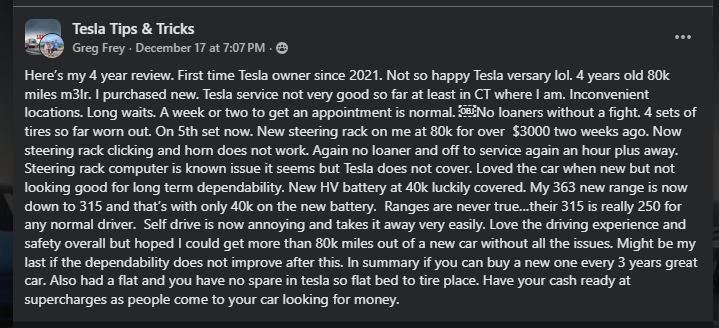
The hardest part of evaluating an EV is resisting the first-year glow. When everything is new, quiet, and fast, it is easy to confuse novelty with durability. The real report card arrives later, when the odometer has shrugged off the early miles, and the car becomes less of a statement and more of a tool. That is the backdrop for a candid four-year ownership post from Greg Frey, shared in the Tesla Tips & Tricks Facebook group, describing life with a Model 3 Long Range purchased new in 2021 and driven to 80,000 miles.
Frey’s review is not a drive-by complaint. It reads like the kind of running logbook a serious owner keeps when the car is both beloved and exasperating. He describes service access in Connecticut as inconvenient, with appointment lead times of a week or two as “normal,” and loaners as something that can require persistence. He also notes major events that change the emotional math of any long-term relationship: a high-voltage battery replacement at 40,000 miles that was covered, and a steering rack replacement at 80,000 miles that he says cost over $3,000. Soon after, he reports new symptoms, including a clicking steering rack and a horn that does not work, followed by another service visit without a loaner.
“Here’s my 4-year review. First-time Tesla owner since 2021. Not so happy Tesla versary lol. 4 years old 80k miles m3lr. I purchased it new. Tesla service not very good so far, at least in CT, where I am. Inconvenient locations. Long waits. A week or two to get an appointment is normal. No loaners without a fight. 4 sets of tires so far wornout. Other n 5th set now. New steering rack on me at 80k for over $3000 two weeks ago. Now the steering rack is clicking, and the horn does not work. Again, no loaner and off to service, an hour plus away. Steering rack computer is a known issue, it seems, but Tesla does not cover it. Loved the car when new, but not looking good for long-term dependability. New HV battery at 40k luckily covered. My 363 new range is now down to 315, and that’s with only 40k on the new battery. Ranges are never true…their 315 is really 250 for any normal driver. Self-driving is now annoying and takes it away very easily. Love the driving experience and safety overall, but hoped I could get more than 80k miles out of a new car without all the issues. Might be my last if the dependability does not improve after this. In summary, if you can buy a new one every 3 years great car. Also had a flat, and you have no spare in tesla so flat bed to tire place. Have your cash ready at superchargers as people come to your car looking for money.”
The most revealing part is not any single repair, but the way the experience compounds. A vehicle can be brilliant to drive and still grind down goodwill if the support system feels distant. Frey says he “loved the car when new” and still praises the driving experience and safety, yet his confidence in long-term dependability is shaken. That tension is familiar in modern EV ownership: the product can feel advanced while the service experience, especially for owners who live far from a service center, feels like a throwback to an era when you planned your life around the dealership.
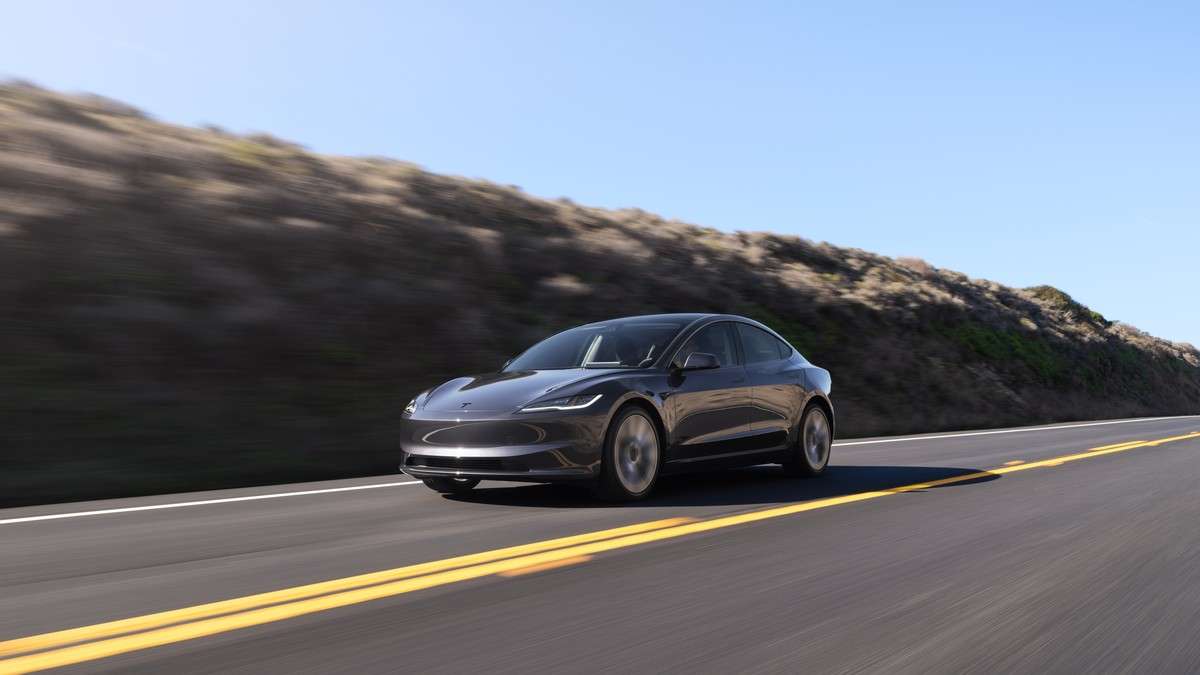
Tesla Model 3: A Minimalist Approach
- The Model 3 focuses on efficiency and responsiveness, delivering quick acceleration while maintaining strong real-world range.
- Its low center of gravity contributes to stable handling, allowing the sedan to feel planted during everyday driving.
- Interior design strips away traditional controls in favor of a central touchscreen, shaping how drivers interact with the vehicle.
- Software integration remains a defining element, with navigation, energy management, and driver assistance systems closely linked within a single interface.
Then there is the tire story, which became the thread’s pressure point. Frey reports going through four sets of tires in 80,000 miles and being on his fifth set now, which immediately triggered disagreement. One commenter argued that kind of wear points to driving style, while others pushed back on the tone and simply blocked the account. A few owners chimed in with their own baselines: some nearing 50,000 miles on their first set, others replacing tires around 45,000 miles, and another owner with 74,000 miles reporting only two sets despite “driving the crap out of it.” The takeaway is not that anyone is lying. It is that tire life is intensely sensitive to alignment, torque use, road surface, climate, tire model, and how often the car is driven hard from a stop, which EVs make very easy to do smoothly and repeatedly.
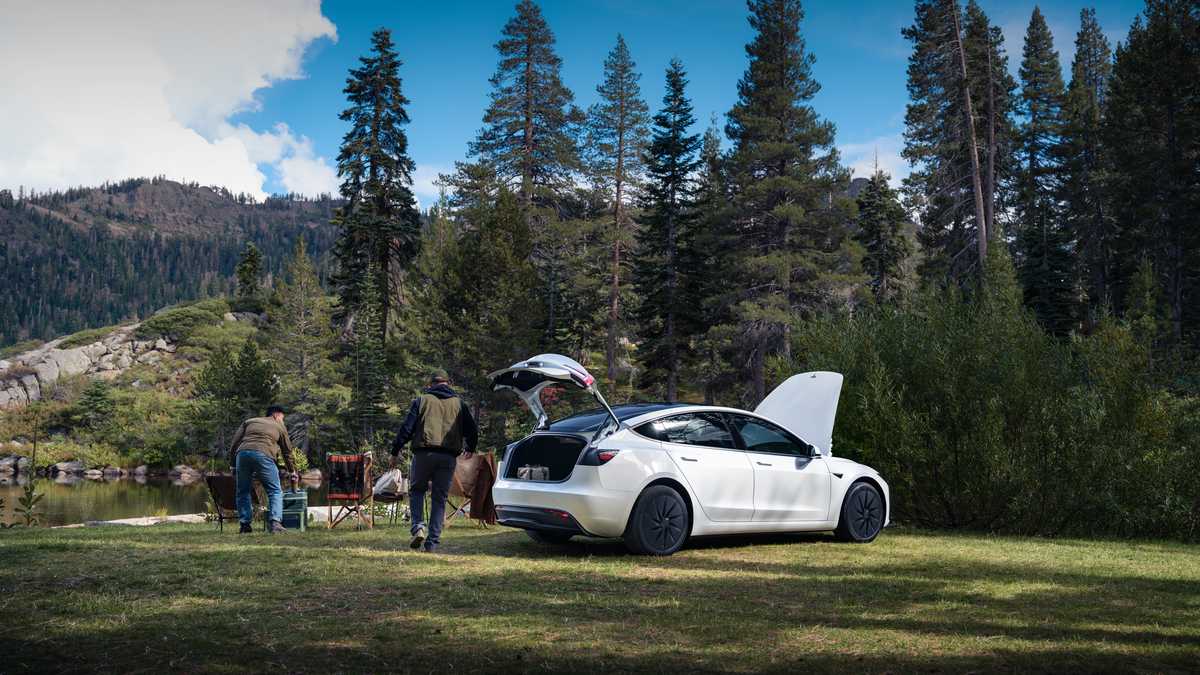
The Model 3’s Range is the other place where expectation meets arithmetic. Frey notes his car’s original rated range of 363 miles, and that after the battery replacement, his displayed range is down to 315, adding that the “315 is really 250 for any normal driver.” That gap is not unusual in principle, even if the exact number varies widely. Official range figures are standardized tests, and real-world results depend on speed, temperature, wind, elevation change, tire choice, and HVAC use. What matters in ownership is not whether a label is “true,” but whether the car’s actual day-to-day range fits the owner’s routines without drama.
The thread also shows how quickly a single owner’s hard luck can become a referendum, and how quickly a referendum can become a shouting match. One Model 3 owner reported excellent service center experiences and minimal maintenance beyond normal scheduling delays that now affect most brands. Another described a spoiler delamination handled under warranty and mentioned a paid warranty extension subscription. Another, living far from chargers and service centers, still had warranty-covered repairs and emphasized how environment and driving conditions shape outcomes. Put together, these replies do not dismiss Frey’s experience. They contextualize it as one data point in a fleet of different lives, miles, and service ecosystems.
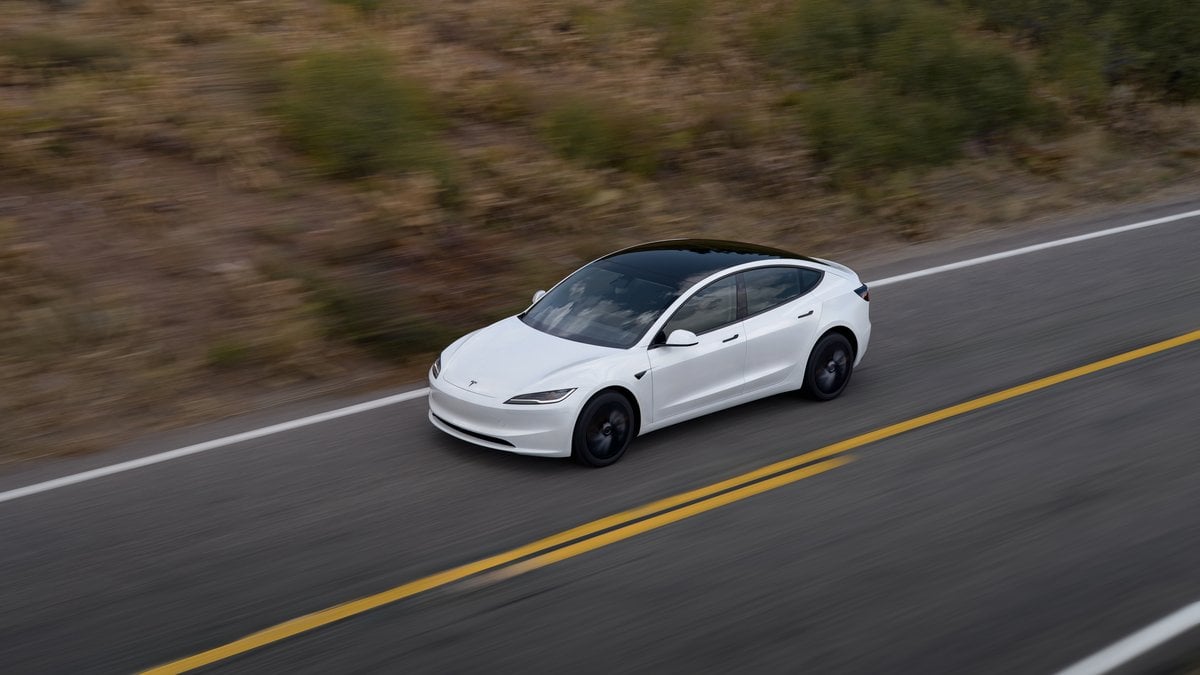
A few smaller details in Frey’s post land because they are practical, not philosophical. He mentions a flat tire leading to a flatbed tow because there is no spare, which can be a nasty surprise if you are used to solving punctures on the shoulder in ten minutes. That design choice is common in modern cars, but it shifts the burden onto roadside assistance and tire shops, and it feels especially consequential when service and support are already perceived as inconvenient. He also mentions being approached for money at Superchargers in the Model 3, an issue that is more about location and local conditions than the vehicle itself, yet it still affects the ownership mood because the charging stop is part of the product experience now.
A Model 3 can remain a rewarding machine to drive while still disappointing an owner who expected fewer high-dollar interventions by 80,000 miles, or who finds the service geography and policies too demanding. At the same time, other owners in the same thread report the opposite, suggesting the platform can be stable and low-maintenance when circumstances line up. The honest conclusion is not a verdict, but a caution: the best test drive is not the one you take today. It is the one you take four years from now, when the car has stopped trying to impress you and starts simply asking to be supported.
Image Sources: Tesla Media Center
Noah Washington is an automotive journalist based in Atlanta, Georgia. He enjoys covering the latest news in the automotive industry and conducting reviews on the latest cars. He has been in the automotive industry since 15 years old and has been featured in prominent automotive news sites. You can reach him on X and LinkedIn for tips and to follow his automotive coverage.
Set Torque News as Preferred Source on Google
Follow us today...