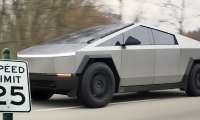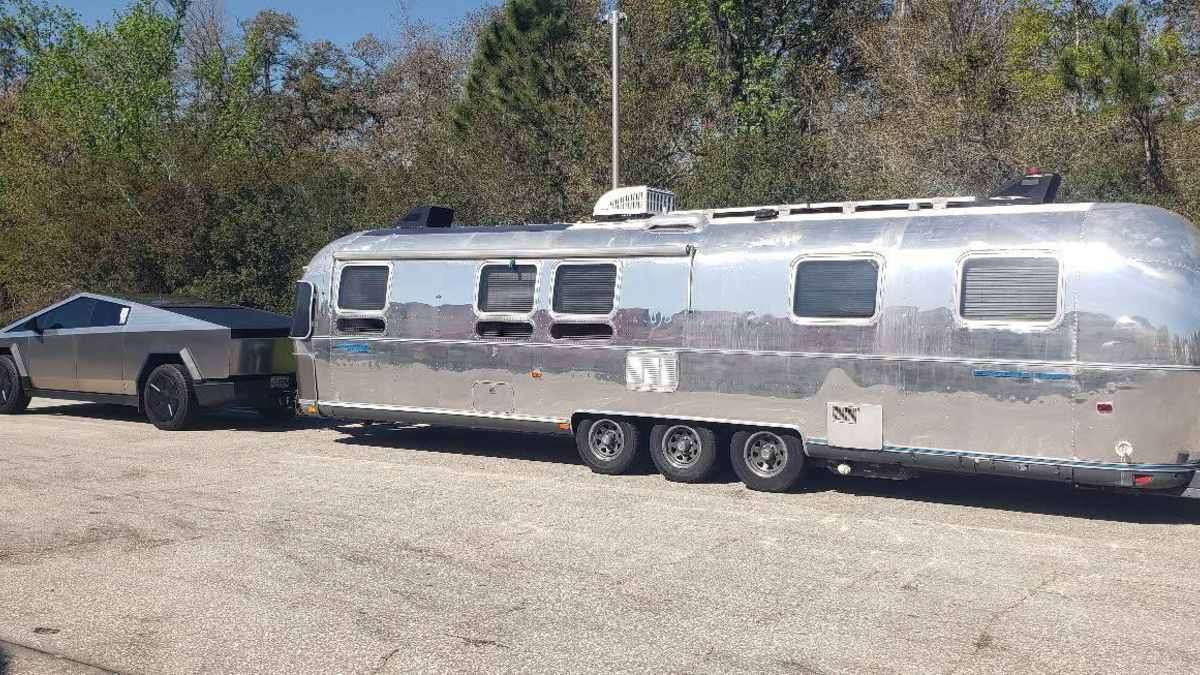

For years, the loudest argument against the Cybertruck was not about styling or software, but legitimacy. Could it actually do truck things, or was it just a stainless steel prop with ambition? One Cybertruck owner believes that question was answered the moment he watched it tow more than 11,000 pounds without complaint, drama, or mechanical theatrics. In his telling, the surprise was not that the Cybertruck could tow, but how uneventful the experience was.
According to the owner, the Cybertruck handled the load with the kind of calm that internal combustion trucks rarely deliver. There was no hunting for gears, no rising engine note, no turbo lag, and no sense that the drivetrain was working itself into a sweat. The motors delivered full torque from zero rpm, and the truck simply moved the load forward. Quietly. Smoothly. The absence of noise, vibration, and shifting was not a novelty. It was the defining feature.
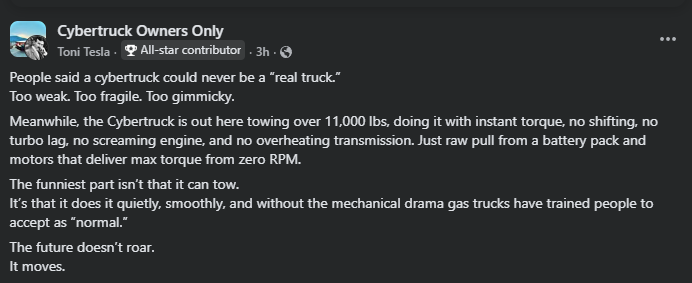
“People said a Cybertruck could never be a ‘real truck.’
Too weak. Too fragile. Too gimmicky.
Meanwhile, the Cybertruck is out here towing over 11,000 lbs, doing it with instant torque, no shifting, no turbo lag, no screaming engine, and no overheating transmission. Just raw pull from a battery pack and motors that deliver max torque from zero RPM.
The funniest part isn’t that it can tow.
It’s that it does it quietly, smoothly, and without the mechanical drama gas trucks have trained people to accept as ‘normal.’
Advertising
The future doesn’t roar.
It moves.”
That detail cuts against decades of conditioning. Truck buyers have been trained to associate effort with sound. A working truck is supposed to roar, clunk, and surge under load. Transmission temperatures climb, downshifts announce themselves, and drivers learn to interpret mechanical stress as proof of capability. The Cybertruck subverts that entire script. It does the same work without the sensory cues people expect, which makes some observers uneasy and others impressed.
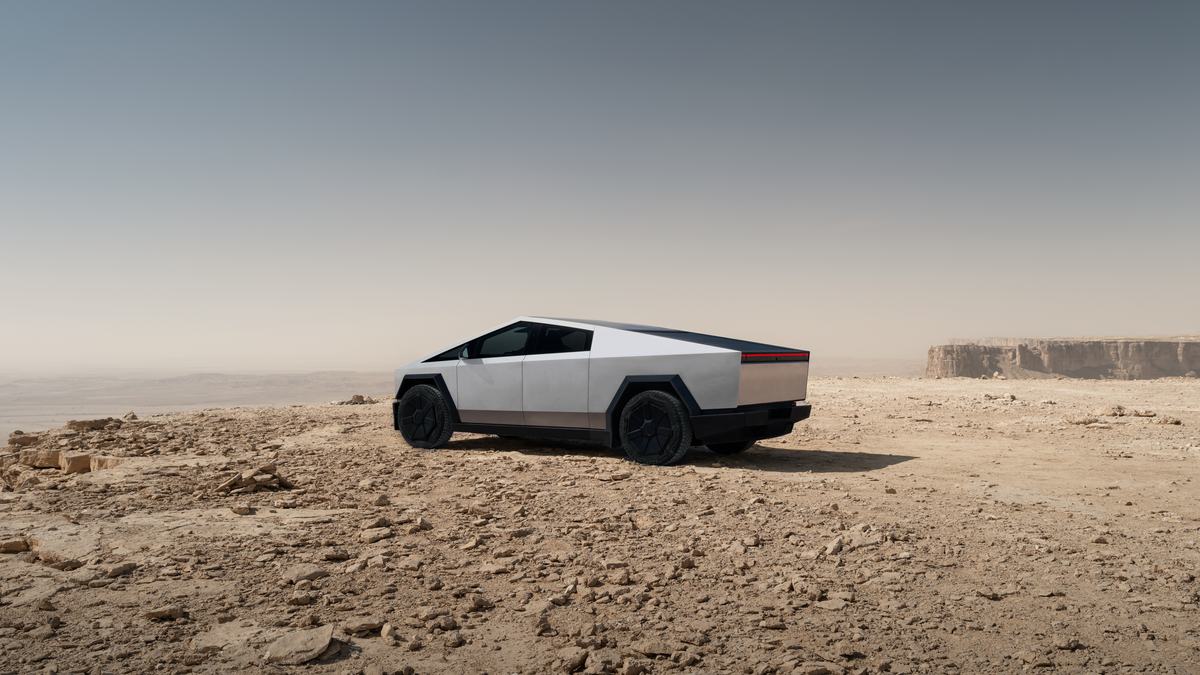
Tesla Cybertruck: Design Philosophy
- The Tesla Cybertruck uses an electric powertrain only and does not offer a gasoline or hybrid option.
- It has a unibody-style structure rather than a traditional body-on-frame layout, which is uncommon for full-size pickup trucks.
- The truck is designed with an enclosed bed and a powered cover, allowing cargo to be locked and protected from the weather.
- Most vehicle settings and controls are accessed through a central touchscreen, with very few physical buttons inside the cabin.
Predictably, the comments brought the range question front and center. Skeptics pointed out that while towing may be effortless, distance is still the constraint. Towing a heavy trailer can reduce range dramatically, sometimes to little more than 100 to 120 miles between charges. For drivers accustomed to keeping large fuel reserves while towing in remote areas, that reality remains a legitimate concern, especially in parts of the country where charging infrastructure is sparse.
That pushback does not negate the original claim, but it reframes it. The Cybertruck’s strength is not that it magically escapes physics. It is that the act of towing itself is no longer mechanically stressful. Range becomes a planning problem rather than a drivetrain problem. Some owners countered that point by noting the flexibility EVs offer in certain scenarios, such as campground access to 50-amp hookups or the ability to recharge wherever power is available, even if slowly.
Others took the discussion further, arguing that the future of electric towing may involve range-extending solutions rather than bigger batteries alone. Concepts like EREV-style generators or trailer-mounted battery systems are already being explored by manufacturers. The Cybertruck, in that view, is an early example of where the mechanical side of towing has already evolved, even if the energy side is still catching up.

He is not claiming the Cybertruck replaces every diesel truck in every scenario today. He is pointing out that the traditional pain points of towing, noise, shifting, heat, and drivetrain stress simply are not part of the experience. That absence changes how towing feels, even if it does not yet change how far you can go.
This is why the phrase “real truck” keeps resurfacing. It is less about numbers on a spec sheet and more about expectations shaped by decades of internal combustion behavior. The Cybertruck challenges those expectations by doing the work without announcing it. For some, that quiet competence feels unnatural. For others, it feels overdue.
The owner’s closing thought lingers because it captures that shift succinctly. The future does not roar. It moves. Whether the infrastructure and range solutions arrive fast enough to satisfy every towing use case remains an open question. But as far as the act of pulling 11,000 pounds down the road is concerned, the Cybertruck appears to have already crossed a line many said it never would.
Image Sources: Tesla Media Center
Noah Washington is an automotive journalist based in Atlanta, Georgia. He enjoys covering the latest news in the automotive industry and conducting reviews on the latest cars. He has been in the automotive industry since 15 years old and has been featured in prominent automotive news sites. You can reach him on X and LinkedIn for tips and to follow his automotive coverage.
Set Torque News as Preferred Source on Google
Follow us today...