

The Chevy Bolt EV and EUV have never chased headlines or red carpets. They aren’t halo cars, nor are they built to light up Nürburgring leaderboards or dominate keynote slides at CES. Instead, they’ve carved out a more meaningful identity, the electric car for real people, living real lives.
Quietly efficient, surprisingly capable, and, thanks to early-life recall issues, often found on dealer lots with heavy discounts, the Bolt has become a cult favorite among EV enthusiasts who care more about utility than hype. These cars may have started rough, but today they’re a gateway to affordable, long-range electric driving.
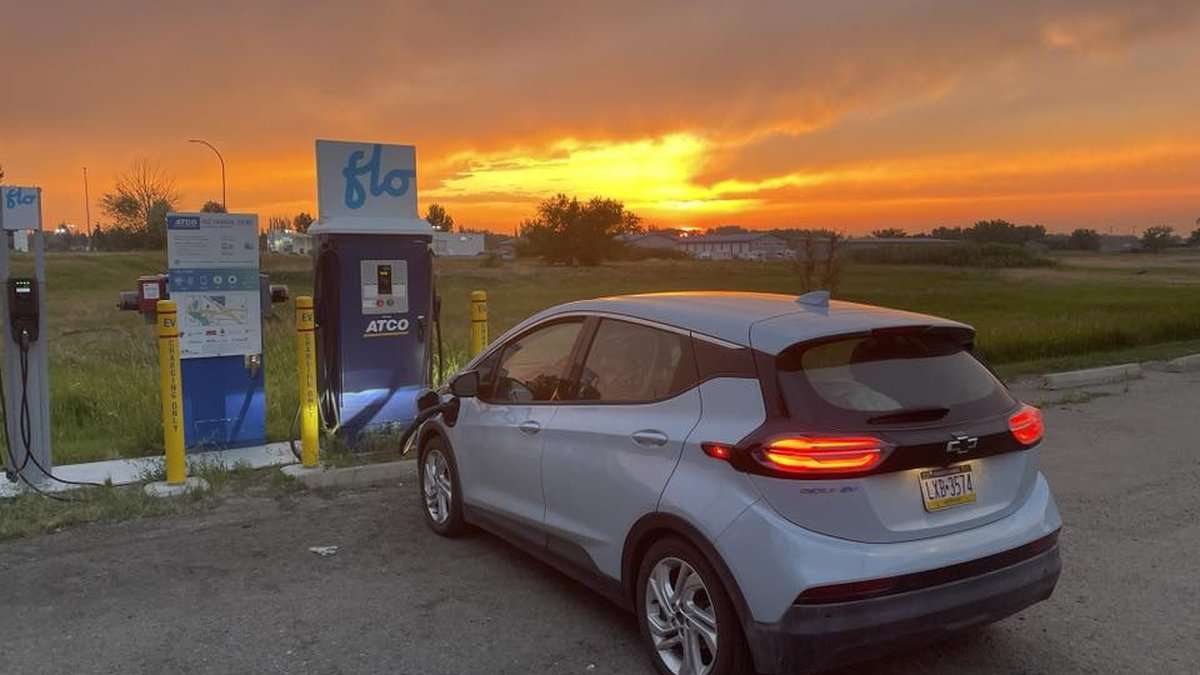
Case in point: Jacob Brown, who’s racked up 69,000 miles on his 2023 Bolt in just two and a half years, and commemorated the journey with a love letter.
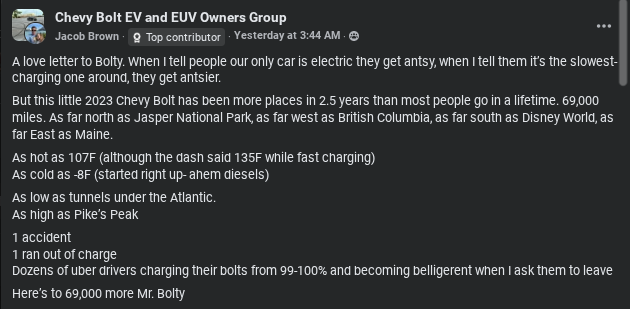
“A love letter to Bolty. When I tell people our only car is electric they get antsy, when I tell them it’s the slowest-charging one around, they get antsier.
But this little 2023 Chevy Bolt has been more places in 2.5 years than most people go in a lifetime. 69,000 miles. As far north as Jasper National Park, as far west as British Columbia, as far south as Disney World, as far East as Maine.
As hot as 107F (although the dash said 135F while fast charging)
As cold as -8F (started right up, ahem diesels)
As low as tunnels under the Atlantic.
As high as Pike’s Peak
1 accident
1 ran out of charge
Dozens of Uber drivers charging their Bolts from 99–100% and becoming belligerent when I ask them to leave
Here’s to 69,000 more Mr. Bolty.”
Bolty didn’t flinch for thousands of miles. And Brown’s experience isn’t unique. In the comments beneath his post, owner Adam Kell chimed in about his 2019 Bolt, affectionately named “The Roller Skate”, with a war chest of 143,000 miles under its belt. His wife has claimed the car as her own, citing a fondness for its instant torque and streetlight skirmishes. So much for handing it down to the teenage daughter.
Next-Gen Chevy Bolt EV: Ultium Platform, LFP Battery & 300+-Mile Range
- Built on GM’s new Ultium platform, the upcoming Bolt will switch to lithium-iron-phosphate batteries, aiming for over 300 mi of electric range, up from the previous 259 mi
- Design-wise, expect a shift toward a compact crossover (EUV) body, drawing styling cues from the Equinox EV and featuring a refreshed front/rear fascia
- It will include faster 100 kW+ DC fast charging, address slow charging issues of the previous generation, and maintain front-wheel-drive with single-motor layout
- Production is set to start in late 2025 at GM’s Fairfax, Kansas City plant, with availability in early 2026 as a 2027 model; pricing is expected to be in the $30k range, positioning it as an affordable EV
But if there’s one talking point that dogs the Bolt like a paparazzo on a C-list celebrity, it’s DC fast charging speed. Yes, it’s not quick. And no, it doesn’t pretend to be. But for some, like Bolt and Tesla owner Ching Shih, that slower pace is part of the appeal:
“Sometimes the slow DCFC is a blessing in disguise. It gives you time to rest and eat without worrying about rushing back to disconnect.”
It’s a subtle rebuttal to the modern obsession with speed-for-speed ’s-sake. On a long drive, twenty extra minutes might just be what you need to plan, breathe, or stare at a horizon that isn’t backlit by brake lights.
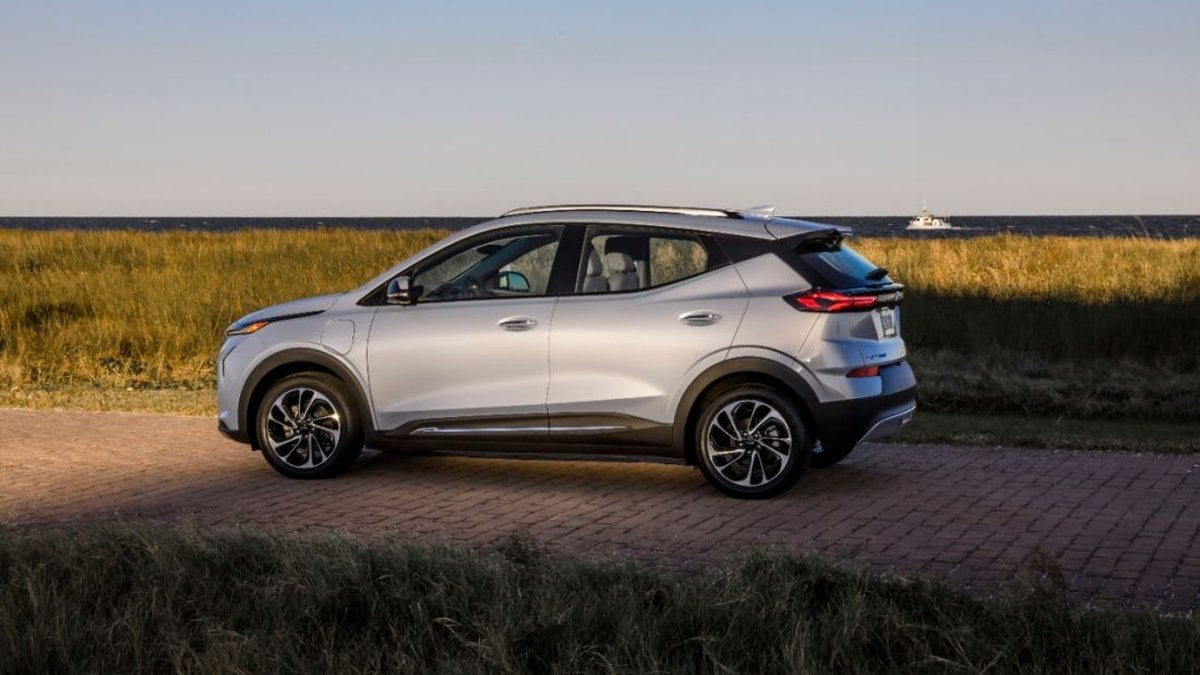
Efficiency is the Bolt’s secret weapon. Rich Daley notes that the car’s real-world miles-per-kilowatt numbers make up for the leisurely charge curve:
“I typically drive a couple of hours and charge for 30 minutes and it is pretty rare that I’m sitting at a charger just waiting after I get snacks, use the bathroom, plan the next stop etc.”
EV Charging Conflicts: Uber Drivers Hogging Chargers at 99% Battery
However, Brown’s journey isn’t without friction, and not from the drivetrain. It’s the charging stations that spark the most drama. Specifically, the habit of some Uber drivers to sit at a charger until their Bolt hits 100%.
“Dozens of Uber drivers charging their Bolts from 99–100% and becoming belligerent when I ask them to leave,”
Brown wrote. It’s a polite indictment, but an honest one. Jon Pierce-Ruhland questioned the business logic:
“Wouldn’t it be better to spend that time taking fares?”
Rideshare EV Charging Dilemmas: A Former Lyft Bolt Driver’s Perspective
Michelle Pierce, who used to drive a Bolt for Lyft, agreed, though she remembers how tough it was to make that case back in 2017.
To be fair, there’s logic on both sides. As Brownlater clarified:
“All joking aside, I do empathize with them… I just wish they would empathize with me pulling up on 3% with 500 miles left to go before I sleep lol.”
Rich Daley explained that in cities like Atlanta, rideshare drivers have to keep the state of charge high, as the spread of suburbs and limited chargers near airports leave little room for risk.
This is the growing pain of an EV infrastructure racing to catch up with the adoption curve. It’s not about bad actors, it’s about shared space.
GM’s EV Evolution: From the Chevrolet Volt’s Hybrid Legacy to the Bolt EV’s Breakout Success
- The Volt was the world's top-selling plug‑in hybrid until its discontinuation in December 2018, with over 157,000 units sold in the U.S. by 2019, regularly earning top honors in its category
- The Bolt EV, launched in 2016, achieved Motor Trend Car of the Year, North American Car of the Year, and dozens of other awards in 2017, including Green Car of the Year, and had sold over 112,000 units globally by 2020
- Bolt sales outpaced Volt sales soon after its launch; in one quarter, Bolt sold ~6,700 units vs Volt’s 4,400, and in some months Bolt deliveries nearly quadrupled Volt’s
- Together, Volt and Bolt were instrumental in earning consumer trust in electric vehicles through strong real-world range and low operating costs, helping GM qualify for $7,500 federal tax credits and paving the way for further EV development
And still, through it all, the Bolt remains the people’s EV. Not because it makes headlines, or shows up in Super Bowl ads, or plays flagship to a trillion-dollar IPO. It’s because it works. Every. Single. Day. It starts in sub-zero mornings, climbs to mountain summits, and refuses to make a fuss while doing it. That’s the kind of workhorse reliability that defined American cars for decades, reimagined through the plug-in lens of the 21st century.
So maybe it’s not surprising that Bolt owners name their cars. Bolty. The Roller Skate. These machines aren’t mere appliances; they’re partners.
In the real world, beyond the forums, beyond the spec sheets, beyond the speed tests, they’re showing up, charging up, and hitting the road. Not because they’re perfect, but because they’re good enough to trust. And in today’s high-gloss automotive circus, that might be the most radical thing of all.
Image Sources: Chevy Media Center
Noah Washington is an automotive journalist based in Atlanta, Georgia. He enjoys covering the latest news in the automotive industry and conducting reviews on the latest cars. He has been in the automotive industry since 15 years old and has been featured in prominent automotive news sites. You can reach him on X and LinkedIn for tips and to follow his automotive coverage.
Set Torque News as Preferred Source on Google
Follow us today...






Comments
See, but that's just part of…
Permalink
See, but that's just part of the ownership experience when you own a vehicle for which there is woefully inadequate infrastructure. But what can you do about it now, right? May as well grin and giggle.
You've hit on a very real…
Permalink
In reply to See, but that's just part of… by Buzz Wired (not verified)
You've hit on a very real aspect of EV ownership right now! It's true that the infrastructure is still catching up in some areas, and it can definitely add a layer of challenge.