

Once in a while, when you finally sit down to do the math on the Big Dumb Thing you bought against all reasonable advice, yes, including from your wife, you might be surprised to find that, somehow, you won. One Facebook user recently did just that. Instead of posting a burnout video or humblebragging about an off-grid camping trip, he dropped a bunch of data with the subtlety of a slap in the face from a cold transmission pan: 18,242 electric miles. Over 900 gallons of gas were not burned. And a quietly triumphant “told you so” tucked into the subtext.
“Since buying my 2025 Rivian R1T, I have saved about 960 gallons of gas. While the image says $3,360... it should be closer to $4 a gallon, being $3840. My electric bill has doubled, but monthly I am only paying about $250 a month, meaning to charge is roughly $125 a month, which roughly costs me $1,000 to charge.”
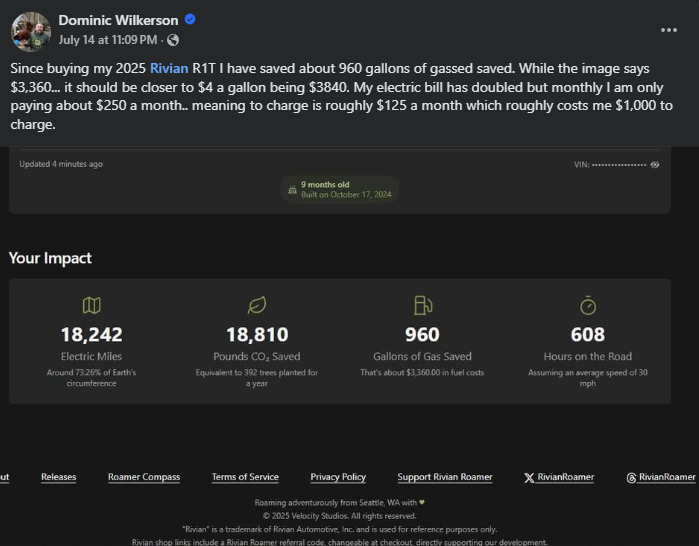
This is about discovering that the math on an electric truck can actually work, even when you thought it wouldn’t.
2025 Rivian R1T Fast‑Charging & Efficiency Specs: 220 kW, 330–420 mi Range & Conserve Mode
- Supports up to 220 kW DC fast charging, enabling recovery from 5% to 80% in approximately 53 minutes, though full charging slows down significantly after that
- Range varies by battery: up to 330 miles with the 109 kWh pack or 420 miles with the 141.5 kWh max pack (EPA estimates)
- In real-world tests, the Quad model achieves about 2.3 mi/kWh, slightly below EPA estimates but consistent with long‑haul use
- The R1T also offers a Conserve mode, which temporarily switches to front-wheel drive to improve efficiency and extend range
Dominic, like many early adopters, isn’t pretending the R1T is for everyone. The truck stickered at $107,000, which will make most finance officers and practical spouses wince. But he counters: “...after tax savings lol like 55k.”
That’s where the picture gets murky. As one commenter rightly pointed out, “Does your average person qualify for said tax savings?” The answer is often no. Many EV buyers walk into the tax credit maze thinking it’s a guaranteed rebate check, only to discover later they’re holding the wrong kind of tax liability. Another Facebook user, Maloray Paw, offered a grim warning:
“We filed for the tax rebate… then came to find out 3 years later we didn't qualify… apparently the consumer is supposed to know when 100k units of that car are sold.”
In other words, read the fine print, or be ready to write the IRS a check. Still, Dominic's not making a case for universal adoption; he’s telling his story, and it’s one of real-world impact. Over 600 hours on the road.
2025 Rivian R1T Cuts Over 18,800 lbs CO₂ While Towing, Off‑Roading & Winter Driving at $125 / Month Charging
More than 18,800 pounds of CO₂ avoided. He’s towing, off-roading, and winter driving, all the stuff that the EV-hesitant love to cite as dealbreakers. And he’s doing it while spending about $125 a month on electricity. Yes, his home electric bill doubled. But that’s still less than half of what most Americans pay to fuel a thirsty pickup. The emotional calculus matters, too. As one commenter asked, “How many smiles has it gotten you?”, perhaps the most honest question in the entire thread.
And yet, even among those encouraged by Dominic’s experience, there’s healthy skepticism. EV incentives and state taxes are a moving target. Washington state, where Wilkerson likely resides based on vehicle telemetry, tacks on additional registration fees for EVs. It’s not enough to tank the deal, but it adds weight to the scale.
Rivian R1T Quad‑Motor Performance: 1,025 hp, 1,198 lb‑ft Torque, Dimensions & Air Suspension
- The Quad setup delivers around 1,025 hp and roughly 1,198 lb‑ft of torque, thanks to a dedicated motor at each wheel, delivering lightning-fast, precision control
- It rides on a mid-size luxury pickup frame measuring approximately 217 in length, 81.8 in width (mirrors folded), with a 135.9 in wheelbase, standing about 75.7 in tall
- Battery options include 105, 135, or 149 kWh, translating to EPA-rated ranges between ~231 and ~401 miles, based on configuration
- Features adaptive air suspension, offering adjustable ride heights and up to 14.9 in ground clearance, combined with torque-vectoring and Michelin Super Sport tires for enhanced on- and off-road performance
This kind of data-driven reflection isn’t new; it’s just rarer in the age of gut-feeling purchasing. In the same way hotrodders once obsessed over jetting carburetors and quarter-mile splits, today’s EV owners are becoming spreadsheet cowboys.
One Kia EV6 owner posted on kiaevforums.com that their charging costs averaged just $5–6 per session, largely due to following the 20/80 charge rule and using mostly off-peak power. Others estimate monthly electric bill increases of $40–60. Not groundbreaking, but enough to shift long-term cost dynamics in favor of electrons over octane.
So, where does this leave us? Somewhere between economic optimism and automotive pragmatism. The Rivian R1T may not be the future for everyone, but for Dominic, it was the right tool for the job. More importantly, it was the right math problem to solve.
And against the odds, it’s paying off. Not in the way that earns applause at Cars and Coffee, but in the kind of quiet, measurable progress that wins you respect at the dinner table, even from the person who told you not to buy it in the first place.
Image Sources: Rivian Media Center
Noah Washington is an automotive journalist based in Atlanta, Georgia. He enjoys covering the latest news in the automotive industry and conducting reviews on the latest cars. He has been in the automotive industry since 15 years old and has been featured in prominent automotive news sites. You can reach him on X and LinkedIn for tips and to follow his automotive coverage.
Set Torque News as Preferred Source on Google
Follow us today...




Comments
Yeah and it depreciated…
Permalink
Yeah and it depreciated twice as much as an ICE truck, insurance is more and good luck getting parts if you get in an accident. Electric cars and trucks are just for people who haven't gotten patted on the back enough from other people. Not a put down just an observation. But thanks for saving the planet!
You don’t feel any…
Permalink
You don’t feel any obligation to report on the change in your gasoline bill?
Do better with your…
Permalink
Do better with your Headlines.
If he saved that much gas, at a low $3/GAL, he SAVED a total of $500 a month in "fuel" converting from ICE to EV. Headline reads like his Electric Bill went way up (YIKES), but his gas saved per month was around $750, which offsets the Electrical increase of $250 per month and results in a $500!!!! a month NET SAVINGS. No small amount of change.