
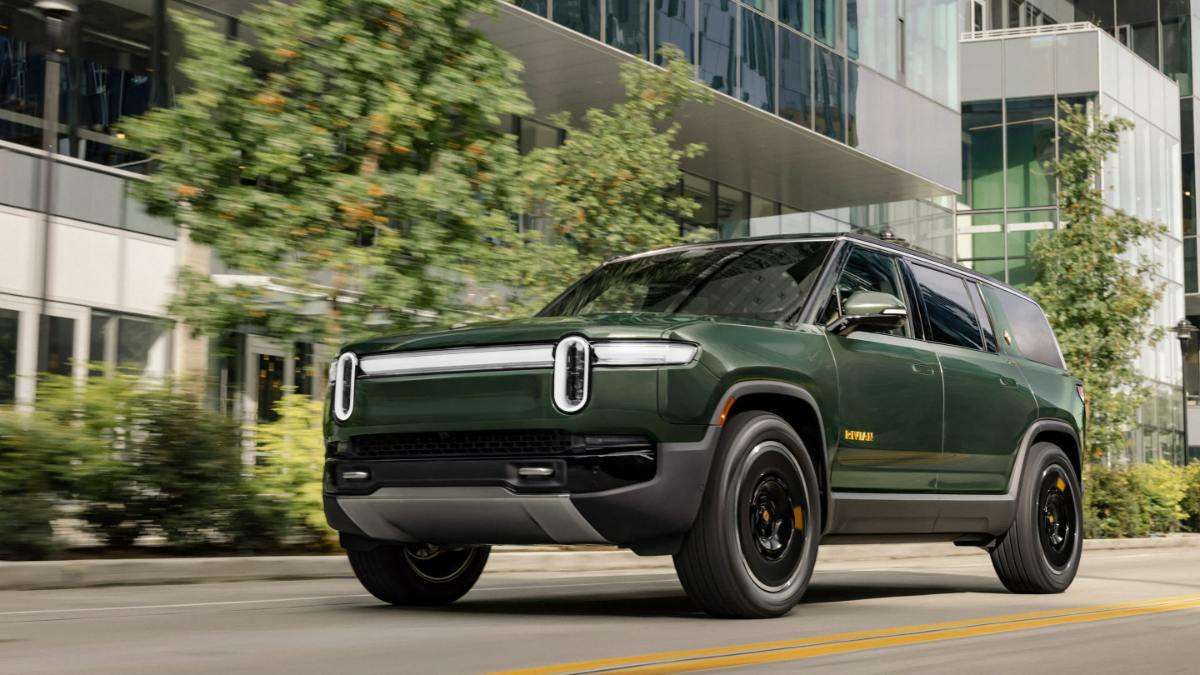

The global village gets a little less cozy when your dashboard lights up like a substation meltdown, and the only support Rivian can offer you is a recommendation to ship your 7,000-pound electric SUV across international borders.
Somewhere in the Guatemalan highlands, surrounded by jungle, volcanoes, and astonishing topography, a 2023 Rivian R1S sits still. It is an object lesson in modern mobility: a vehicle designed to conquer terrain but undone by distance, specifically, the distance from its maker’s service network. This isn’t a story of failure or folly, but of what happens when our technology is faster than our infrastructure. And it’s not the first time the automotive world has met its own frontier.
The R1S in question belongs to Paola Castillo, an owner who did what the ads told her was possible: bought the all-electric SUV in the United States and took it to Central America for life, adventure, and everything in between.
“Need help, Critical Battery Issue on my Rivian R1S (now in Guatemala)
Hi everyone, I’m hoping someone here can help or share any experience with this problem.
I have a Rivian R1S Quad-Motor 2023, purchased last year in the U.S. and later brought to Guatemala, where we currently live. Recently, our vehicle showed a “Critical Battery Issue” message.
The first alert we got was “Electrical hazard possible”, and right after that, the “Critical Battery Issue” appeared, followed by many other warning notifications across the system.
The strange part is that the car was used normally the day before, then plugged in to charge overnight, and the next morning, all these messages appeared.
After searching online, I found many other owners reporting the same issue, even on vehicles with less than 100 miles, so it seems to be a somewhat common failure.
Advertising
We already contacted Rivian support, but they told us to take the vehicle back to the United States for service.
Has anyone here experienced the same problem and managed to fix it without taking the vehicle back to the U.S.?
Any advice, steps, or insights from those who have dealt with this “Critical Battery Issue” would be greatly appreciated!
Thank you in advance.”
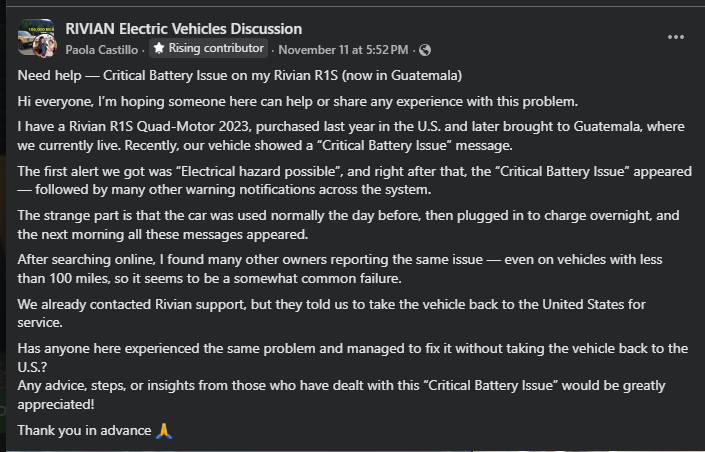
She contacted Rivian support. Their answer? Take the vehicle back to the United States for service.
It’s a harsh dose of reality for anyone who believes cars are now as boundaryless as our Instagram feeds. The Rivian R1S is an astonishing piece of engineering. Quad motors, a 135-kWh battery pack, air suspension, torque vectoring, and enough onboard computing to rival early space missions. But no matter how sophisticated the machine, it still needs support. It needs technicians who know its language, tools that can speak to its ECUs, and software that unlocks its secrets. Move it too far outside the Rivian grid, and you're no longer in the future.
Rivians Customer Support System
- The company behind the R1S, Rivian Automotive, Inc., is a U.S.-based automaker headquartered in Irvine, California, with its primary manufacturing facility in Normal, Illinois.
- They emphasise direct customer service and support infrastructure in the U.S., including a dedicated support centre for owners that you can contact for questions about charging, deliveries, vehicle features, and more.
- Their service model includes outreach and support for new owners, helping with everything from setup, charging infrastructure, and vehicle familiarisation. This “dedicated onboarding” style helps build confidence in the ownership experience.
- Being U.S.-based also means they’re building out their own infrastructure and manufacturing domestically, which can mean proximity to parts, service centres, and feedback loops – for owners, this can translate into a better-tailored customer service experience.
The internet, however, has its own infrastructure. And when traditional support failed, the modern campfire lit up in the form of Facebook groups and comment threads. “I can help you,” replied Jan Marcel Massoni Mozol. “I have access to Rivian software and provide remote support for Rivian owners outside the US, including Salvage vehicles and airbag-deployed cases.” This is the digital evolution of the roadside Samaritan. Not a guy in a denim jacket with a breaker bar, but a remote technician with diagnostic credentials and encrypted access. In this era, salvation sometimes comes not from a service bay but from a chat window.
That said, there was also good old mechanical wisdom in the comments. “It’s the stupid 12V battery,” wrote one owner. “Replace it and it should resolve.” It might sound ridiculous that a $90,000 EV with over 800 horsepower could be undone by the same twelve-volt battery that’s been keeping dome lights glowing since the Eisenhower administration. But it’s a reality in the EV world. The auxiliary battery acts as the gatekeeper to the whole system. If it fails, or even drops below a certain voltage, the software sees ghosts, and the vehicle locks itself in a digital panic. Another user added, “The single 12V battery in my ‘23 Gen1 is in the frunk area.” That might be all the difference between a successful fix and another expensive shipping quote.
Yet there’s a larger truth lurking in this story. As Elias Han pointed out, “Without scanning the vehicle or even having the proper equipment to fix it… You’re pretty much out of luck.” That’s the unsaid cost of owning a vehicle like the R1S outside its natural ecosystem. This isn’t like owning an old Land Cruiser, where a hammer and a prayer might get you through to the next town. Today’s vehicles are software platforms first and transportation second. They need networks, not just roads. And Rivian, to its credit, is still growing. But its current footprint, service-wise, is North America. Venture beyond that, and you are, for all intents, driving off the edge of the known map.
It’s also worth stating what this isn’t: a critique of Rivian’s quality or electric vehicles in general. These machines are extraordinary. But what they represent, mobility divorced from fossil fuel infrastructure, also demands a new support paradigm. The technology is ready, but the real-world logistics are still catching up. Paola’s experience is a canary in the lithium-ion coal mine. What happens when thousands of these vehicles are eventually exported, sold secondhand, or taken abroad? When the third owner in Belize finds a warning message and no one within 2,000 miles can help?
It’s not just about charging stations or range anxiety. It’s about having the people and systems in place to keep these machines running when they inevitably hiccup. Paola Castillo’s story is both a warning and a hopeful glimpse. A warning that EV support must go global, and a glimpse that perhaps a new kind of grassroots solution, owners helping owners, remote techs plugging in from across oceans, may grow to meet the need. Whether her R1S is back on the road or still parked under a mango tree waiting for help, she’s shown us that the EV frontier isn’t just about batteries. It’s about bandwidth. And community.
Image Sources: Rivian Media Center
Noah Washington is an automotive journalist based in Atlanta, Georgia. He enjoys covering the latest news in the automotive industry and conducting reviews on the latest cars. He has been in the automotive industry since 15 years old and has been featured in prominent automotive news sites. You can reach him on X and LinkedIn for tips and to follow his automotive coverage.
Set Torque News as Preferred Source on Google
Follow us today...




Comments
It will only get worse as…
Permalink
It will only get worse as the software gets locked down and you have to jailbreak your own vehicle just to be able to repair it. I'll stick to a 40 year old vehicle I can repair myself.
Hmmph. Before buying our…
Permalink
Hmmph. Before buying our first Tesla, I located and visited the nearest service center, which happily was only 19 miles away. "How will I fix it?" should always be your first question on any significant non-disposable purchase!
Rather than ship the car…
Permalink
Rather than ship the car round-trip to the service center, ship a repair guy with a load of tools and parts to you. Probably cheaper.