
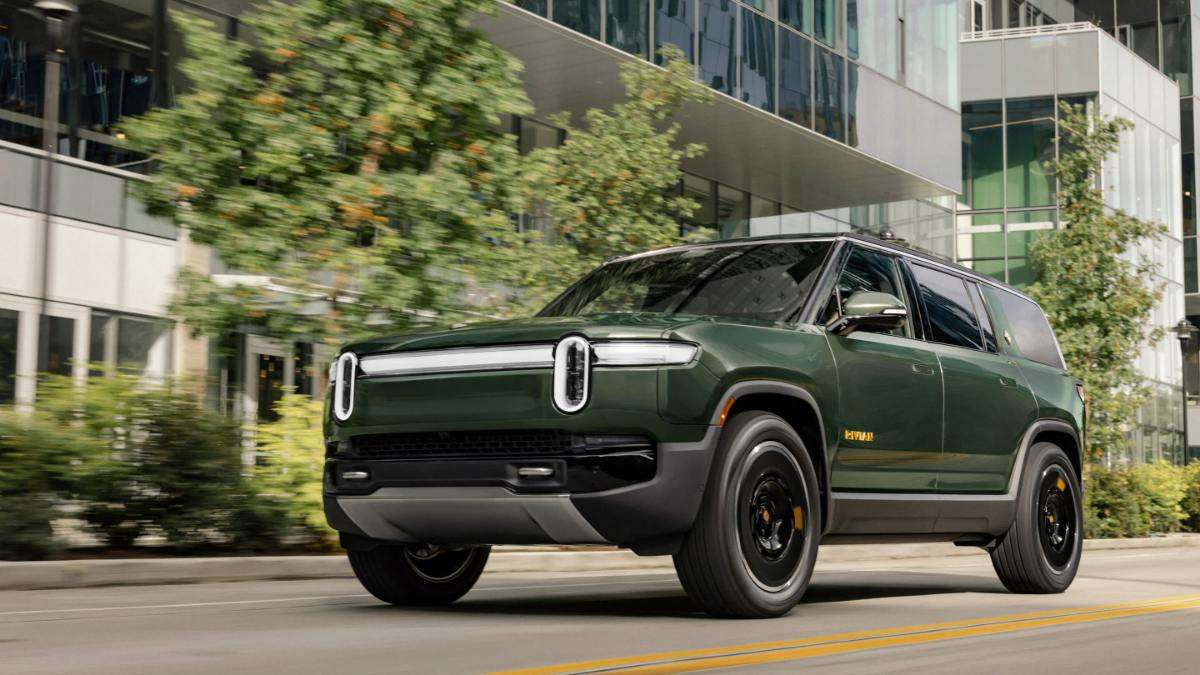

Amateur radio operators have always been early adopters of new technology, but the transition to electric vehicles presents challenges that go far beyond learning new equipment. The electromagnetic environment inside an electric vehicle creates interference patterns that didn't exist in the era of simple alternators and mechanical ignition systems. High-frequency switching from motor controllers, DC-DC converters, and battery management systems generates broadband noise that can render traditional mobile radio installations useless. Yet for operators who depend on reliable communications for emergency response, professional duties, or personal passion, abandoning mobile radio isn't an option.
Jeff Schmeichel faced exactly this dilemma when he took delivery of his 2026 Rivian R1T. As an experienced amateur radio operator, he knew that mobile communications capability was non-negotiable, but the lack of information about radio installations in electric vehicles left him starting from scratch. His methodical approach to solving the installation challenges provides a roadmap for other operators making the transition to electric vehicles:
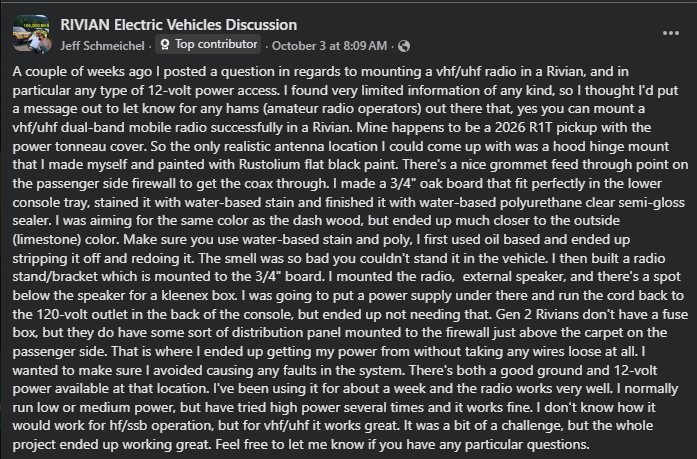
"A couple of weeks ago, I posted a question in regards to mounting a VHF/UHF radio in a Rivian, and in particular, any type of 12-volt power access. I found very limited information of any kind, so I thought I'd put a message out to let know for any hams (amateur radio operators) out there that, yes, you can mount a VHF/UHF dual-band mobile radio successfully in a Rivian. Mine happens to be a 2026 R1T pickup with the power tonneau cover. So the only realistic antenna location I could come up with was a hood hinge mount that I made myself and painted with Rustolium flat black paint. There's a nice grommet feed-through point on the passenger side firewall to get the coax through. I made a 3/4" oak board that fit perfectly in the lower console tray, stained it with water-based stain, and finished it with water-based polyurethane clear semi-gloss sealer. I was aiming for the same color as the dash wood, but ended up much closer to the outside (limestone) color. Make sure you use a water-based stain and poly. I first used oil-based, and ended up stripping it off and redoing it. The smell was so bad you couldn't stand it in the vehicle. I then built a radio stand/bracket, which is mounted to the 3/4" board. I mounted the radio, external speaker, and there's a spot below the speaker for a Kleenex box. I was going to put a power supply under there and run the cord back to the 120-volt outlet in the back of the console, but ended up not needing that. Gen 2 Rivians don't have a fuse box, but they do have some sort of distribution panel mounted to the firewall just above the carpet on the passenger side. That is where I ended up getting my power from, without taking any wires loose at all. I wanted to make sure I avoided causing any faults in the system. There's both a good ground and 12-volt power available at that location. I've been using it for about a week, and the radio works very well. I normally run low or medium power, but have tried high power several times, and it works fine. I don't know how it would work for HF/SSB operation, but for VHF/UHF it works great. It was a bit of a challenge, but the whole project ended up working great. Feel free to let me know if you have any particular questions."
The power tonneau cover that forced Schmeichel to develop a custom hood hinge antenna mount represents the kind of design constraint that electric vehicle manufacturers never considered when optimizing for aerodynamics and functionality. Traditional magnetic mounts won't work on aluminum body panels, and the sleek rooflines that improve electric vehicle efficiency eliminate the roof rack mounting points that amateur radio operators have relied on for decades. His solution required fabrication skills that go beyond typical automotive modifications, demonstrating how electric vehicle adoption demands new technical competencies from amateur radio operators.
Finding reliable 12-volt power in modern electric vehicles poses challenges that didn't exist in the era of simple automotive electrical systems. The distribution panel that Schmeichel discovered on the passenger side firewall solved what many consider the most critical challenge of electric vehicle radio installation. Unlike traditional vehicles with accessible fuse boxes and straightforward 12-volt systems, modern electric vehicles bury their low-voltage systems behind layers of electronic protection designed to prevent interference with high-voltage components. His non-invasive approach to power access provides other operators with a template that avoids warranty issues while delivering the clean power that radio equipment requires.
The woodworking precision that Schmeichel brought to his radio mounting solution reflects the craftsmanship tradition that has always distinguished serious amateur radio installations from casual equipment mounting. His experience with oil-based versus water-based finishes illustrates the attention to detail required when integrating technical equipment into premium vehicle interiors. The trial-and-error process he describes, stripping and refinishing the mounting board due to odor issues, shows the kind of persistence that separates successful installations from abandoned projects. This level of craftsmanship becomes even more important in electric vehicles where interior quality expectations exceed those of traditional work trucks.
The Technical Reality of Electric Vehicle RF Environment
Electromagnetic interference concerns have kept many amateur radio operators from embracing electric vehicles, and these fears aren't entirely unfounded. The absence of AM radio in many electric vehicles serves as a visible reminder of the electromagnetic compatibility challenges that electric drivetrains create, particularly for amplitude-modulated signals that lack the noise rejection capabilities of frequency modulation. When operators ask whether "EVs themselves made it very hard to operate radios on bands like that," they're reflecting widespread concern about the RF noise environment inside electric vehicles.
The frequency-dependent nature of electric vehicle interference explains why Schmeichel's VHF/UHF installation succeeded where HF operations might fail. VHF and UHF communications use FM modulation and operate at higher frequencies, while HF communications rely on AM modulation at relatively low frequencies. The switching frequencies of electric motor controllers typically generate harmonics in the HF range, creating interference that can overwhelm AM signals while leaving FM communications relatively unaffected. This frequency-dependent interference pattern explains why electric vehicle RF compatibility varies dramatically across different amateur radio bands.
The noise rejection advantage of FM modulation becomes crucial in the electrically hostile environment of modern electric vehicles. While AM signals can be rendered unusable by even modest levels of electrical noise, FM signals can maintain full quieting and excellent audio quality in the same environment. Schmeichel's successful high-power operation demonstrates that properly designed VHF/UHF installations can coexist with electric vehicle systems without mutual interference, provided installers understand both the vehicle's electrical architecture and the characteristics of their radio equipment.
Power supply considerations in electric vehicles offer both opportunities and challenges that don't exist in traditional vehicles. The 120-volt outlet that Schmeichel initially considered using represents power options that traditional vehicles cannot provide, but his decision to use direct 12-volt power from the distribution panel demonstrates that DC power remains preferable for amateur radio equipment. This choice avoids the inefficiency and potential noise issues of AC-to-DC conversion within the vehicle, reflecting the kind of technical judgment that experienced amateur radio operators bring to installation challenges.
The successful week of testing that followed Schmeichel's installation provides confidence that electric vehicles can support serious amateur radio operations when approached with proper technical understanding. His ability to operate at high power without triggering vehicle protection systems or causing interference demonstrates that Rivian's electrical architecture can handle the current demands and RF emissions of amateur radio equipment. This compatibility represents a significant advantage over some electric vehicles that have proven problematic for high-power radio operation due to sensitive electronic systems or inadequate power distribution capacity.
Installation approaches like Schmeichel's provide templates for other modifications that require power access without compromising vehicle warranties or triggering fault codes. His success shows how electric vehicle modifications can be accomplished safely when approached with appropriate technical knowledge and respect for vehicle design constraints. The broader implications extend beyond amateur radio to demonstrate how electric vehicles can accommodate specialized equipment when installers understand both vehicle systems and equipment requirements.
The collaborative knowledge sharing that characterizes the amateur radio community becomes particularly valuable as more operators transition to electric vehicles and face similar installation challenges. Detailed technical information about mounting techniques and power access methods enables other operators to replicate successful installations without repeating trial-and-error processes. This knowledge transfer becomes essential as the amateur radio community adapts to electric vehicle technology while maintaining the communications capabilities that define the hobby.
Emergency communications implications of successful VHF/UHF operation in electric vehicles extend beyond individual convenience to public safety applications. Amateur radio operators often provide critical communications support during disasters when commercial systems fail, and the ability to operate from electric vehicles could provide significant advantages in emergency scenarios. The large battery capacity of electric trucks like the Rivian R1T enables extended operation without engine running, while the quiet operation of electric vehicles makes them ideal for communications operations in noise-sensitive environments where emergency communications require reliable mobile platforms.
Understanding modern vehicle electrical architecture becomes increasingly important as vehicles incorporate more sophisticated electronics and become more sensitive to unauthorized modifications. The careful approach to power access that Schmeichel demonstrated, avoiding wire modifications while achieving reliable connections, shows the technical competence that amateur radio operators must develop to work safely with complex electronic systems. This expertise becomes increasingly valuable as traditional automotive knowledge becomes less applicable to modern electric vehicles.
Electric vehicles may actually offer advantages for certain types of amateur radio operation compared to traditional vehicles. The availability of both 12-volt and 120-volt power sources, combined with the quiet electrical environment at VHF/UHF frequencies, could make electric vehicles superior platforms for these frequency bands. The absence of alternator noise and engine vibration creates operating conditions that amateur radio installations in electric vehicles can exploit for improved performance compared to traditional mobile installations.
For amateur radio operators considering electric vehicle purchases, experiences like Schmeichel's provide both encouragement and practical guidance. His successful installation demonstrates that VHF/UHF mobile operation remains viable in electric vehicles when approached with proper planning and technical understanding. The detailed documentation he provides enables other operators to evaluate whether their specific radio requirements can be met within the constraints of electric vehicle design and electrical architecture.
Image Sources: Rivian Media Center
Noah Washington is an automotive journalist based in Atlanta, Georgia. He enjoys covering the latest news in the automotive industry and conducting reviews on the latest cars. He has been in the automotive industry since 15 years old and has been featured in prominent automotive news sites. You can reach him on X and LinkedIn for tips and to follow his automotive coverage.
Set Torque News as Preferred Source on Google
Follow us today...



Comments
Hello: I found this article…
Permalink
Hello:
I found this article on the web and wanted to do a follow-up on it. While the install & bracket worked out very well, and feeding the coax through the firewall was a breeze, I did run into one issue. I'm using a Yaesu FTM-150ASP dual band radio in the vehicle. While the UHF portion seems to work very well, the VHF (144-148 MHz) portion has a tremendous amount of noise on it. The radio has a built-in spectrum scope on it, and it shows about 75 to 80% baseline noise on the VHF portion steady. This noise of course makes using the VHF portion quite difficult unless I'm very close to the repeater. It transmits fine and I get very good reports, but the receive on my end is horrible. I put ferrite cores on both ends of the coax and don't believe it's any common line noise on the outside of the coax at all. It instead appears to be on frequency noise coming directly into the antenna. I thought about a band pass filter of some sort, but that would probably render the UHF side of the radio useless. So in summary, the install worked out very well, but the VHF noise generated by the Rivian itself is horrible. Just wanted to put that follow-up to the install out there in case anyone finds a way around it, please let know. TIA Jeff S.