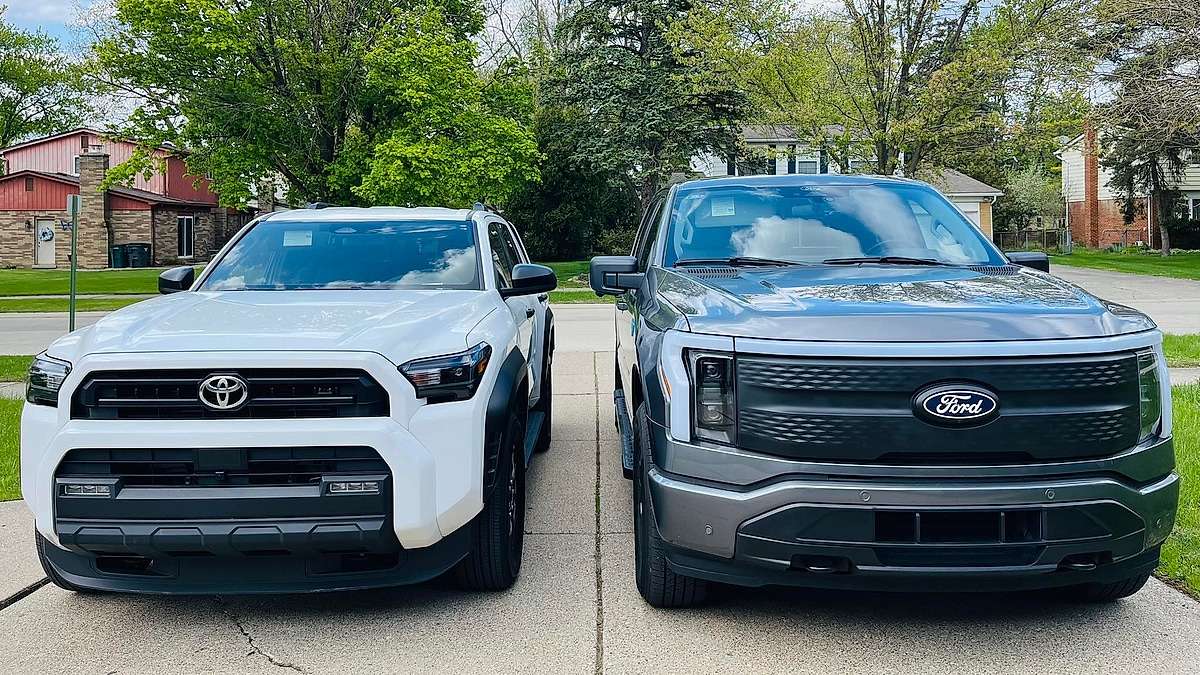

Using his local rates, one owner calculated that a 2025 Ford F-150 Lightning costs about 10 cents a mile to drive, compared with 25 cents a mile for a 2025 Toyota 4Runner SR5. That gap looks huge on paper. The comments under his post explain why it still is not the whole truck story.
For years, the American truck argument was supposed to be simple. Bigger meant thirstier. Heavier meant more expensive to run. If a full-size pickup had twice the power of a midsize SUV, common sense said it should also cost more every time it left the driveway.
A recent post about the 2025 Ford F-150 Lightning and 2025 Toyota 4Runner SR5 turns that old logic inside out.
Vladimir Aeron Pagsaligan laid out the comparison in blunt, useful terms. He said his Lightning averages 2.4 miles per kWh, while his residential electricity rate comes out to $0.24 per kWh with fees and taxes included. By his math, the truck costs about $0.10 per mile to drive. For the 4Runner SR5, he used 20 mpg and $5 per gallon gasoline, which works out to $0.25 per mile. Over 1,000 miles, that becomes a $100 driving cost for the Lightning versus $250 for the 4Runner.

That is the kind of comparison people actually understand. It is not MPGe, not emissions, not ideology. It is simply what it costs to move the vehicle down the road.
And it gets more interesting when the numbers are stretched across a full year. At 12,000 miles, the gap between 10 cents and 25 cents a mile becomes $1,800. At 20,000 miles, it becomes $3,000. For anyone using a truck as a commuter, family hauler, or daily errand machine, that is no longer trivia. That is the budget structure.
The arithmetic is simple, but the assumptions matter
Pagsaligan’s post works because the math is so easy to follow. Electricity at 24 cents per kWh divided by 2.4 miles per kWh gives 10 cents per mile. Gas at $5 per gallon divided by 20 mpg gives 25 cents per mile. The Lightning comes out at less than half the cost per mile.
There is also enough real-world plausibility in the comparison to make it feel grounded. Toyota says the standard turbocharged 2025 4Runner makes up to 278 horsepower and can achieve up to an EPA-estimated 26 mpg highway in the most favorable setup, which means 20 mpg is not a fantasy number but more of a mixed-use, normal-driving assumption than a best-case sticker result.
Ford, meanwhile, has spent years trying to make the Lightning feel like a truck first and an EV second. The 2025 F-150 Lightning is sold with dual motors, standard four-wheel drive across the lineup, and up to 10,000 pounds of conventional towing in certain trims. On the power side, Ford’s official technical specs list Lightning outputs ranging from 452 horsepower to 580 horsepower depending on configuration, which explains why the post’s “twice the horsepower” line is directionally fair even if it does not compare trim for trim.
That is what makes the post feel so unintuitive. The Lightning is not only a larger and heavier vehicle. In many configurations, it is also the far more powerful one. Yet under the owner’s stated assumptions, it is dramatically cheaper to operate mile for mile.
Home charging is where the Lightning’s advantage becomes real
The comment section underneath the post is where the story gets better, because it turns a neat comparison into a map of who actually wins from an electric truck.
Several owners immediately pointed to electricity rates. One commenter said his all-in home charging cost is about 18 cents per kWh, which would lower the Lightning’s cost per mile even more. Another joked that his California rate was 11 cents per kWh, while a Canadian commenter claimed an even lower effective figure. George Dean said he has solar and drives his Lightning “for FREE.”
That is the hidden story in this whole comparison. The Lightning is not magically cheap. It is cheap when home charging, local utility rates, workplace charging, or solar line up in the owner’s favor.
Ford’s own marketing leans into this kind of ownership logic. The company says F-150 Lightning scheduled maintenance costs are estimated to be more than 49% lower than a gas-powered F-150 over five years or 75,000 miles, and it highlights home charging as part of the ownership proposition.
Once that is understood, the post stops looking like an EV evangelism moment and starts looking like a regional energy story. In one ZIP code, the Lightning becomes a low-cost daily truck. In another, where residential electricity is punitive or home charging is unavailable, the advantage shrinks or disappears.
That matters because the economics of EV ownership are often discussed as if they are universal. They are not. They are local.
The comments also reveal where the Lightning still loses the argument
The best comment in the thread may be the one that pushed back.
“Since the Lightning can’t do the truck things we need it to do, we have a Powerboost for anything beyond the city limits,” one commenter wrote.
That one sentence explains why the post struck such a nerve.
The Lightning’s strongest case has never been “it replaces every truck for every person.” Its strongest case is that it can be an outstanding daily-use truck for people whose towing, hauling, and distance needs fit inside a certain box. The problem is that many truck buyers do not buy trucks for average days. They buy them for edge cases, because the whole point of truck ownership is often to have the extra capacity on the day it matters.
Another commenter pushed back on that too, saying the Lightning “does all truck things extremely well,” just perhaps not as far as some owners would like.

That exchange is more useful than either side probably intended. It shows that the cost-per-mile argument and the truck-capability argument are not really competing. They are talking about different jobs.
If the truck’s life is mostly commuting, school runs, errands, short local hauling, jobsite electricity, and overnight home charging, the Lightning looks brilliant. If the truck’s life regularly includes long highway runs, uncertain charging access, towing at a distance, or a need to leave the city without planning around electrons, the case gets more complicated.
That does not invalidate the savings. It just narrows where the savings matter most.
The 4Runner comparison is interesting because it is not a ridiculous straw man.
This is part of why the post works. The 4Runner SR5 is not some cartoonishly inefficient dinosaur. It is a highly relevant comparison because it represents a real kind of American buyer: someone who wants durability, simplicity, cargo room, road-trip confidence, and the freedom to fuel up in five minutes without rethinking the route.
In other words, the 4Runner is a vehicle built around freedom from planning, while the Lightning is increasingly a vehicle built around freedom from fuel prices.
Those are different kinds of convenience.
That difference is what gets lost when EV vs. gas comparisons become too tribal. The Lightning’s cost advantage is real. Under the numbers in this post, it is not even close. But the 4Runner still represents something that a lot of buyers value more than a cheap mile. It represents an uncomplicated range, broad refueling access, and the confidence that an unexpected 300-mile day does not have to be budgeted in charging stops.
About The Author
Noah Washington is an automotive journalist based in Atlanta, Georgia, covering sports cars, luxury vehicles, and performance culture. His reporting focuses on explaining the engineering, design philosophy, and real-world ownership experience behind modern vehicles.
Noah has been immersed in the automotive world since his early teens, attending industry events and following the enthusiast communities that shape how cars are built and driven today. His work blends industry insight with enthusiastic storytelling, helping readers understand not just what a car is, but why it matters.
Noah is also a member of the Southeast Automotive Media Association (SAMA), a professional organization for automotive journalists and industry media in the Southeast.
His coverage regularly explores sports cars, luxury vehicles, and performance-driven segments of the automotive industry, including the evolving culture surrounding Formula Drift and enthusiast builds.
Read more of Noah's work on his author profile page.
You can also follow Noah here:
Set Torque News as Preferred Source on Google
Follow us today...