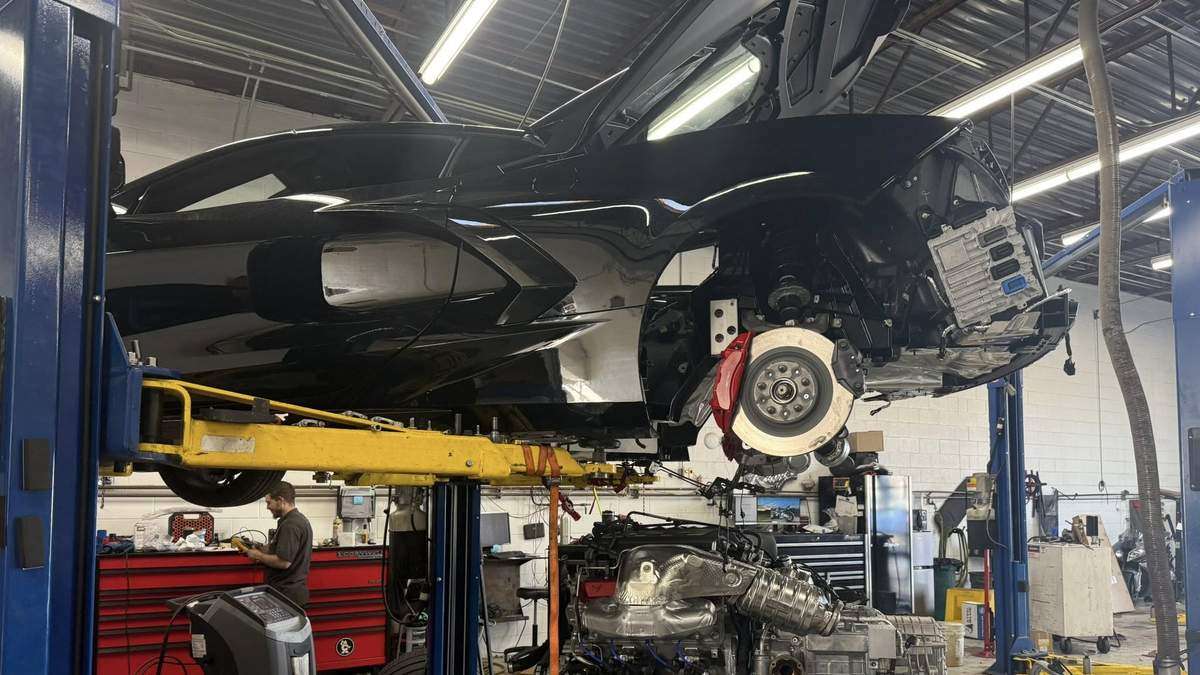

The promise of the mid-engine Corvette was never subtle. It was about rewriting expectations, about proving that America could build a world-class sports car that no longer needed excuses or asterisks. By almost every measurable standard, the C8 Stingray has done exactly that. It is fast, composed, visually dramatic, and engineered with an ambition that still feels slightly unreal when you remember what Corvettes used to be. But progress, especially the kind that involves stuffing an engine behind the driver, comes with consequences, and sometimes those consequences reveal themselves in the most uncomfortable ways.
That reality surfaced recently in the C8 Corvette Stingray Owners group when a post appeared showing a brand-new car, four miles on the odometer, sidelined by a faulty coolant temperature sensor. On paper, this is the kind of issue that barely registers. Sensors fail. Modern cars are full of them. The jolt came not from the diagnosis, but from the apparent scale of the repair required to address it. Seeing a new Corvette opened up for something so mundane was enough to stop even seasoned enthusiasts mid-scroll.
“Oops. New one off the lot. 4 miles. Needs a coolant temp sensor.”
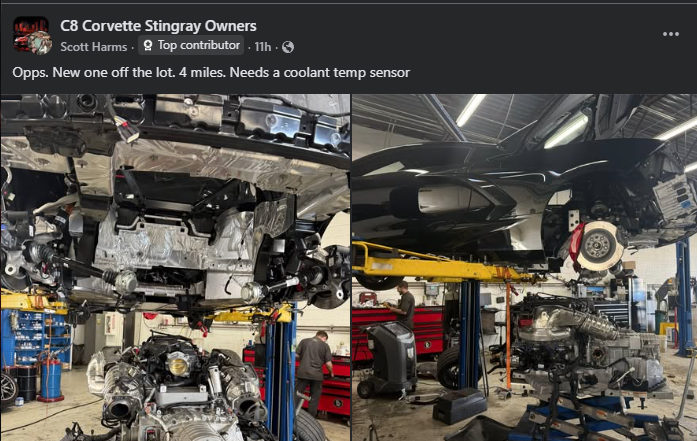
Several owners quickly recognized the scenario. One recalled the same issue on a 2020 model at just over 1,100 miles, paired with the same service procedure. Being taken back into the shop to see the car in that state, they admitted, was stomach-turning. Even questions about replacing something as ordinary as a fan belt were met with the same answer. Access, not the part itself, was the real problem. When the engine lives where luggage once did, the rules change.
Although the original poster never said he was a salesman or technician, it seems like he has intimate knowledge of the Corvette and even has access to the bay-area of the dealership.
Chevrolet C8 Corvette: Mid-Engine Performance
- The rear cargo layout splits storage between front and rear compartments, creating usable space for luggage but requiring more planning than a single conventional trunk.
- Cooling management plays a central role in the car’s design, with large side intakes and rear airflow paths influencing exterior proportions and cabin noise levels.
- Steering calibration emphasizes precision over isolation, transmitting more surface detail to the driver while remaining stable at highway speeds.
- Interior visibility reflects the mid-engine architecture, with limited rearward sightlines offset by camera assistance and mirror placement.
Not everyone reacted with alarm. One commenter pointed out that this is actually evidence of how modular Chevrolet made the C8. Compared to older cars, engine removal is more straightforward and more standardized. From an engineering perspective, that is true. The C8 was designed with serviceability in mind, at least as much as a mid-engine car reasonably can be. The disconnect comes from perception. A “simple” repair no longer looks simple when it requires removing major components to reach a sensor that would have been trivial on a front-engine car.
There was also an important caveat raised quietly in the background. The post may well have originated from a dealership technician, and there is a real possibility that what circulated was partially satirical. Technicians have long used visual exaggeration to make a point, especially when modern packaging turns routine jobs into production numbers. But satire only lands because it contains truth. Whether the teardown shown was strictly necessary or played up for effect, the underlying lesson remains intact.
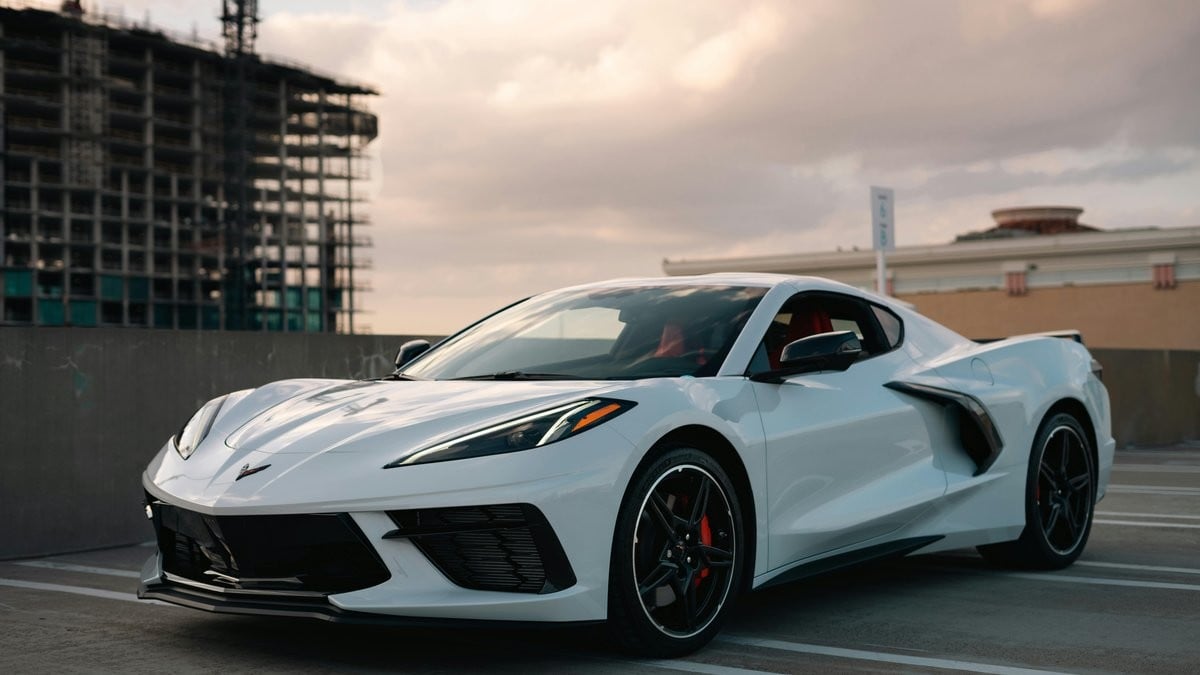
That lesson is not that the C8 is flawed or poorly designed. It is that sophistication comes at a cost, and that cost is often paid later, in time and complexity rather than horsepower or dollars at the showroom. Mid-engine cars are dense machines. Everything is tightly packed, optimized for performance, cooling, and balance. The tradeoff is that access becomes a privilege, not a given.
Some prospective buyers watching the discussion admitted it gave them pause, while others doubled down on extended warranties, reasoning that if this is the price of admission, protection is cheap insurance. Both reactions are reasonable. The C8 is not a fragile car, but it is an advanced one, and advanced machines demand a different mindset from their owners.
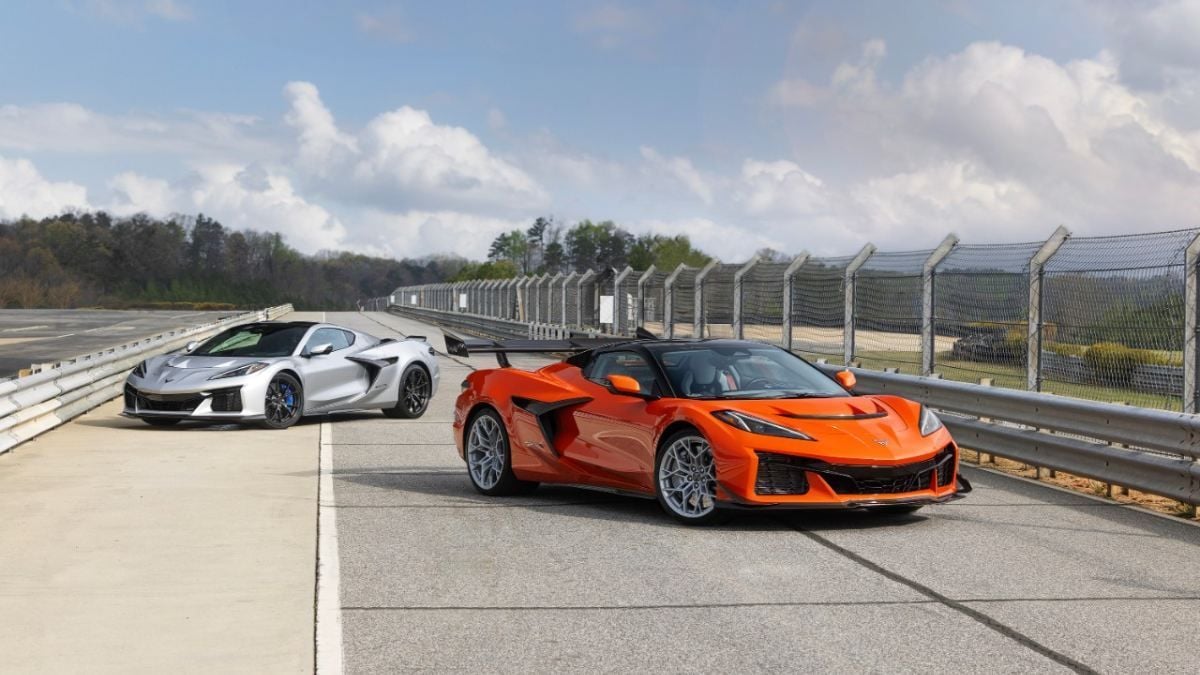
This episode does not undermine the Corvette’s achievement. If anything, it reinforces how far it has traveled. The Stingray is no longer a blunt instrument built around simplicity and space. It is a tightly engineered performance car, subject to the same realities as its European and exotic peers. Whether the image was satire or documentation, the takeaway is the same: the C8 delivers extraordinary capability, but it asks its owners to understand that even small things can live at the center of very big jobs.
Image Sources: Chevrolet Media Center
Noah Washington is an automotive journalist based in Atlanta, Georgia. He enjoys covering the latest news in the automotive industry and conducting reviews on the latest cars. He has been in the automotive industry since 15 years old and has been featured in prominent automotive news sites. You can reach him on X and LinkedIn for tips and to follow his automotive coverage.
Set Torque News as Preferred Source on Google
Follow us today...