

Cold weather has a special talent for exposing the gap between what an EV promises on paper and what it delivers on frozen pavement. That gap is exactly what sparked a thoughtful post in the Chevy Equinox EV Group, where one owner decided to push back against winter range anxiety with something refreshingly old-fashioned: math, observation, and a clear understanding of how the car actually thinks.
The images tell the story before the words do. At minus 18 degrees Fahrenheit, the Equinox EV’s display shows just 37 miles of remaining range at 22 percent state of charge. To an unprepared driver, that number looks alarming. Yet the trip data alongside it shows an efficiency of 1.7 miles per kilowatt-hour over the current drive.
Multiply those two numbers, the owner argues, and you get a far more honest picture of what the car can still do in the cold.
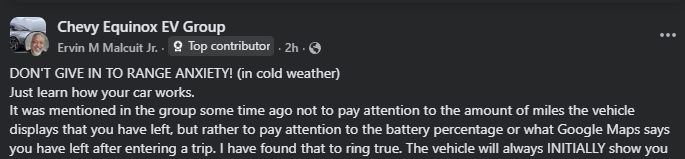
“Don’t give in to anxiety! (in cold weather)
Just learn how your car works.
It was mentioned in the group some time ago not to pay attention to the amount of miles the vehicle displays that you have left, but rather to pay attention to the battery percentage or what Google Maps says you have left after entering a trip. I have found that to ring true. The vehicle will always INITIALLY show you the max range after a fresh charge, as though the conditions were ideal. Then, after a little bit, the vehicle starts to realize that it is cold... and then starts to modify the mileage left to match the conditions and how you drive.
However, I have found the most accurate is to do a simple math equation. Take your current trip's mi/kWh multiplied by the battery percentage, and it will equal what you really have left for mileage. (I always reset my trip2 to be my current trip.) After the vehicle has been driven for most of its battery charge, the displayed mileage will become. That's why mine actually agree even though it is minus 18 degrees F out right now. So, in my case, I just press the little speak button on my steering wheel and say, "1.7 X 22," and the vehicle will give me the answer. Now, I can plan if I need to charge to make whatever distance I need to go, or if you can afford to turn the heat up a little more.
Mi/kWh X battery percentage = current miles left to travel.
Advertising
I keep my heat set from 68 to 72 degrees with the fan on 2 to 5 and with the ECO setting off and recirculate off. Heat works great all the time and never seems to impact my range. The only time it does is if you jack up the heat all the way or sit without driving for a long time with the heat on. Then, the mi/kWh gets skewed a little, but it still gives you more than enough info to calculate your range. I hope this helps for those who need it!
Happy New Year!”
His method is simple by design. Reset Trip 2 at the start of a drive, watch the real-time mi per kWh figure, then multiply it by the remaining battery percentage. In his case, 1.7 times 22 yields roughly 37 miles, which aligns almost perfectly with what the car ultimately delivered once it finished recalibrating itself for brutal temperatures. The key insight is that the vehicle’s range estimate is not lying; it is guessing early and correcting late.
Chevrolet Equinox: Practicality and Conservative Design
- The Equinox is positioned as a compact crossover focused on affordability and everyday usability rather than standout performance or distinctive styling.
- Ride tuning favors comfort and isolation, smoothing out most road imperfections while offering limited feedback through the steering.
- Interior design prioritizes straightforward controls and familiar layouts, making the cabin easy to navigate but visually conservative compared with newer rivals.
- Powertrain performance is adequate for commuting and highway travel, though acceleration under load can feel restrained during passing or uphill driving.
That behavior is familiar to anyone who has lived through an EV winter. After a fresh charge, the car assumes ideal conditions and displays a generous range estimate. Once driving begins and the battery temperature, heater load, wind resistance, and speed settle into reality, the algorithm tightens its expectations. The longer you drive on a single charge, the more accurate the estimate becomes. The frustration comes from watching that number drop quickly at the start, even when the actual usable energy has not suddenly vanished.
The owner’s broader message is not to ignore the Equinox, but to stop treating the miles remaining display as a fixed truth. Battery percentage is stable. Efficiency is measurable. Miles are a projection. When those three are understood together, cold weather stops feeling like an emergency and starts feeling like a variable you can manage.
Not everyone in the comments was convinced. Some pointed out that multiplying the percentage by efficiency assumes a round-number battery capacity, which the Equinox EV does not have. Others noted that Google Maps often predicts arrival with far less remaining charge than reality delivers, making it difficult to trust navigation-based estimates. These criticisms are technically valid, but they also miss the owner’s point. This is not precision engineering. It is situational awareness.
What matters is that the method consistently lands close enough to reality to inform decisions. Can you make it home without charging? Can you afford to turn the heat up a notch? Do you need to stop now or later? In extreme cold, those questions matter more than whether your calculation is off by two miles.
The discussion also highlights an underappreciated truth about EV heating. Moderate cabin temperatures with reasonable fan speeds have far less impact on range than most drivers assume. It is prolonged idling with the heater blasting or cranking the system to its limits that distorts efficiency numbers. Driven steadily, even in deep cold, the Equinox EV appears far more predictable than its initial range display suggests.
What this owner ultimately offers is not a hack, but confidence. Range anxiety thrives on uncertainty and opaque systems. Understanding how the car estimates range, and how to sanity-check that estimate yourself, takes away much of that fear. The vehicle is not fragile. It is cautious, especially in the cold.
As EVs move into colder regions and more mainstream ownership, these kinds of owner-driven insights matter. They translate complex systems into usable knowledge. Minus 18 degrees is no longer a warning sign. It is just another input. And once you know how to read it, the numbers stop being scary and start being useful.
Image Sources: Chevrolet Media Center
Noah Washington is an automotive journalist based in Atlanta, Georgia. He enjoys covering the latest news in the automotive industry and conducting reviews on the latest cars. He has been in the automotive industry since 15 years old and has been featured in prominent automotive news sites. You can reach him on X and LinkedIn for tips and to follow his automotive coverage.
Set Torque News as Preferred Source on Google
Follow us today...







Comments
His calculation method is…
Permalink
His calculation method is pretty close and accurate. I have used the specs and observation to derive the same equation.
The Equinox EV battery capacity is 85 kWh. How much energy is represented by a given percentage of charge? Divide 85 kWh by 100% and that gives you 0.85 kWh/percent. Rounding this gives you 0.9 or 1.0 kWh/percent thus assuming 1 kWh/percent makes easy math and reasonably accurate approximation.
Thus your current efficiency multiplied by percentage you're willing to use (I don't want to let the battery get below 10% especially in cold weather) and you get your expected range [ (mi/kWh)*(kWh) = mi ]
I used this reliably on 700 mi one way Thanksgiving road trip to Mi and lots of day to day driving and short road trips.
It seems strange to…
Permalink
It seems strange to celebrate incorrect logic leading to what appears to acceptable results. Once this driver has a different car with a different battery size they will see how incorrect their math is.
The correct math would be 22% x 85kwh battery = 18.7kwh remaining x 1.7 m/kWh= 31.79 miles estimated range.
Please don't teach people the previous method unless their battery is actually very close to 100kwh, otherwise you are setting people up for failure and giving EVs a bad reputation.
Underrated reply. This…
Permalink
In reply to It seems strange to… by Rich (not verified)
Underrated reply. This article is very poorly researched. Complete garbage.
Uuhhhhh......No. That is not…
Permalink
Uuhhhhh......No.
That is not how math works.
The real math would be miles\kwh multipled by remaining kwh in the battery. EVs all have varying battery capacity, so 2.0 miles\kwh in a car that has a 100 kwh battery will be able to go mich further than another EV that uses a 70 kwh battery even though they both may show the same 20% state of charge. It drives me insane when people post some "hack" and think they are genius when it is so incredibly wrong.
All that, for what?
Permalink
All that, for what?