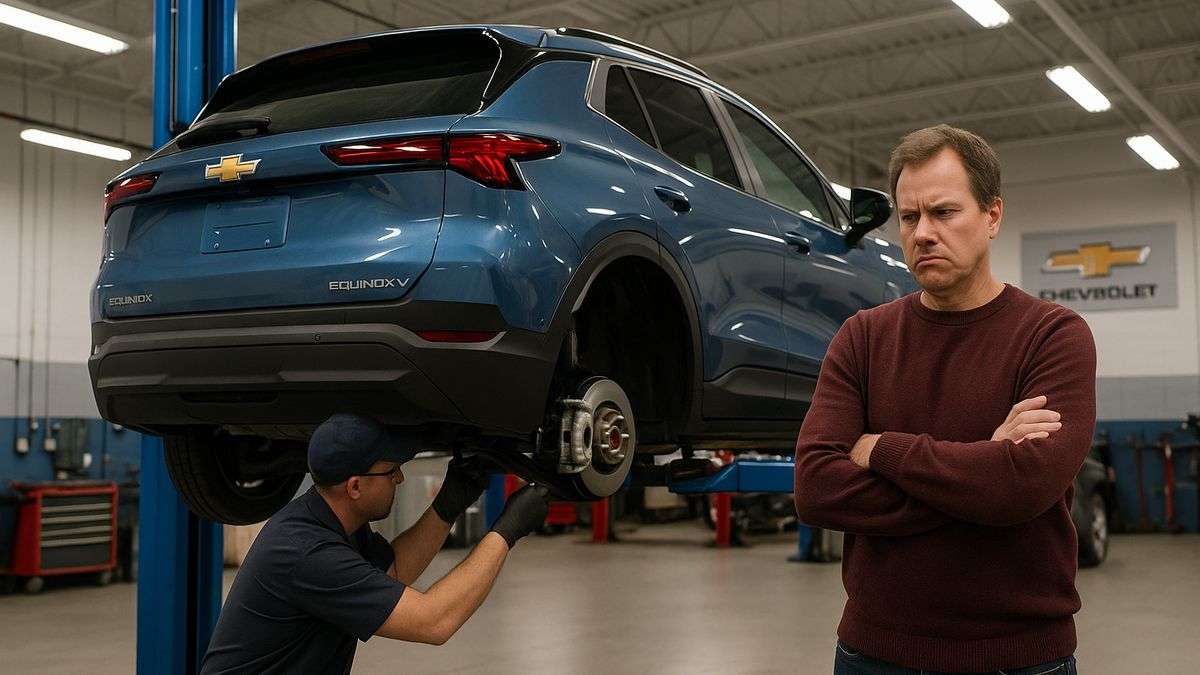

The good news is that electric vehicles have grown to about 12% of new car sales in the U.S. The bad news is that some car dealers still struggle to service them properly. This can come in the form of EV owners getting free coupons for oil changes from local dealerships, or service techs not understanding things like how regenerative braking affects brake behavior in EVs. Social media is filled with posts about this. Here’s a Reddit post that we found interesting:
Select-Fun-1536 started a long post about squealing low mileage brakes on his EV:
“Back in September 2024, I bought two Chevy Equinox EV 2025s — one for me and one for my wife. Both vehicles have less than 10,000 miles on them. And guess what? Both are already having the exact same issue: the brakes make a horrible squealing noise every time you press the pedal, and when you go in reverse the sound is absolutely unbearable.
I’ve taken both SUVs to the dealer twice already. Each time I had to pay $35 for a brake inspection, and both times they told me “everything was fine.” Now, on the third visit, they suddenly tell me the brake pads need to be replaced, and it’s going to cost $498 PER VEHICLE. That’s nearly $1,000 out of my pocket for what I strongly believe is a manufacturing defect.
Here’s what frustrates me the most: (1) Both vehicles are covered under the extended warranty, but the dealer says brakes are “not included.” (2) They claim the warranty only covers the battery and motors. (3) How is it possible that two brand-new vehicles, same model, same mileage, bought at the same time, have the same brake problem, and it’s NOT considered a factory defect?
This makes zero sense. Honestly, I feel scammed. I trusted Chevy, bought two brand-new EVs, and in less than a year they’re already trying to squeeze almost a grand out of me for something that should not be happening.”
Malusrosa suggested a cause and solution:
“Your brake pads are almost certainly glazed and/or contaminated from a lack of use and once you get it off they will still have 90,000 miles in them. This happens a lot on EVs and they should probably develop software to routinely disable regenerative braking to prevent it. You can fix it by doing the following.
Toss the car into neutral at 40-60 mph, then use the brake pedal to brake moderately hard to 10 mph. Put it back in gear, repeat 3-4 times, then finish with a very hard stop to 0mph. Immediately get back to speed and cruise for a bit using brakes as little as possible to let them cool, and they should quiet up."
H0tsauce-2 made a comment about the dealer:
“This sounds like a dealership issue, not a Chevy issue. Considering how little use EV brakes actually get, the idea that you've already burned through them is laughable. The pads on my Bolt lasted 130,000 miles for heaven's sake. Find a different dealership and see what they say, or talk directly to Chevrolet.”
One is the best things about owning an EV is the super low cost of ownership and lack of service needs. However, EVs are still relatively new and many service techs lack experience with EVs even though they have been trained. For EV owners, depending on the brand that they own and where they live in the country, taking their cars for service can feel a bit like the wild west.
EV Satisfaction is Rising, but Service Frustration Lingers
As electric vehicles become more common and sales volume increases, attention is shifting towards the quality of service and support. A recent study by CDK Global shows a curious split. Satisfaction remains high, with 82% of owners open to buying another EV. Service needs are also widespread, with 85% visiting a dealership during the first year of ownership. The market looks healthy from a buyer’s perspective, but it looks like service capacity is straining to keep pace.
EV sales set a record in the first half of 2025 with more than 607,000 EVs sold in the U.S. That surge may reflect a rush to buy before federal incentives begin phasing out. The growth is creating pressure on service bays. Same-day appointments fell from 40% in 2023 to just 28% in 2024, which signals a tightening pipeline for routine fixes.
Wait times are lengthening across brands, according to CDK Global. Owners who waited three days or more climbed from 9 percent to 14 percent over the same period. Reported time in the shop varies by brand group. 34% of non-Tesla owners reported longer service times than comparable gas vehicles, while 23% of Tesla owners said the same. Many EV owners find the cost of service to be reasonable. Fifty-three percent of non-Tesla owners said EV service cost less than gas maintenance, while 41 percent of Tesla owners agreed.
Getting a problem fixed in a single visit is becoming less common. Only 65% of non-Tesla owners reported a one-and-done repair. A notable 21% needed four or five visits to resolve a problem. CDK’s analysis notes that dealers have prepared for EV work, although owners are still experiencing longer waits and multiple trips to complete a fix.
Not every data point is negative. Only 13% of EV owners reported paying out of pocket for service. The study showed that 16% of appointments related to recalls, split evenly between Tesla and other brands. On the good news side of the ledger, convenience options are expanding. Mobile service reached 19% of owners in 2024, up from 14% in 2023. Dealer pickup is gaining ground as well, rising from 6% to 9% in the same window.
It is worth remembering that these figures come from customer surveys. Owner experiences carry value, although survey research can include bias. Measures such as wait duration and number of visits still offer useful signals about the daily realities of EV ownership.
Bottom Line
EV demand continues to grow, while service networks race to match that momentum. Survey data shows strong loyalty, rising delays, and promising convenience options. Continued progress is expected to come from staff gaining experience with EVs, parts availability, technician training, and more use of mobile service. Owners are sending a clear message, which is that fast fixes, fair costs, and fewer repeat visits will define the next phase of EV adoption.
What Do You Think?
How long did you wait for your most recent EV service, same day, one to two days, or longer?
Have you used mobile service at your home or office, and how did it go?
Chris Johnston is the author of SAE’s comprehensive book on electric vehicles, "The Arrival of The Electric Car." His coverage on Torque News focuses on electric vehicles. Chris has decades of product management experience in telematics, mobile computing, and wireless communications. Chris has a B.S. in electrical engineering from Purdue University and an MBA. He lives in Seattle. When not working, Chris enjoys restoring classic wooden boats, open water swimming, cycling and flying (as a private pilot). You can connect with Chris on LinkedIn and follow his work on X at ChrisJohnstonEV.
Set Torque News as Preferred Source on Google
Follow us today...