
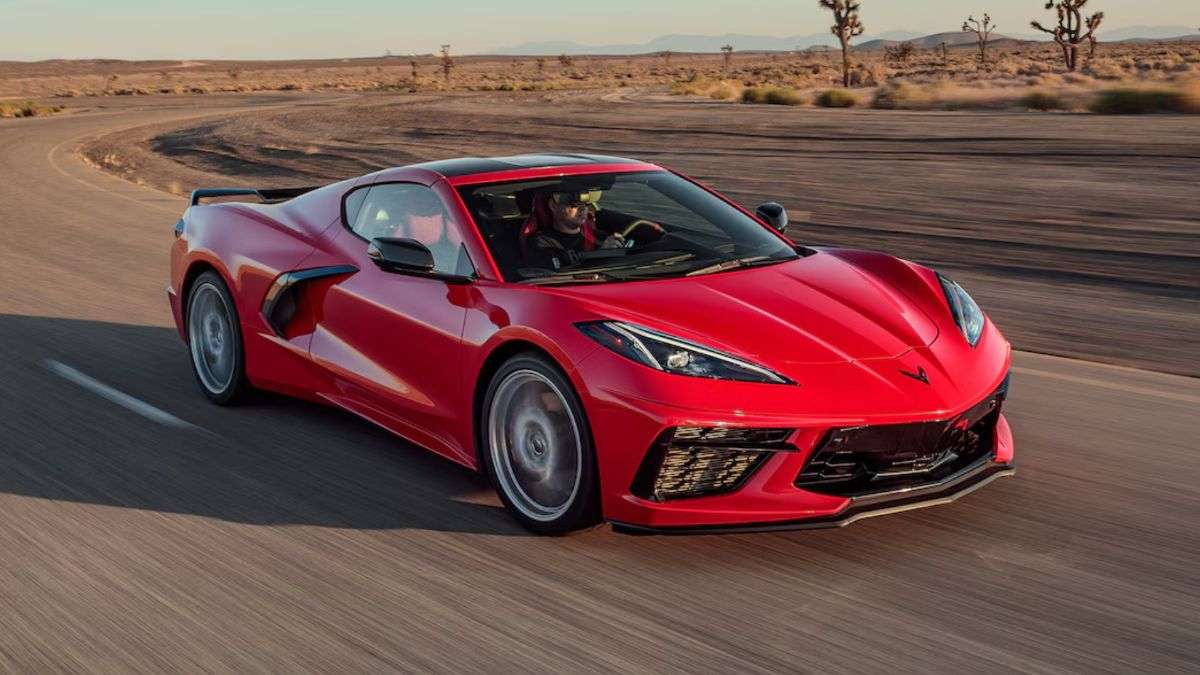

Modern performance cars promise simplicity through technology, but every so often, they remind you how unforgiving that simplicity can be when one assumption breaks.
A recent post in the C8 Corvette Owners group reads like a slow-motion trap closing, one small oversight cascading into a situation that left a mid-engine Stingray completely inaccessible, fully charged, and utterly unusable.
The sequence started innocently enough. A 2023 Corvette Stingray with a very low battery would not crank, but still had enough power to pop the frunk. The owner charged the battery, expecting that to be the end of it. Instead, the car decided to do what modern cars do best when confused: protect itself. The doors auto-locked, even though the only key fob was sitting in the center console cup holder. Suddenly, a running, charged car became a sealed stainless and composite vault.
“23 Stingray. The battery was super low. No crank. Enough juice to open Frunk. Charged battery. My ONLY key fob is in the center console drink tray. Door locks auto-locked (what?). Now can't get in. Fob has a fresh battery. Jacked up the rear of the car and dropped it to shake the remote. No go. Try to open doors, some of the body's electrical wakes up, but no open. Dash screen backlights, but no text on screen. Disconnected / Wait / Reconnected battery...no change.
No OnStar subscription, and they can't subscribe to it when out of the vehicle. The spare fob is unprogrammed and in the glove box. I do have a GM scan tool....
Thoughts?
Remember - I don't have another key.”
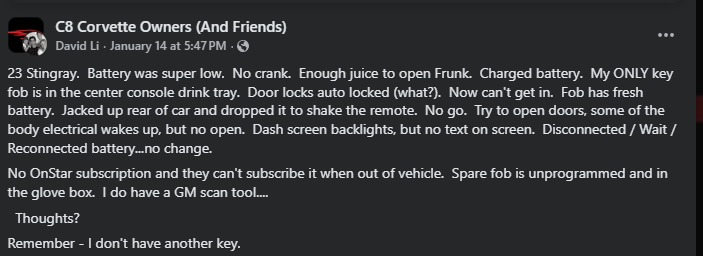
From there, the situation grew increasingly surreal. The fob had a fresh battery. The car would partially wake when a door handle was touched. The dash backlighting would glow, but no text appeared. Disconnecting and reconnecting the battery changed nothing. In a moment that perfectly captures modern desperation, the owner even jacked up the rear of the car and dropped it in hopes the fob might shift enough to be detected. It did not. Technology is many things, but it is not sentimental.
Chevrolet C8 Corvette: Mid-Engine Layout & Cabin Ergonomics
- The mid-engine layout shifts weight rearward, improving traction and corner exit stability while changing the car’s handling balance compared with earlier front-engine Corvettes.
- Cabin ergonomics reflect a cockpit-style approach, with a tall center console separating driver and passenger and emphasizing driver-focused controls over shared space.
- Ride quality varies noticeably by drive mode, allowing the suspension to feel compliant during daily use but significantly firmer when pushed on uneven pavement.
- Forward visibility is strong for a low sports car, though rearward sightlines are constrained by the engine placement and structural buttresses.
The real cruelty was in the details. There was no OnStar subscription active, and OnStar could not be activated remotely without access to the vehicle. The spare fob existed, but it was unprogrammed and locked in the glove box. Even owning a GM scan tool did not help, because the software cannot unlock a door when the car refuses to acknowledge a key. The system had done exactly what it was designed to do, and in doing so, removed every obvious escape route.
The eventual solution was refreshingly old-school. Proof of ownership in hand, the owner went to the local dealer and had a physical hard key cut to the VIN. For $150, including tax, part number 13536119, a simple piece of metal did what encrypted radio signals, apps, and modules could not. The door opened. The fob was retrieved. The car started immediately. Crisis over.
What makes the resolution instructive is what it did not require. The electronic portion of the fob, which would have cost another $220 plus programming, was unnecessary just to regain access. The mechanical backup key, a component many owners forget exists at all, was enough. Once inside, the Corvette behaved as if nothing had ever happened. The frunk closed. The car drove. The drama evaporated.

The comments beneath the post read like a support group for those who have learned similar lessons the hard way. Veterans repeated the same rule with varying degrees of bluntness: never leave a fob in the car. Others shared stories of towing older Corvettes long distances just to have a door unlocked by a service manager with a key cutter. A few pointed out that an unprogrammed fob is still useful if the physical key is cut, a reminder that redundancy still exists if you know where to look.
What this episode really highlights is the fragile confidence modern cars ask of their owners. The Corvette has no traditional door lock cylinder visible from the outside. Its security is absolute until it is not, and when it fails, recovery depends on knowledge rather than force. The systems assume that digital access will always be available, and when it is not, the solution feels archaic by comparison.
There is no villain here. The car did not malfunction in the traditional sense. It followed its logic faithfully. The owner made a reasonable assumption that charging the battery would restore normal operation. The problem was not negligence, but the intersection of automation and edge cases. When those collide, the car stops being a machine and becomes a puzzle.

The takeaway is simple, if slightly humbling. Know where your hard key is. Have it cut. Enable OnStar, even if you never plan to use it. And never assume that because a car is running software, it will always offer a software-based escape hatch. Sometimes, the most advanced performance car in America can be defeated by nothing more than a locked door and a forgotten piece of metal.
The Stingray survived with its dignity intact, and its owner walked away wiser, lighter in the wallet, and very likely unwilling to ever set a key fob down in a cup holder again.
Image Sources: Chevrolet Media Center
Noah Washington is an automotive journalist based in Atlanta, Georgia. He enjoys covering the latest news in the automotive industry and conducting reviews on the latest cars. He has been in the automotive industry since 15 years old and has been featured in prominent automotive news sites. You can reach him on X and LinkedIn for tips and to follow his automotive coverage.
Set Torque News as Preferred Source on Google
Follow us today...






Comments
Gee, if only that owner was…
Permalink
Gee, if only that owner was smart enough to RTFM. GM does provide a key and a way to unlock the car if the battery dies. Don't blame GM for one owner's stupidity.