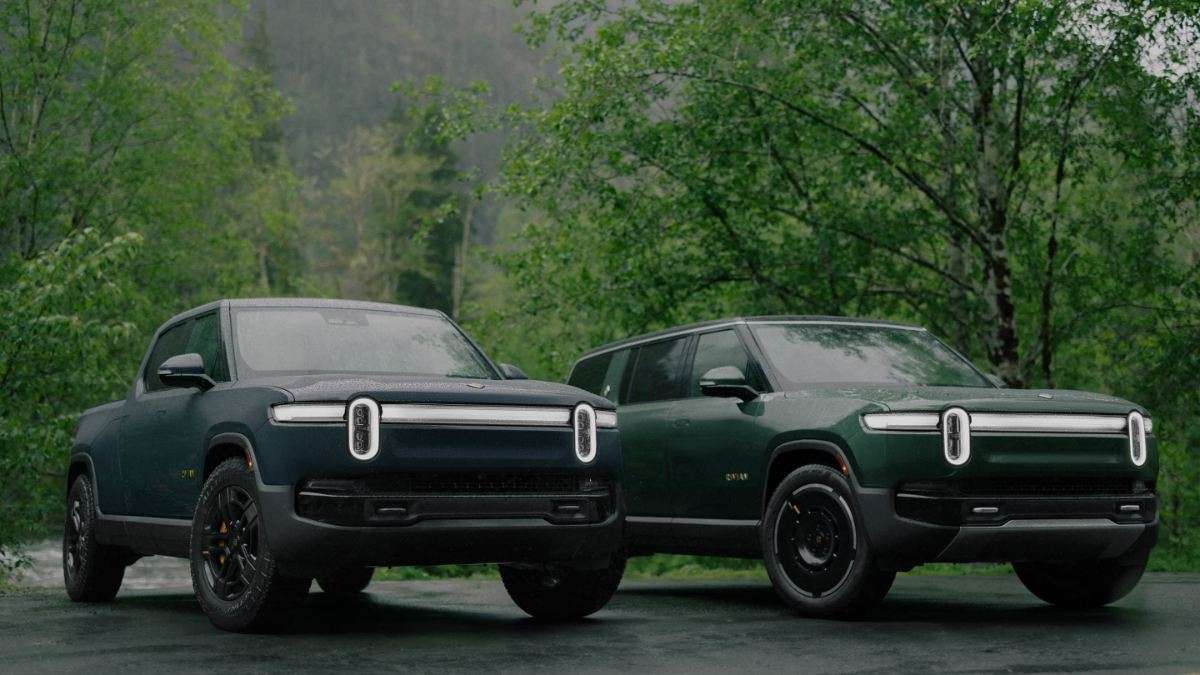

There is something eternal about the American road trip. It is not about horsepower or fuel type but the act itself: packing up, pointing the machine toward the horizon, and seeing what the next few thousand miles have to say. The road trip has always been a test of man and machine, of patience and preparation, and of one’s willingness to get lost and find something better. One Rivian R1S owner recently proved that electrons can carry the same poetry as gasoline.
David Geller took to Facebook to share his experience, and his post read like a dispatch from the modern frontier:
“After owning our R1S for two and a half years, we finally took it on its first long-distance adventure, a 3,000-mile loop from Seattle to Los Angeles, then across Arizona and Utah, before heading home through Idaho and Washington. The R1S performed flawlessly and was an absolute joy to drive. It felt solid and confident at highway speeds, which, these days, seem to be higher than ever.Charging was, for the most part, an excellent experience. Tesla Superchargers were by far our favorites; the compatible ones connected instantly and charged quickly every time. We did have one tense moment in a small town where the Electrify America station was offline and the nearby Tesla Supercharger wasn’t yet compatible, with very little range left, which was nerve-racking. Fortunately, we discovered a Circle K with fully operational Superchargers, and everything worked perfectly from there on out.
The Rivian trip-planning feature was also a standout. It mapped our route flawlessly, guided us to reliable chargers, and truly made the journey smooth and stress-free.”

That 3,000-mile loop reads like an atlas of the West’s greatest hits. From Seattle’s gray skies to Los Angeles’s glow, across Arizona’s endless desert and Utah’s sculpted canyons, then back through Idaho’s mountain air into Washington’s cool green. It’s a drive that reminds you how much the continent still stretches and breathes. The Pacific Coast unfurls like a story you’ve heard but never finished, and by the time you reach Utah, the sky has widened into something that feels closer to space than weather. The R1S carried him across all of it with poise and silence, an electric whisper tracing the same roads once thundered by small-blocks and six-cylinders.
Rivian R2: What Might Be Next
- The R2 is being targeted as a more affordable, mass-market SUV compared with the R1S, sources suggest a starting price around US$45,000, significantly under the R1S.
- Key technical upgrades for the R2 include a new “Maximus” drive unit that has about 40% more power density than the drive units used in the R1 models, as well as new battery cell design and manufacturing simplifications.
- Because the R2 is built with a cost-reduction objective (for example, the company expects R2 production cost to be less than half of that of the R1) that could shift development and manufacturing resources away from the R1S or force pricing/feature changes in the R1S.
- For owners or prospective buyers of the R1S, the arrival of the R2 may impact residual values, update cadence (i.e., what updates the R1S receives), and how the manufacturer positions the R1S (as flagship/high-end) vs. R2 (volume model), meaning the R1S might increasingly be marketed as premium, with the R2 absorbing more of the volume segment.
Geller’s post struck a chord online. The comment section became a digital campfire, alive with stories and small lessons from fellow travelers.

Maury Austin wrote, “I stopped at a Tesla charging station near the Grapevine in LA. Added 20 miles of range for $20. Unplugged and left! A dollar a mile!” It was equal parts surprise and irritation, the voice of someone realizing that even convenience has its costs. Theresa DeBen Capri chimed in with the kind of advice that only comes from miles on the road: “If you are taking a road trip, subscribe to Tesla charging for a month. You will pay for the subscription on the first day. You can cancel when you get home.” It’s the same old ritual, really, veterans passing wisdom to rookies, the camaraderie of travelers who know what it’s like to sweat over a gauge that’s creeping too close to empty.

Not all routes are as forgiving. Katrina Touchet added a reminder that progress still has its blind spots. “It’s only good if you have enough chargers on your route. The route I take multiple times a year to see family can be nerve-racking.” Her comment speaks for every driver who’s ever watched a range estimate shrink faster than the distance to the next stop. Geller replied that he and his passengers “let the car select the route for the whole trip, from point to point. The only challenge was our Kanab, UT, to Boise, ID route. It was beautiful, though!” That single line carries the spirit of the whole story. The challenge and the beauty exist together. That’s the heart of every worthwhile journey.
The low-battery scare Geller described could have come from any era. A century ago, it might have been a dry carburetor in a Wyoming windstorm. In the 1970s, it might have been a gas station closed for the night on Route 66. This time, it was a silent countdown on a digital dashboard in a small town where one network was down and another wasn’t yet ready. Then, the relief of finding a Circle K with working Superchargers was a minor miracle that turned panic into gratitude. That moment, that swing from doubt to triumph, is why people still hit the road.
What’s remarkable isn’t that the technology worked. It’s what enabled something timeless. The R1S became invisible, doing exactly what great road-trip cars have always done: disappear beneath the experience. The hum of the tires and the sweep of the scenery took center stage. The car’s digital trip planner, once just a feature, became the navigator of a seamless odyssey across a region that still rewards anyone willing to go see it.
In the end, Geller’s story is less about electricity and more about endurance, of the road trip itself and of the desire to keep exploring. The Facebook thread that followed his post wasn’t just about charge times or costs. It was about rediscovery, about proving that the spirit of the open road has survived every technological shift.
Image Sources: Rivian Media Center
Noah Washington is an automotive journalist based in Atlanta, Georgia. He enjoys covering the latest news in the automotive industry and conducting reviews on the latest cars. He has been in the automotive industry since 15 years old and has been featured in prominent automotive news sites. You can reach him on X and LinkedIn for tips and to follow his automotive coverage.
Set Torque News as Preferred Source on Google
Follow us today...