
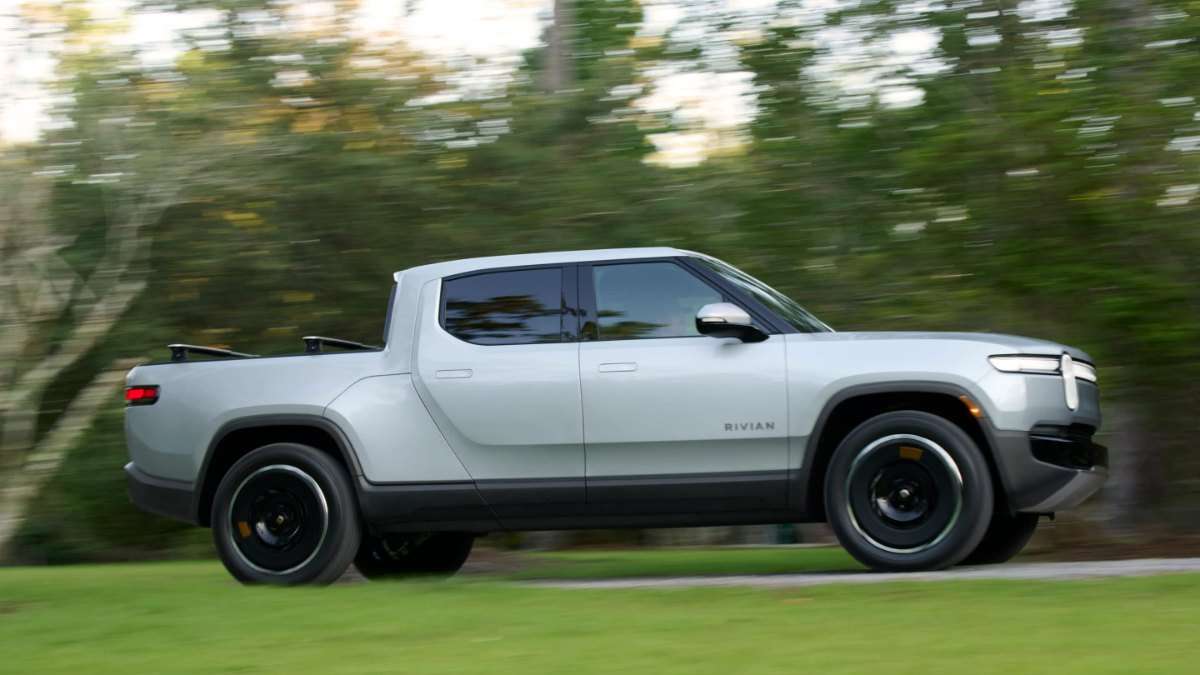

There is a special kind of Rivian driver who does not trust vibes, only numbers. The sort of person who looks at a cross-country vacation and sees not just scenery and fuel receipts, but a rolling experiment in energy management. Harvey Payne is one of those owners. His family’s summer trip in a 2023 Rivian R1T Performance Dual Motor Max Pack, camper in tow, wound through a dozen states and turned into something more than a simple escape. It became data, plotted against miles and kilowatts, and it led him to a conclusion that cuts through a lot of internet mythology about fast charging: across Tesla, Rivian Adventure Network, ChargePoint, and Electrify America, he found peak speeds clustered within a few kilowatts of each other and charging curves that mattered far more than any single headline number.
“In discussing road trips, I've seen some say to avoid Tesla because it is too slow. I haven't noticed such, but did just do a big road trip this summer through a dozen states pulling our camper. On that trip, we certainly did a lot of campground charging, charging at friends and family, and a little L2 at public and destination venues. A little less than 1/2 the kWh charged on the trip was at 41 DCFC sessions. 21 Tesla Superchargers, 10 Rivian Adventure Network, 8 ChargePoint, and 2 Electrify America sessions.
I have an ElectraFi account that logs all my sessions (so long as I have a signal). I thought it might be interesting to compare my sessions to see if there was any truth to Tesla being slower. I downloaded each session, loaded it into a spreadsheet, and made the attached scatter chart. This shows charging speed in kW vs the current state of charge. The fuller the battery gets, the slower it charges -- on all EVs. Often it isn't the peak speed everyone seems to be interested in -- it's the curve. I don't need to charge at 250 kW for 3 seconds if it will drop the curve to sub-100 before the first minute is over, for example.
Anyway -- sorry for the eye chart. Every session is on there. I skipped the start of the charge ramping up and the end, where it got to the set limit and dropped to zero. I also cut out the middle of a couple of RAN charges when the charger errored out. This would be a concern, but they pushed an update that fixed the bug, so I didn't include this data. It was a pain at the time to deal with. I got a notification on my phone, and it had stopped. I had to leave my unfinished meal behind with my wife to guard it from the busboy, walk across the parking lot, unplug and replug to restart the session, then walk back across the parking lot, back into the restaurant to finish my meal. But I digress.
Some of the Tesla sessions were from V3 superchargers and some from the V3 with V4 dispensers. The V3 may indeed drop the curve a bit because Rivian wants to draw more power for a longer period than a Tesla. In the chart, I'd bet that the lower Tesla trend was the V3 dispensers, while the upper curve was the V4.
The ChargePoint chargers were a mix, as they are, of various power levels. I think the fastest ran right around 160 kW or so, and the slowest was only 62.5 kW.
I had only two EA sessions -- one on a 350 kW charger and the other on a 150 kW charger. You can find the green dots in there somewhere. Note the very fastest speed of the whole trip was 208.9 kW at an EA station -- so there's that.
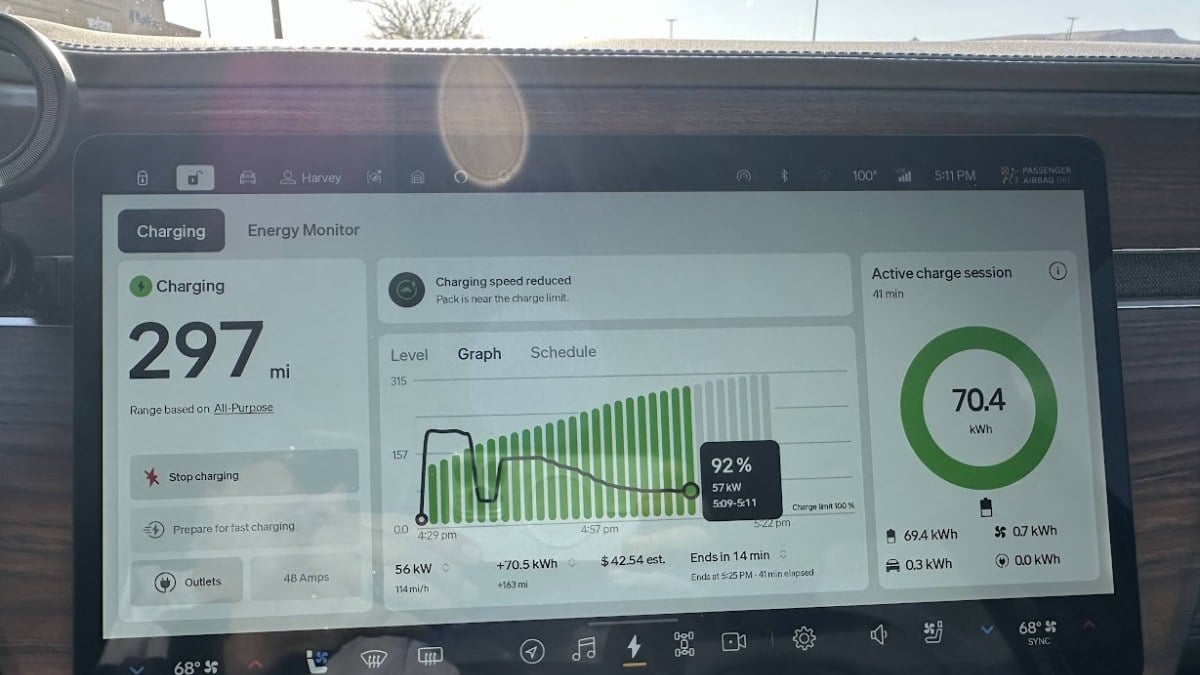
The RAN generally did fine except for the two noted crashes above. Supposedly, that was a software glitch that's been fixed. Those sessions did happen early, and I did apply an update while on the trip that seemed to have fixed it. The very last session of the whole trip was a RAN charge that was funky --- and shown on the graph in those dots along the 50 kW line. I've included the screenshot reported by the truck for that session and also the graph, which definitely looks different, reported by ElectraFi. It was 100 degrees outside, and as typical, the RAN didn't have any shade. This wasn't my first 100+ temperature charge of the trip -- it was pretty common, actually, in the southern states.
Advertising
For the sake of completeness, the fastest the RAN ever did was 206.8. The fastest for Tesla was 208.5. I already mentioned EA won at 208.9, and ChargePoint was way back at 152.9.
You'll notice the lowest we ever got was 9.6 kW. I'm sure Kyle Conner and the Out of Spec team are disappointed in me, but I can live with that burden. We did push it up to full on several occasions, and honestly, that was usually because we weren't ready to leave yet, and I like to take every opportunity to charge. The fact that I'm still pulling 34 kW at 99% full is amazing to me. Pulling 100 kW at almost 80% full is pretty amazing, ng too.
This was all with our Gen11 2023 Rivian R1T Performance Dual Motor Max Pack. Most fast charges were with the trailer still hooked up. We never had to drop once to charge on the trip -- but maybe once we should have. A few sessions were when we were already set up at camp, and we needed a boost.”
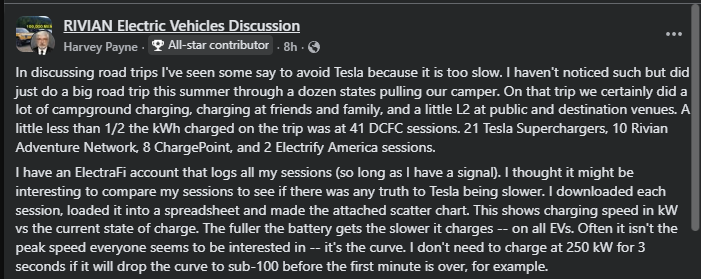
ElectraFi logged sessions, a spreadsheet sorted them, and a scatter chart turned the journey into a portrait of modern DC fast charging. What Payne found, once he trimmed the noise off the ramps and the zeroed-out tails, was a near photo finish across the major networks. Electrify America set the trip record at 208.9 kW, with Rivian Adventure Network close behind at 206.8 and Tesla peaking at 208.5, while ChargePoint topped out at 152.9 on its best day and dipped into the 60s at its laziest. The interesting part was not that one logo edged out another on a good cable with a cool battery. It was that in repeated real-world use, with a trailer hanging on the hitch, they all played in broadly the same league. More revealing still, his truck could still take 100 kW near 80 percent state of charge and 34 kW at 99 percent. For a driver who likes to do the math, that is gold. It means top-offs you can plan around instead of long flat spots on the curve that trap you at the charger while your food gets cold.
Rivian R1T: What The Owners Say
- Owners consistently praise the refined ride quality, saying the air suspension and quiet cabin make it feel more like a luxury SUV than a pickup.
- Many R1T drivers highlight the truck’s confidence-inspiring off-road performance, reporting that it handles snow, trails, and steep grades with ease.
- Rivian owners often emphasize the thoughtful utility features, like the Gear Tunnel and built-in air compressor, which they say make daily use and adventures more convenient.
- Testimonials frequently mention responsive and friendly customer service, with mobile service visits resolving issues quickly.
The post hit the RIVIAN Electric Vehicles Discussion group like a well-written road test. Other owners recognized a fellow traveler who had turned his family vacation into a field study. “Thanks for the data!” wrote Phil Nwafor, fresh off his own 1,500-mile run and wishing he had been as methodical. Phil’s take sharpened the point. The real advice, he argued, is not to avoid any one network, but not to over-index on a single solution. On his latest long day behind the wheel, he logged eight charging stops on the busiest travel day of the year and did not wait once for an open stall. In his view, newer installations from Electrify America, GM-backed sites, and the coming Ionion network can hold higher power deeper into the state of charge curve on certain routes, while some Superchargers still shine in others. The important thing, he said, is that the conversation has changed from scarcity to choice in only a few years.
That shift was reflected in the rest of the comment thread, which read like a cross between a campfire debrief and a technical Q&A. Lee Isselhardt wanted hard numbers on how many campgrounds allowed the Rivian to plug in and what kind of range Payne saw while towing. Those are not academic questions when you are dragging a camper across hot southern interstates. They are the equations that govern whether you arrive at a campsite with a comfortable buffer or a nervous glance at the state of charge screen. Rivian owners, it turns out, tend to enjoy this kind of arithmetic. Campground voltage, trailer weight, wind, elevation, charging curve, and battery preconditioning all fold into trip planning the way fuel range calculations did for generations of truck and RV drivers before them.
There was also the perspective of someone on the cusp of joining this club of traveling statisticians. “We take delivery of our R1T Dual Max on Saturday,” wrote Roger Klemm, who has been living the electric life in BMW i3s for a decade and was looking forward to seeing more than 50 kW on a charger and more than 150 miles of range on the dash. Payne replied with a story about a friend who loved his i3 so much that when he heard production was ending, he traded his in on a new one to keep the experience going. That exchange bridged the early era of compact city EVs and the current wave of adventure-oriented trucks. The common thread is a kind of quiet, serious enthusiasm, a willingness to adapt, and a habit of turning lived experience into data other drivers can actually use. In the background, another commenter, Tim Higham, simply called it “great” and an “awesome share,” which in its own way is a recognition that good field work is valuable.
For all the charts and careful analysis, some of the most vivid parts of Payne’s story are the moments where life barged in on the experiment. When a Rivian Adventure Network unit glitched and stopped mid-session, his phone lit up, the food was still on the table, and the busboy was circling. He left his wife to guard the meal, walked across a hot parking lot in 100-degree heat, reset the session with an unplug and replug, then trudged back to finish dinner. That sort of episode would have been a trip-killing disaster in the very early days of public charging. In this case, it was an annoyance that got logged, sorted, and then fixed by a software update pushed during the same journey. The last RAN session misbehaved in a different way and showed up as dots along a 50 kW line on his chart, likely influenced by heat and hardware limits in an unshaded site. As frustrating as it can be in the moment, this is what front-line development looks like: fixes that arrive over the air while the truck is still dusty from the road.
Take a step back from the individual sessions, and what emerges is a picture of a maturing ecosystem. A 12-state tow across hot southern highways, with a camper hooked up for most of the fast charges, no need to drop the trailer, and only one real logistical hiccup is not a stunt. It is a proof of concept that this kind of travel has become practical. The peaks in his log are interesting, but the real story is the consistency. When a truck can hold triple-digit kilowatt rates well into the upper reaches of the battery and still accept useful power near full, it changes how families plan their days. You can charge while you eat, walk the dog, or check in at the campground, and trust that the time is buying real range instead of trickling in a few extra miles.
Payne’s journey did exactly what good road trips have always done. It revealed a bit about the country and a bit about the machine carrying you through it. The lesson was not that one charging brand is the hero and another the villain. It was that, for a careful driver willing to do the math, the modern network of Tesla Superchargers, Rivian Adventure Network sites, Electrify America stations, and ChargePoint locations can work together to support serious travel, even with a trailer, even in punishing heat. The special discovery here is that the conversation among owners has evolved into something pragmatic and encouraging. They are no longer asking if this is possible. They are trading scatter plots and campground tips, choosing among viable options, and quietly rewriting what an American road trip looks like on a spreadsheet.
Image Sources: Rivian Media Center
Noah Washington is an automotive journalist based in Atlanta, Georgia. He enjoys covering the latest news in the automotive industry and conducting reviews on the latest cars. He has been in the automotive industry since 15 years old and has been featured in prominent automotive news sites. You can reach him on X and LinkedIn for tips and to follow his automotive coverage.
Set Torque News as Preferred Source on Google
Follow us today...




Comments
Well with a gas vehicle you…
Permalink
Well with a gas vehicle you just put gas in and go you don't have to wait and plan and wait and wait the one thing you can't get back is your time, time is a lot more valuable than electricity.