
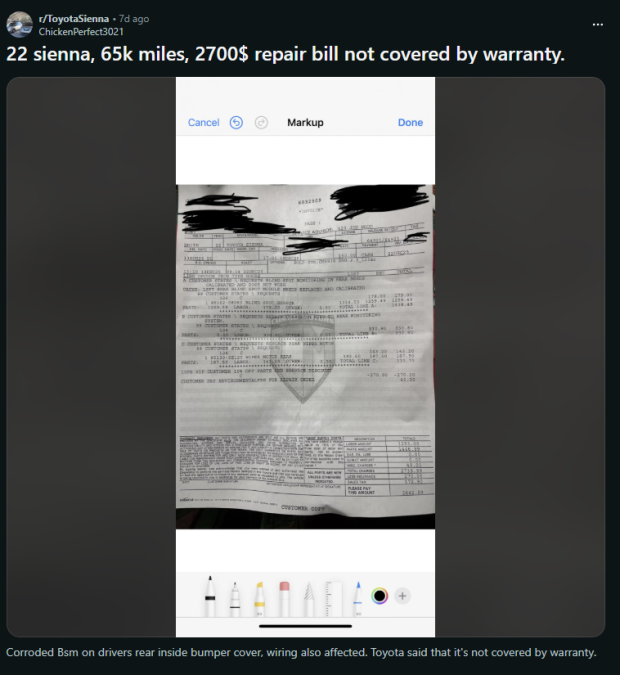
A $2,700 repair bill on a three-year-old minivan is the kind of thing that makes owners question not just their warranty coverage, but the broader reality of modern vehicle ownership. That is exactly what prompted a 2022 Toyota Sienna owner with 65,000 miles to post their experience to r/ToyotaSienna, after learning that a significant repair related to the blind spot monitoring system would not be covered by warranty. The invoice, dense with labor lines and parts codes, tells a story that is becoming increasingly familiar.
At the center of the repair is corrosion in the driver-side rear blind spot monitoring module, located behind the bumper cover. According to the service documentation, the corrosion extended beyond the sensor itself and into the associated wiring, triggering a cascade of faults. The result was not just a disabled safety feature, but persistent dashboard warnings and alerts that made living without the system difficult, especially for a family vehicle intended to be calm and unobtrusive.
“Corroded Bsm on drivers rear inside bumper cover, wiring also affected. Toyota said that it's not covered by warranty.”
The warranty denial, while frustrating, is not unusual. Toyota’s basic warranty expires at three years or 36,000 miles, and blind spot monitoring systems fall outside the scope of the longer powertrain coverage. Several commenters correctly pointed out that, from a contractual standpoint, Toyota is on solid ground. That does little to soften the blow for an owner staring at a repair bill that rivals the cost of a major mechanical failure.
Toyota Sienna: Hybrid Efficiency, Passenger Comfort, and Family Accessibility
- The Sienna’s standard hybrid drivetrain focuses on efficiency and smooth operation, delivering predictable power suited to family transport rather than quick acceleration.
- Interior packaging emphasizes passenger comfort, with sliding doors and a low step-in height improving accessibility across all three rows.
- The second-row seating layout supports long-distance travel, though seat removal flexibility is more limited than in older minivan designs.
- Ride tuning favors stability and quiet operation, filtering road noise effectively while maintaining composure under full passenger loads.
What stands out in the invoice is how quickly costs accumulate once electronics and labor converge. Roughly $2,400 of the total bill is tied directly to the rear blind spot monitoring system, including parts replacement, calibration, and labor. This is not a simple sensor swap. Modern driver-assistance systems require precise alignment and calibration after replacement, adding time and cost that cannot be skipped without compromising functionality.
Some commenters suggested living without the system entirely, a reasonable thought in theory. In practice, as the owner later explained, the constant warning lights and alerts made that option untenable. This highlights an uncomfortable truth about modern vehicles: many features are no longer optional once installed. Even if a driver is willing to forgo a system, the car itself often refuses to let the issue fade quietly into the background.
There was also brief speculation about whether the issue might be related to a recent Toyota recall. That hope was quickly extinguished when other users clarified that the recall in question was software-only and unrelated to physical corrosion or wiring damage. Software updates are cheap. Corroded hardware is not.
Corrosion itself raises harder questions. A rear bumper location exposes sensors and wiring to moisture, road salt, and debris, especially in colder climates. While manufacturers design these systems to withstand normal exposure, real-world conditions can be harsher than laboratory assumptions. When corrosion appears this early in a vehicle’s life, owners naturally wonder whether the line between environmental damage and design vulnerability is as clear as warranty language suggests.
The broader takeaway is not that the Sienna is unreliable or that Toyota is uniquely at fault. Rather, it is a reminder that modern vehicles increasingly concentrate value and risk in electronic systems that are expensive to diagnose and repair once they fall outside warranty coverage. A minivan that remains mechanically sound can still generate a four-figure repair bill from a single compromised module.
For owners facing similar situations, the advice offered in the thread remains sound. Getting a second opinion can help validate the diagnosis and pricing, and in some cases, Toyota goodwill assistance may still be possible, even outside the formal warranty window. But as this invoice makes clear, modern vehicle ownership requires a recalibrated sense of what “normal” repair costs look like. The days when expensive bills were reserved for engines and transmissions are over. Today, a sensor behind a bumper can do just as much damage to the household budget.
Image Sources: Toyota Media Center
Noah Washington is an automotive journalist based in Atlanta, Georgia. He enjoys covering the latest news in the automotive industry and conducting reviews on the latest cars. He has been in the automotive industry since 15 years old and has been featured in prominent automotive news sites. You can reach him on X and LinkedIn for tips and to follow his automotive coverage.
Set Torque News as Preferred Source on Google
Follow us today...