
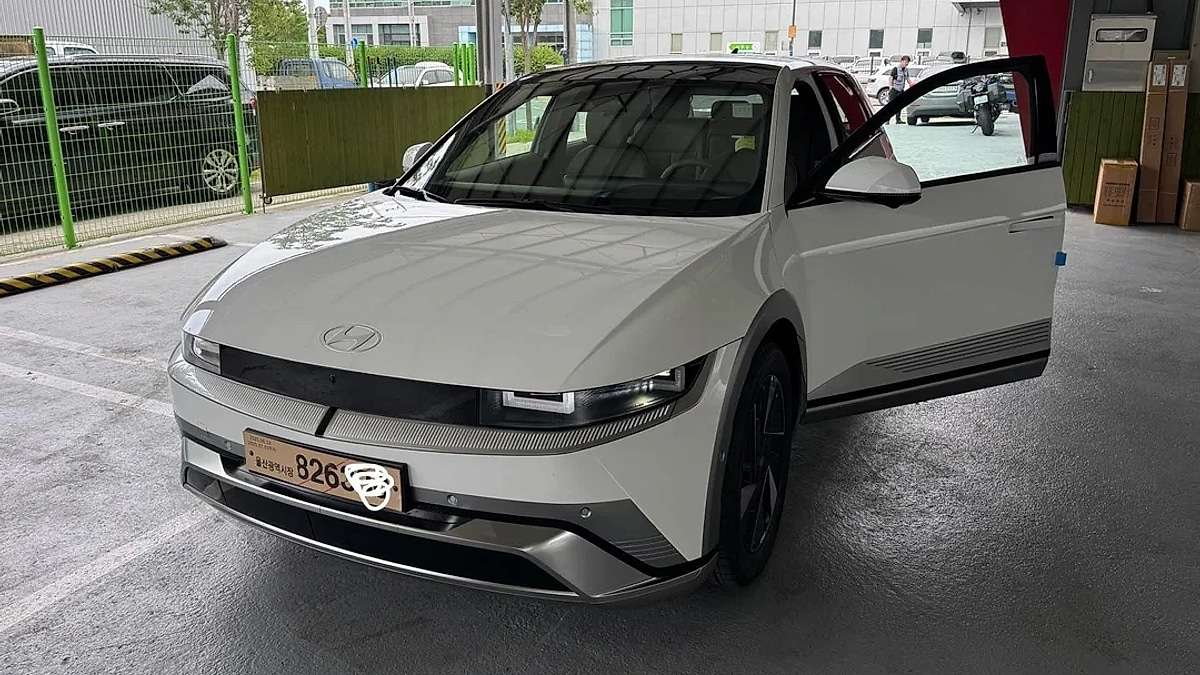

Joongyu_hyundai did not set out to produce a data set. He set out to drive his new Hyundai Ioniq 5. Nine months and roughly 12,400 miles later, he has accumulated one of the more useful real-world efficiency logs published by an owner, complete with seasonal variation, charging cost calculations, and a blunt assessment of what extreme Korean weather does to range.
He took delivery in July 2025. His commute and weekend trips have covered enough distance to expose the vehicle to summer heat that touches 104 degrees Fahrenheit, winter cold that drops to minus 4 degrees, and the moderate temperatures of spring that produce the best results. The numbers move enough across those conditions that any buyer doing total-cost-of-ownership math should pay attention.
The Efficiency Spread: From 5.6 Miles per kWh Down to 3.1
In spring driving, Joongyu_hyundai reports achieving approximately 4.35 miles per kilowatt-hour under normal driving. When he drives more conservatively, that figure climbs to about 5.6 miles per kilowatt-hour.
Those are strong numbers for a vehicle the size and weight of the Ioniq 5. The EPA rates the US-market 2024 Ioniq 5 at between 3.3 and 3.6 miles per kilowatt-hour, depending on trim and drivetrain. Joongyu_hyundai's efficient-driving result of 5.6 miles per kilowatt-hour sits well above the official American estimate, and even his normal spring figure of 4.35 exceeds the EPA combined rating.

The winter picture is different. In the coldest Korean conditions, with temperatures dropping to roughly minus 4 degrees Fahrenheit, efficiency falls to about 3.1 miles per kilowatt-hour. That represents a drop of roughly 29 percent from his normal spring figure and 45 percent from his most efficient driving.
Those seasonal swings are not unique to the Ioniq 5. Every battery electric vehicle loses range in extreme cold because lithium-ion battery chemistry slows at low temperatures, cabin heating draws substantial power, and winter tires increase rolling resistance. What makes Joongyu_hyundai's data useful is that it quantifies the drop for one specific driver over a full annual cycle in a climate with genuine extremes.
Another owner in the same thread, joonee1988, reported averaging 3.23 miles per kilowatt-hour while driving what they described as spiritedly. That figure aligns closely with Joongyu_hyundai's winter low, suggesting that driving style and ambient temperature can produce roughly equivalent efficiency penalties.
The Cost Reality: 3.4 Cents to 6.9 Cents per Mile
South Korea's electricity rates for EV charging are notably lower than what most American drivers encounter at public fast chargers. Joongyu_hyundai reports paying approximately 19 cents per kilowatt-hour for slow charging and about 22 cents per kilowatt-hour for fast charging.
Those rates produce the following cost-per-mile figures:
- Normal spring driving at 4.35 miles per kilowatt-hour: approximately 4.4 to 5.0 cents per mile
- Efficient driving at 5.6 miles per kilowatt-hour: approximately 3.4 cents per mile
- Extreme winter at 3.1 miles per kilowatt-hour: approximately 6.1 to 6.9 cents per mile
For context, a gasoline vehicle averaging 30 miles per gallon at current US fuel prices of roughly $3.20 per gallon costs about 10.7 cents per mile in fuel alone. Even Joongyu_hyundai's worst-case winter EV cost of 6.9 cents per mile undercuts that gasoline equivalent by roughly 36 percent. In optimal conditions, the Ioniq 5 costs about one-third as much per mile as the 30-mpg gasoline benchmark.
A commenter from Germany, ununtot, added a useful international comparison. After 10 months and 4,703 miles in an Ioniq 5, they report paying 7.60 euros per 62 miles, with actual energy consumption of 33.3 kilowatt-hours per 100 miles. The onboard computer showed 29.6 kilowatt-hours per 100 miles, meaning the car's own display understated actual consumption by about 12 percent. That discrepancy between displayed and actual consumption is worth tracking for any owner doing their own cost calculations.
Charging Speed: 20 to 80 Percent in 18 Minutes
Joongyu_hyundai's charging experience reflects a market reality that Korean EV owners enjoy, but many American drivers still lack. He reports that charging from 20 to 80 percent state of charge takes about 18 minutes in real-world conditions, a figure that matches what Hyundai advertises for the Ioniq 5's 800-volt electrical architecture.
The 800-volt system, shared across Hyundai, Kia, and Genesis electric vehicles built on the E-GMP platform, allows the Ioniq 5 to accept charging speeds up to roughly 230 kilowatts under ideal conditions. That architecture is what enables the sub-20-minute 20-to-80 percent charging sessions that Joongyu_hyundai describes as routine.
He also notes that charging infrastructure in Korea is well developed, particularly along highway corridors, making long-distance trips manageable. Korea has invested aggressively in DC fast charging along its expressway network, and the country's smaller geographic size compared with the United States means that even modest-range EVs can cover most intercity routes without anxiety. The Ioniq 5's combination of fast charging speed and reasonable efficiency makes it particularly well-suited to that environment.
The ICCU Question
One commenter, MaddHavikk, raised the issue that has shadowed Hyundai and Kia electric vehicles in owner communities worldwide: the integrated charging control unit, or ICCU. The component, which manages the flow of electricity between the battery, the charging port, and the vehicle's 12-volt electrical system, has been the subject of multiple owner reports of failure across several Hyundai and Kia EV models.
Joongyu_hyundai addressed the concern directly. He wrote that he has seen many ICCU cases discussed in Korean online communities, but that most real-world owners around him have not experienced problems, particularly those with facelift model year vehicles. He added that in Korea, when an ICCU does fail, dealers typically repair it the same day and provide a rental car, which reduces the practical inconvenience.
The ICCU issue is documented across multiple owner forums and social media platforms, but the failure rate remains difficult to quantify from publicly available data. Manufacturer service campaigns for ICCU-related issues have varied by market and model year, and prospective buyers should check current NHTSA filings and manufacturer service bulletins for the most up-to-date information. Joongyu_hyundai's experience suggests that the concern may be more visible in online discussion than prevalent in daily use, though the geographic variation in dealer response time matters.
What Korea Gets That America Does Not
The discussion also touched on market-specific equipment. One commenter, Marshmallatonin, expressed admiration for the beige interior shown in Joongyu_hyundai's photos and noted that the color is not available in the US market. Another user, CaramelDays, asked whether the beige interior was a special edition, which prompted speculation about a Disney-themed Limited trim for the 2026 model year.
Commenter MPR_255 asked directly what features the Korean market receives that American buyers do not. Joongyu_hyundai did not provide a comprehensive answer, but the beige interior and potential Disney edition trim suggest that Hyundai continues to reserve certain aesthetic options for its domestic market.
Ownership Verdict: Fast Charging and Solid Efficiency
Joongyu_hyundai's overall assessment is positive. He identifies fast charging capability and solid efficiency as the two biggest strengths of his ownership experience so far. The single downside he acknowledges is the winter efficiency drop, which he considers significant enough to mention but not severe enough to diminish his overall satisfaction.

Fellow Korean owner joonee1988, who took delivery in August 2025, offered a similar endorsement. They wrote that the Ioniq 5 is their favorite vehicle among everything they have driven, particularly in what they described as an era of high fuel prices. That comment confirms the economic logic that continues to drive EV adoption in markets where electricity is cheap relative to gasoline.
The data set Joongyu_hyundai has compiled is more valuable than a typical owner review because it spans a full seasonal cycle, includes specific cost calculations, and quantifies the difference between efficient and normal driving styles. For any prospective Ioniq 5 buyer, particularly one in a climate with cold winters, the spread from 3.4 cents per mile in ideal conditions to 6.9 cents per mile in winter extremes provides a realistic envelope for operating costs.
What Prospective Buyers Should Track
Joongyu_hyundai's experience suggests three specific metrics that matter for Ioniq 5 ownership:
First, seasonal efficiency variation. Buyers in cold climates should budget for a 25 to 45 percent efficiency reduction in winter months, which directly increases cost per mile and reduces available range on a single charge.
Second, real versus displayed consumption. The German owner ununtot found a 12 percent gap between the car's onboard readout and actual energy consumed, which can distort cost calculations if owners rely solely on the dashboard display.
Third, charging speed consistency. Joongyu_hyundai's 18-minute 20-to-80 percent figure is achievable on high-power chargers, but charging speed depends heavily on station power output, battery temperature, and state of charge. The 800-volt architecture helps, but real-world charging times still vary.
For buyers comparing the Ioniq 5 to gasoline alternatives, the math remains favorable even at the worst-case winter figure. At 6.9 cents per mile, the Ioniq 5 still undercuts most comparable gasoline crossovers by a meaningful margin, and in spring and summer conditions, the gap widens substantially. The 12,400-mile data set from Korea confirms what many EV owners already suspect: the efficiency advantage is real, but it is not constant across all conditions.
About The Author
Noah Washington is an automotive journalist based in Atlanta, Georgia, covering sports cars, luxury vehicles, and performance culture. His reporting focuses on explaining the engineering, design philosophy, and real-world ownership experience behind modern vehicles.
Noah has been immersed in the automotive world since his early teens, attending industry events and following the enthusiast communities that shape how cars are built and driven today. His work blends industry insight with enthusiastic storytelling, helping readers understand not just what a car is, but why it matters.
Noah is also a member of the Southeast Automotive Media Association (SAMA), a professional organization for automotive journalists and industry media in the Southeast.
His coverage regularly explores sports cars, luxury vehicles, and performance-driven segments of the automotive industry, including the evolving culture surrounding Formula Drift and enthusiast builds.
Read more of Noah's work on his author profile page.
You can also follow Noah here:
Set Torque News as Preferred Source on Google
Follow us today...






