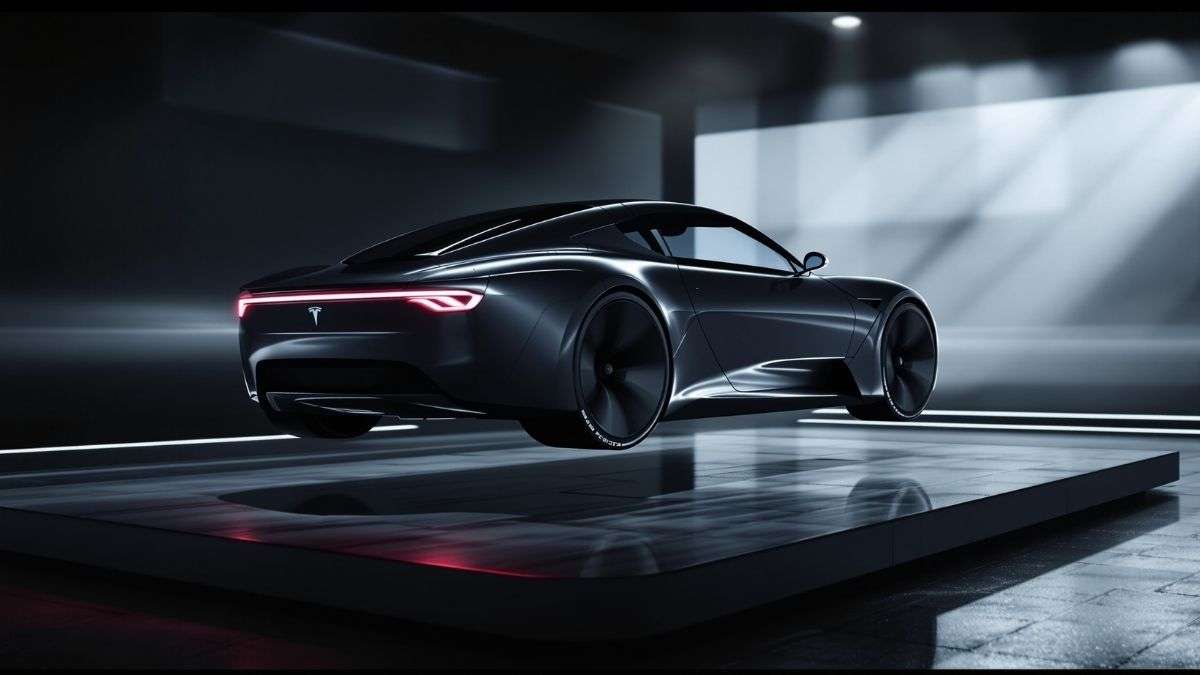

Elon Musk is at it again. Just when the conversation around Tesla seems to be normalizing—focusing on production targets, charging networks, and the (still-not-quite-here) Cybertruck—he hijacks the narrative. This time, he didn't just promise a new feature; he promised a new dimension.
Speaking on a recent podcast, Musk teased a new Tesla prototype to be unveiled before the end of the year, a machine he claims is “crazier than if you took all the James Bond cars and combined them.” He even questioned if it qualifies as a "car" at all. The implication, which the internet has greedily consumed, is that after 100 years of science fiction, Elon Musk is finally delivering the flying car.
This is, of course, an electrifying idea. It’s also, in all likelihood, a masterful piece of misdirection. Before we all start saving up for a pilot’s license, we need to ask a simple question: Is this a genuine engineering breakthrough, or is it the most audacious hype-building exercise in automotive history?
Crazier Than Q Branch
Musk’s choice of words is, as always, deliberate. The "James Bond" quote is not an engineering spec; it’s a marketing masterstroke. It immediately conjures images of the 1977 Lotus Esprit from The Spy Who Loved Me—a car that drove off a pier, retracted its wheels, and became a submarine. It’s a reference designed to evoke a sense of childlike wonder and techno-fantasy.
But Bond’s gadgets were movie magic. In the real world, building a car that is also a submarine is a terrible compromise; you get a bad car and a worse boat. The same physics applies to the air. A "flying car" is a vehicle that has to lug around the dead weight of a propulsion system (rotors, wings, or in this case, thrusters) while on the ground, and the dead weight of a car's chassis (wheels, suspension, crash structures) while in the air.
By setting this fantastical benchmark, Musk gives himself cover. If the final product "only" hovers for three seconds, he can still claim it’s "crazier than Bond," because no Bond car ever actually flew with rocket boosters. It’s a marketing goal, not a practical one.
The Ghost of Roadster Past
This "new" concept isn't entirely new. It sounds suspiciously like the final, mythical form of a product we were promised eight years ago: the second-generation Tesla Roadster.
When the Roadster was first unveiled in 2017, it came with Earth-shattering (and still unproven) specs: 0-60 in 1.9 seconds, a 620-mile range, and a 2020 delivery date. Even more outlandish was the "SpaceX package," a future option that would replace the back seats with a high-pressure composite-overwrapped pressure vessel (COPV) and a series of SpaceX cold-gas thrusters.
At the time, Musk claimed these thrusters would unlock a 0-60 time of 1.1 seconds. He also, almost as an aside, tweeted that it "might even allow a Tesla to fly."
It seems we've now circled back to that “might.” This isn't a "flying car" so much as it is the Roadster (SpaceX Edition). The technology—cold gas thrusters—is very real. SpaceX uses them for attitude control on its Dragon capsules. They work by expelling pressurized gas (like nitrogen) at high speed. They are simple, reliable, and powerful for short bursts.
But they are not a source of sustained flight. They are incredibly inefficient, a "con" to their "pro" of simplicity. To lift a 4,000-pound car for even a minute would require a massive and impossibly heavy tank of propellant. What they can do is provide immense, short-duration bursts of thrust—enough to make a car jump, hover for a few seconds, or achieve acceleration that would liquefy your internal organs.
Hype, Hot Air, or Cold Gas?
So, is this real? Yes, but it depends on your definition. The technology is real. The likelihood of it being integrated into a car is real. The idea that it will be a "viable" form of transport is pure fantasy.
Musk’s genius is in conflating an engineering demonstration with a consumer product. He has a history of doing this. Full Self-Driving has been "feature complete" and "a year away" since 2016. The Tesla Bot debuted with a person in a spandex suit. The Cybertruck's "armor glass" shattered.
This flying car is the ultimate hype product. The engineering challenges are monumental, but the regulatory ones are a vertical brick wall.
The Federal Aviation Administration (FAA) is just now creating a framework for "powered-lift" aircraft, a category designed for the flock of eVTOL (electric Vertical Take-Off and Landing) "air taxis" being developed by companies like Joby and Wisk. These are, for all intents and purposes, quiet electric helicopters. They are managed by a new "vertiport" infrastructure and will be flown by professional, licensed pilots in specific air corridors.
What the FAA does not have a category for is a 4,000-pound sports car with rocket engines strapped to it being "driven" by a civilian. Where would you take off? A highway? That’s illegal. A driveway? The noise would shatter windows, and the thrust would be a guillotine for any passing pedestrian or curious pet. As other flying car hopefuls have found, you can't just bypass physics and law. You need a pilot's license. You need a flight plan. You need to operate from an airport.
This "car" would be, at best, a track-day toy for billionaires, confined to private airfields. It is not, in any conceivable future, a solution to your morning commute.
A Prototype by Christmas?
This brings us to the "prototype by year-end" claim. This is perhaps the most believable part of the whole story, precisely because it’s paired with the ominous qualifier: "unforgettable, whether it's good or bad."
We’ve seen this movie. The Cybertruck reveal was unforgettable. The shattered glass was, in its own way, "bad." Musk has set the stage for a spectacular demonstration that could easily go "wrong" in a way that only generates more headlines.
So, what will we see in this imminent "unforgettable" demo? My money is on a new-body Roadster, strapped to the floor of a stage. With the press of a button, it will fire its thrusters in a deafening, fog-machine-fueled blast, and "hover" six inches off the ground, held in place by very visible, very necessary tethers. Or perhaps, in a moment of pure showmanship, it will make a 20-foot "hop" from one platform to another.
It will be absurd. It will be amazing. And it will be all over the internet for weeks.
Wrapping Up
The flying Tesla is the perfect Elon Musk product: 10% plausible engineering, 90% audacious marketing, and 100% cultural spectacle. It is not "viable" in any practical sense, and it won't be "anytime soon." The regulatory, safety, and infrastructure hurdles are exponentially greater than the technical ones.
This is not a product. It’s a statement. It’s a challenge to the engineers at SpaceX and Tesla to do something ridiculous, and it’s a challenge to the world to stop talking about the competition and look at what he's doing.
Is it real? It’s a "real" engineering project, likely in the form of the long-delayed Roadster. But it's not a real transportation solution. It’s a hype-building exercise to remind us that while other companies are building better cars, Musk is, at least in his imagination, still building James Bond gadgets. And to be honest, it’s a lot more fun to talk about. Just don’t hold your breath, or your deposit.
Disclosure: Images rendered by Artlist.io
Rob Enderle is a technology analyst at Torque News who covers automotive technology and battery developments. You can learn more about Rob on Wikipedia and follow his articles on Forbes, X, and LinkedIn.
Set Torque News as Preferred Source on Google
Follow us today...