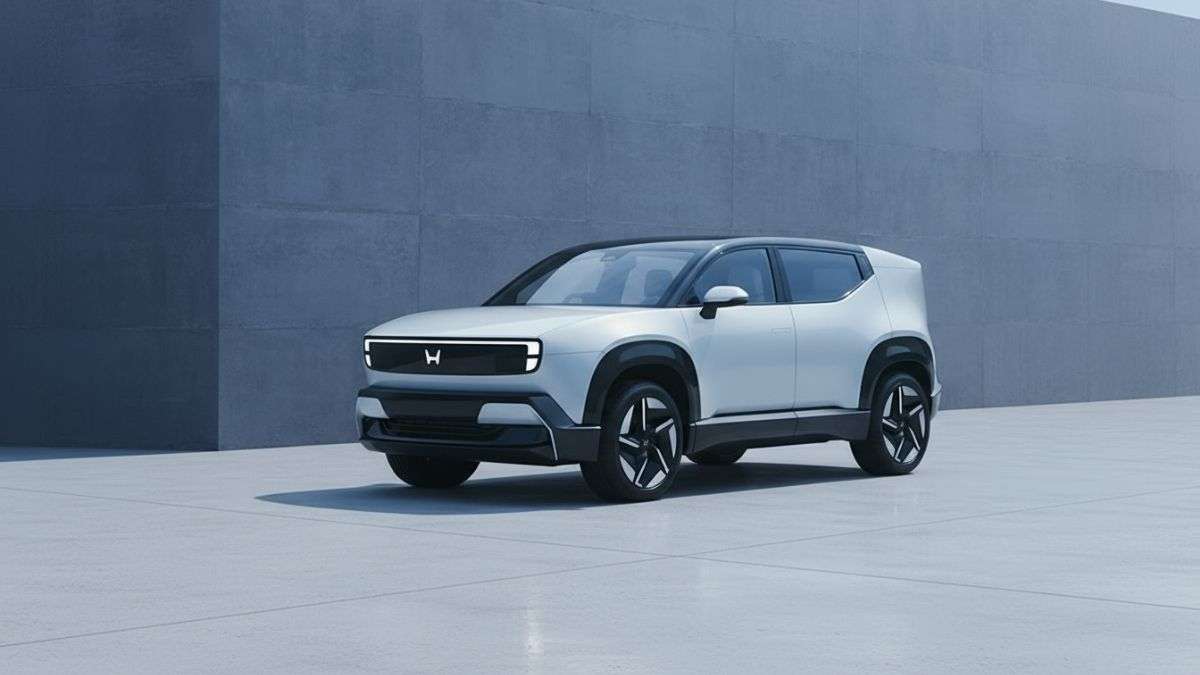

For the past five years, Honda has felt like a giant asleep at the wheel of the EV revolution. While rivals in Korea, the US, and China were launching segment-defining electric vehicles, Honda’s strategy seemed to consist of a re-badged GM crossover (the Prologue) and a vague promise of "sometime in the future." That future finally arrived yesterday. With the October 28 unveiling of the "Alpha" SUV, the first production vehicle from its next-generation 0-Series, Honda has finally, mercifully, entered the game.
This isn't just another EV. This is the real start of Honda's electric era. It's a vehicle that carries the full weight of the company's reputation and financial future on its futuristic, wedge-shaped shoulders. And it arrives not a moment too soon.
Honda’s Cautious, Profitable, and Perilous Path
Honda's current economic health is, ironically, spectacular. While competitors were getting bled dry in a brutal EV price war over the last two years, Honda was quietly executing a brilliant counter-strategy: mastering hybrids. Their hybrid sales have surged, with models like the CR-V and Accord hybrids flying out of dealerships. This has padded their bottom line, creating a massive war chest to fund their EV transition without taking on the crippling debt or risk that others have.
But this smart financial move came at a high cost: relevance. In the minds of the public, Honda has become the "hybrid company," not a technology leader. The Honda Prologue, while a competent vehicle, is a stopgap. It's a GM Ultium-based crossover that feels more like a joint venture than a true Honda. This has left a wide-open door for brands like Hyundai and Kia to steal a generation of tech-savvy buyers.
The "Alpha" as a Statement of Intent
This is why the "Alpha" is so critical. In the short term, it changes the narrative overnight. It gives Honda's incredibly loyal (and patient) dealer network a high-tech, desirable, in-house EV to sell. It stops the bleeding of Honda loyalists who were reluctantly leaving the brand for a Tesla Model Y or Hyundai Ioniq 5.
In the long term, this SUV is the public debut of Honda's new, proprietary "e:Architecture" platform. This is their "skateboard," their foundation, and their answer to VW's MEB or Hyundai's E-GMP. This platform, first teased with the Saloon and Space-Hub concepts at CES in 2024, is the basis for every Honda EV for the next decade. The "Alpha's" success or failure will validate (or invalidate) their entire engineering direction.

The Battle for Relevance: Will It Be Successful?
Success is not guaranteed. The "Alpha," which appears to be a mid-size, two-row SUV, is launching directly into the most brutally competitive, over-saturated segment in the entire EV market. This is a knife fight in a phone booth against established killers. Its direct competitors are the Tesla Model Y (the best-selling car in the world), the Hyundai Ioniq 5, the Kia EV6, the Ford Mustang Mach-E, and the VW ID.4.
These cars have been on the market for years. They have established followings, refined their technology, and built a reputation. Honda is showing up late to a party that's already in full swing, and it needs to make a massive impression just to get noticed.
What Honda Must Do to Win
Honda has a secret weapon that none of its rivals (save perhaps Toyota) can claim: a multi-generational, iron-clad reputation for engineering, quality, and reliability. People trust the "H" badge. To leverage this, they must nail four things:
- Price It to Win: This cannot be a $60,000 "premium" vehicle. It must directly challenge the heart of the market. It needs to be priced competitively against the Ioniq 5 and Model Y, likely starting in the mid-$40,000s.
- Deliver "Honda-ness": The car must feel like a Honda. That means bulletproof build quality, clever interior packaging (will we see an EV version of the "Magic Seat"?), intuitive controls that aren't buried in touchscreens (please, give us a real volume knob), and an efficient, fun-to-drive feel.
- Deliver on the Tech Promises: The 0-Series concepts came with huge promises: a new battery chemistry that charges from 15-80% in 15 minutes and battery degradation of less than 10% after 10 years. These are massive claims. If the "Alpha" delivers this, it instantly leaps to the front of the pack in battery technology.
- Market It Aggressively: Honda needs to spend money. It needs to tell the world, loudly and clearly, that its engineering prowess has been successfully transferred to the electric age.
Wrapping Up
The Honda "Alpha" is arguably the most important vehicle the company has launched in a generation. It is late, but it arrives from a position of enviable financial strength and with a deep reservoir of brand loyalty to draw upon. The competition is fierce, but the Honda name carries immense power. If the company has successfully infused its core DNA of reliability, clever engineering, and real-world value into this new electric platform—and if it delivers on its ambitious battery tech promises—the "Alpha" won't just be a success. It will be the vehicle that re-establishes Honda as an engineering leader for the next 50 years.
Disclosure: Images rendered by ChatGPT 5.0
Rob Enderle is a technology analyst at Torque News who covers automotive technology and battery developments. You can learn more about Rob on Wikipedia and follow his articles on Forbes, X, and LinkedIn.
Set Torque News as Preferred Source on Google
Follow us today...