
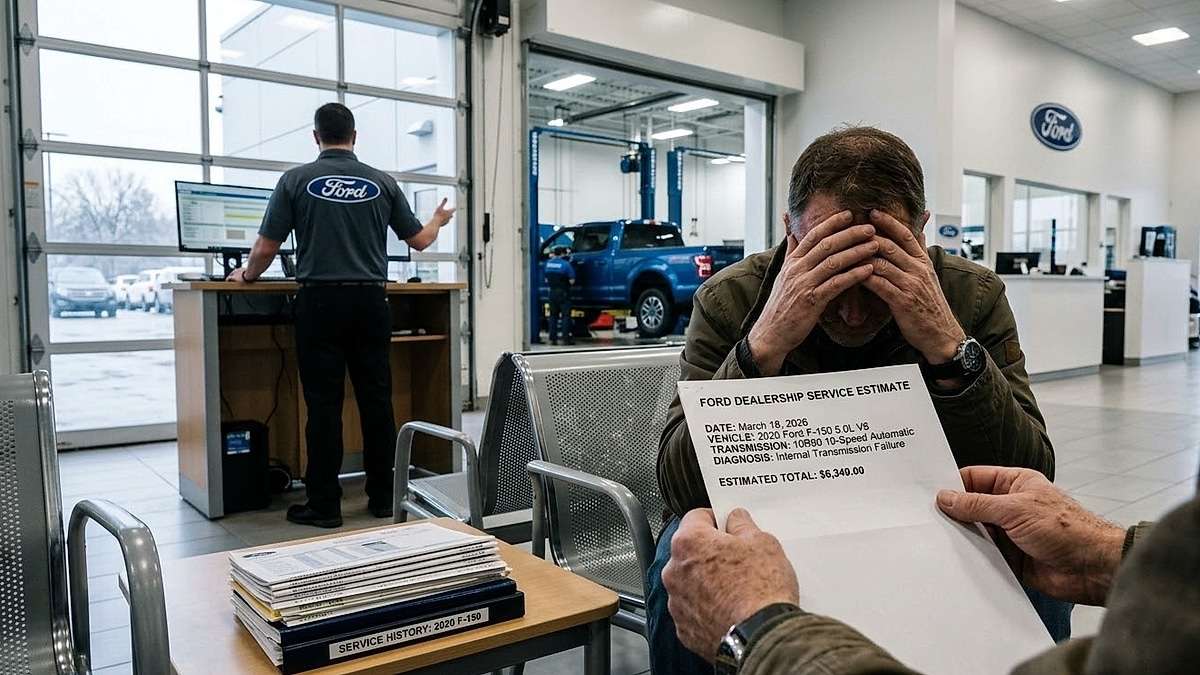

The $6,000 "2026 crisis" for 2020 Ford F-150 owners isn't a result of poor maintenance, but a design flaw in the 10R80 transmission’s CDF clutch drum. Specifically, an internal bushing often migrates out of place, obstructing critical oil passages. This misalignment leads to delayed shifts, "gear hunting" between 7th and 10th, and eventual internal clutch destruction.
Even with 4,500-mile oil changes, this mechanical shift is inevitable for many as trucks hit the 60,000-mile mark in 2026; just as factory powertrain warranties expire. Beyond the gearbox, the Gen 3 5.0L Coyote V8 introduces a second failure point: PTWA (Plasma Transferred Wire Arc) cylinder liners. These weight-saving liners can cause oil consumption exceeding one quart per 1,000 miles, often dismissed by dealers as "within spec" until the engine stalls.
To avoid a total loss, owners must monitor two specific metrics: transmission fluid temperatures exceeding 215°F during unloaded driving and harsh downshifts when decelerating. These are the physical signatures of a failing CDF drum and a saturated lead frame, signaling that a rebuild is required before a catastrophic highway failure occurs.
In my research on Ford reliability, I found a recent post shared in a Facebook community of Ford truck enthusiasts in which William LaFave from Warren, Michigan, highlighted these exact concerns, questioning whether even an impeccable service history can save a 5.0L owner from the steep costs of staying on the road.
William LaFave says, “So I bought a one-owner 2020 Ford F-150 5.0L with 49k miles from an 85-year-old man, thinking, 'man, this is a great idea.' Now, after seeing so many horror stories, I’m thinking maybe I made the wrong move."
"I thought the 5.0L was bulletproof? What issues should I expect or look out for? The truck has an impeccable service history with oil changes every 4,500 miles and regularly reported maintenance checkups.”

From My View: The "Bulletproof" Illusion
I have spent 30 years in this industry watching legends rise and fall, and right now, we are seeing a massive shift in how the 2018–2020 F-150 is perceived. For decades, the 5.0L Coyote V8 was the gold standard for longevity.
If you wanted a truck to last 300,000 miles, you skipped the turbos and went with the natural-breather setup. But as I’ve investigated recently, the "Gen 3" Coyote introduced in 2018 brought along some baggage that even the most religious maintenance schedule cannot always unpack.
Who is at risk?
The owners most at risk are those like William, who buy into the 40,000 to 60,000-mile range. This is the "danger zone" where factory powertrain warranties are about to expire, and the internal hardware flaws of the 10R80 transmission begin to manifest.
You see, an 85-year-old owner likely drove that truck gently. While that sounds like a win, gentle driving often masks the "harsh shift" symptoms of a failing CDF clutch drum until a younger, more aggressive driver takes the wheel and puts the torque to the pavement.
The 2026 Diagnostic: 3 High-Probability Failure Signals
While a clean CARFAX and 4,500-mile oil changes offer peace of mind, they cannot detect the mechanical fatigue specific to the 2018–2020 F-150 hardware. Owners must monitor these three technical "Red Flags" to identify internal degradation before the powertrain warranty expires.
1. The 215°F Thermal Threshold
The 10R80 transmission is designed to operate between 195°F and 210°F. If your digital transmission temperature gauge consistently hits or exceeds 215°F during unloaded, level-ground cruising, it is a primary indicator of internal bushing friction. As the CDF drum bushing migrates, it restricts fluid flow, causing the pump to overwork and the clutch packs to overheat. Thermal spiking is often the first "silent" sign of a pending $6,000 rebuild.
2. The "Park-to-Drive" Engagement Lag
A healthy 10-speed should engage within sub-one-second intervals. A 2-to-4 second delay, often accompanied by a violent "clunk" when the gear finally catches, signals a loss of hydraulic pressure within the CDF clutch drum. This lag indicates that the internal seals are no longer aligning with the oil feed holes. If you experience this "neutral slide," the drum is already physically compromised and will eventually fail to hold 7th through 10th gears.
3. High-Vacuum Oil Scavenging
The Gen 3 Coyote’s PTWA (Plasma Transferred Wire Arc) liners, combined with original PCV calibrations, can create a high-vacuum environment during deceleration.
The Test: Drive at 50 mph, let off the throttle completely for 5 seconds, and then accelerate firmly.
The Flag: A puff of blue smoke from the tailpipe during re-acceleration confirms that oil is being pulled past the piston rings. This isn't a "maintenance" issue; it is a hardware-software mismatch that leads to carbon buildup and eventual engine stalling.
Expert Note: If you encounter these flags, do not settle for a "standard" diagnostic. Specifically request a transmission lead frame health check and a cylinder borescope to document scoring before your 60,000-mile coverage sunsets.
My Take: The 5.0L Oil Consumption Reality
When Ford moved to the Plasma Transferred Wire Arc (PTWA) cylinder liners in 2018, they did it to save weight. However, as I reported in my story about why one 2019 Ford F-150 owner was left out in the cold, this technology can lead to oil consumption that defies "normal" logic. I have seen cases where these engines drink a quart every 1,000 miles, yet the dealer claims it is within spec.
Expert analysis from the team at Lemon Law Help confirms that these 2018–2020 models are prone to high oil consumption rates, noting that defective pistons and piston ring assemblies allow oil to enter the combustion chamber, which can eventually lead to engine stalling or total failure.
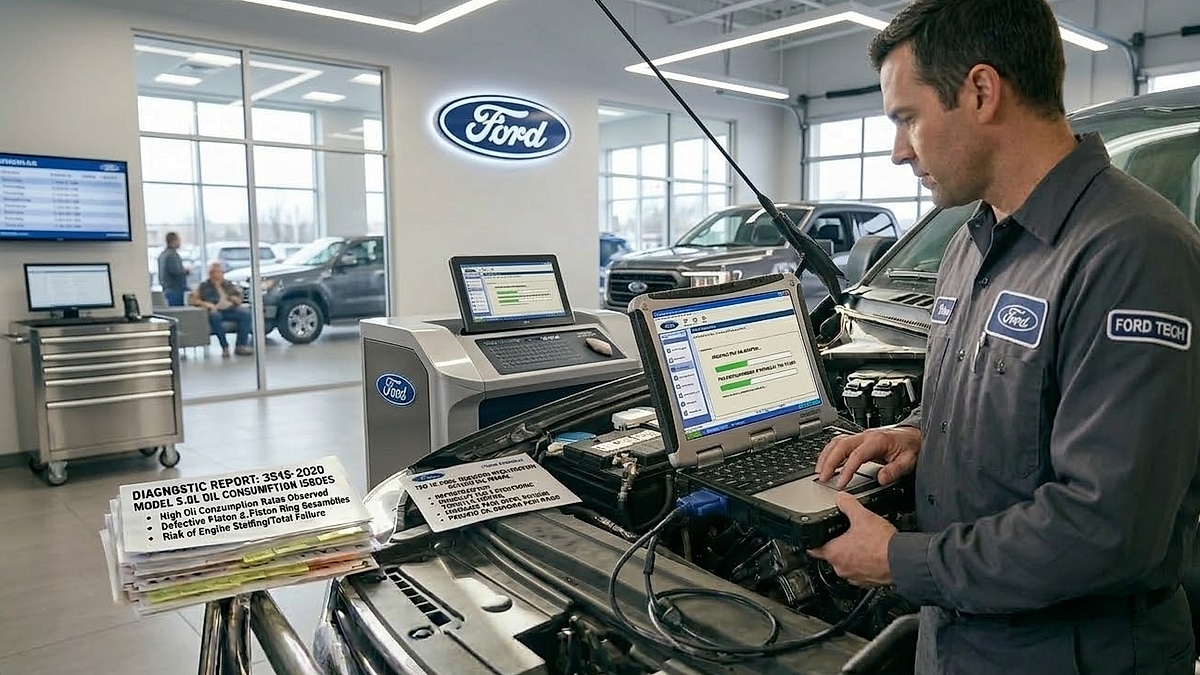
What You Need To Know
1. The Software Fix: Ford released TSB 19-2365 to reprogram the PCM and reduce "deceleration vacuum" that sucks oil past the rings. If your truck hasn't had this, get it done immediately.
2. The Dipstick Trap: Ford actually issued a longer dipstick to "increase" the oil capacity on the markers. It doesn't stop the burning; it just hides it longer.
3. Transmission Temps: If you see your 10-speed hitting 215°F or higher during normal driving, your internal bushings are likely already failing.
How the 10R80 Transmission Fails
The most significant threat to your wallet in 2026 isn't actually the engine; it is the transmission. The 10R80 automatic is a marvel of engineering, but it has a "soft" internal component, the CDF drum. A bushing inside this drum can become misaligned, blocking oil passages.
I recently covered how one owner ditched his late-model F-150 for a Tundra specifically because of these "junk" 10-speed issues. When that bushing moves, you get the infamous "clunk" or a three-second delay when shifting from Park to Drive.
Technicians at Inglewood Transmission have identified that CDF drum flex reduces clutch apply area and overheats the pack, often requiring a full rebuild that can easily top $6,000. This is why William’s truck feels "impeccable" now, but could be one heavy tow away from a breakdown.
Why This Matters Now
Why is this a "2026 crisis"? Because the bulk of these 2020 models are hitting their sixth year on the road. Most extended service plans (ESPs) and factory warranties are timing out.
I have documented this transition in my report on why owners are calling the 2019 F-150 a money pit after facing cam phaser and transmission failures back-to-back.
Field Observations from Owner Communities
The community feedback is split, but the "horror stories" William mentioned are rooted in real data. One user on Reddit noted the severity of the situation for those ignoring the early signs, stating, "Mine sucks down 3 QTs of oil in 5k miles, and Ford says this is perfectly acceptable. Then the trans downshifts so hard I think it's going to fall out of the truck sometimes," which you can read in the full discussion here.
Another owner highlighted the vulnerability of the newer hardware despite good maintenance, mentioning, "18-20 have oil consumption issues. 10 speeds suck from 18-22 regardless of engine. That's the short of it," as found in this Reddit thread.
Key Takeaways
- Monitor the Oil: Check your dipstick every 1,000 miles. Do not rely on the oil life monitor; it does not measure volume.
- Test the Transmission: Drive the truck until it is at full operating temperature (about 20 miles). Listen for "gear hunting" or harsh downshifts between gears 7, 8, and 10.
- Service Records Aren't Everything: A 4,500-mile oil change is great, but it won't fix a misaligned bushing in a CDF drum or a scored cylinder wall.
- Warranty is King: If you are buying a 2018–2020 model today, an airtight extended warranty is a non-negotiable requirement.
A Dream Find That Isn't
While William’s truck sounds like a dream find, the 2026 reality is that "impeccable maintenance" cannot always outrun a mechanical design flaw, so I recommend he take this F-150 to a master technician for a borescope inspection of the cylinders and a diagnostic "health check" on the transmission's lead frame before that 60,000-mile powertrain clock strikes midnight.
How About You?
What has your experience been with the 5.0L Coyote or the 10-speed transmission in your Ford truck? Have you faced the dreaded $6,000 repair bill, or is your F-150 still running strong past the 100,000-mile mark? I want to hear your story. Your feedback helps other owners avoid expensive mistakes. Please share your thoughts and leave a comment in the red “Add new comment” link below.
Related Technical Deep Dive: While the 2020 model faces transmission hurdles, the 2017 F-150 generation struggles with a specific brake master cylinder bypass failure that technicians often label "unrepairable." Understanding these year-over-year mechanical shifts is vital for used truck buyers. Read the full investigation by Denis Flierl here.
Denis Flierl is a 14-year Senior Reporter at Torque News and a member of the Rocky Mountain Automotive Press (RMAP) with 30+ years of industry experience. Based in Parker, Colorado, Denis leverages the Rockies' high-altitude terrain as a rigorous testing ground to provide "boots-on-the-ground" analysis for readers across the Rocky Mountain region, California EV corridors, the Northeast, Texas truck markets, and Midwest agricultural zones. A former professional test driver and consultant for Ford, GM, Ram, Toyota, and Tesla, he delivers data-backed insights on reliability and market shifts. Denis cuts through the noise to provide national audiences with the real-world reporting today’s landscape demands. Connect with Denis: Find him on LinkedIn, X @DenisFlierl, @WorldsCoolestRides, Facebook, and Instagram.
Photo credit: Denis Flierl via AI
Set Torque News as Preferred Source on Google
Follow us today...







Comments
I have a 2020 F150 STX which…
Permalink
I have a 2020 F150 STX which I love and it my 3rd one. However my V8 with 50,000 miles just had the transmission rebuild by Ford. My CDF drum was bad, luckily I had an extended warranty so it only cost me $100 deductible. I was not impressed with how long it took. The deal ship had it a month which was a long time. It was because of all the Ford Co. bullshit rules they had to follow. All in all I was lucky but still a big pain. It’s sad how expensive they have become and almost everything now a days is disposable and not meant to last long.
I have a 2020 Ford F-150…
Permalink
I have a 2020 Ford F-150 with 62,000 currently in the shop getting the transmission replaced for $8,100. Thanks Ford for the 60,000 mile warranty.
I have a 2020 Lariat with…
Permalink
In reply to I have a 2020 Ford F-150… by Randy Sniff (not verified)
I have a 2020 Lariat with 114,000 miles. Full service records and has been well taken care of. And I’m on here because early Saturday morning at 12;30 am i started having transmission issues at the end of a 3 hour drive home from a business trip. Next day took it in to a nearby mechanic to have the codes read. Also was getting the wrench symbol and “read manual” warning,
Turns out I’m looking at the major transmission rebuild for $8k or a new transmission at $10k per a call to the local Ford Dealer’s service department. Who knew immediately and very well what the issue is, but offered no support. I’m now looking to trade in on a GMC or Tundra.
2019 F150 5.0 10r80 garbage…
Permalink
2019 F150 5.0 10r80 garbage can. 80k miles. Cam phasers replaced 9 months ago. Sunroof track failure 4 months ago. Loose 3 to 4 qts oil between oil change. Now total Transmission Failure. Sitting at dealer until i can get $8500.