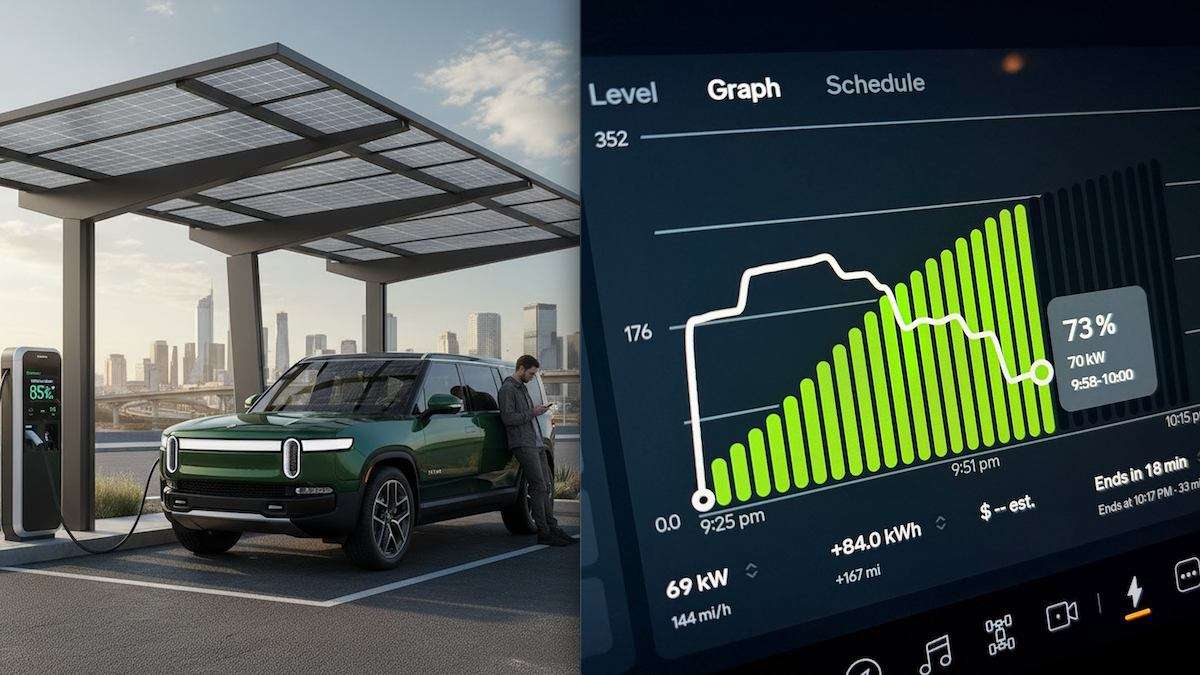

A Rivian R1S owner is furious! His new KIA EV9 is super fast charging. But his Rivian R1S? It's "horrid," saying it's "Tesla slow". Is Rivian's fast charging truly broken?
The Rivian R1S Charging Dilemma: Why the Kia EV9 Is Leaving It in the Dust
Tech reviewer Quinn Nelson of @SnazzyLabs has sparked a fierce debate over DC fast-charging performance, detailing a stark and frustrating difference between his two electric SUVs. Since acquiring a Kia EV9, Nelson has been severely underwhelmed by his Rivian R1S, which he now labels "horrid" and "Tesla slow."
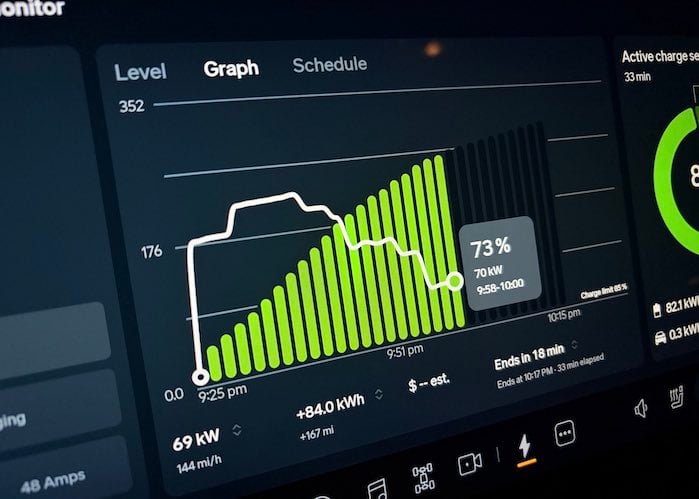
The EV9 consistently maintains a robust charging speed of 200kW up to 80% State of Charge (SoC), achieving significant range boosts in as little as 15 minutes. In sharp contrast, Nelson reported that his Rivian R1S was crawling at just 70kW at 73% SoC, even in moderate 50°F weather, leading him to criticize its real-world charging capability.
Quinn Nelson sums it up,
“Ever since we got a KIA EV9, I’ve been so annoyed whenever I have to DC fast charge my Rivian R1S. It’s so slow. It’s like… Tesla slow. The EV9 can maintain 200kW to 80% SoC. Literally takes like 15 min to get 70+%. Meanwhile, it’s 50°F, and my Rivian R1S is at 70kW at 73%. Horrid.”
This is more than just a complaint; it's a symptom of the biggest gap currently facing the EV industry: the gulf between 400-volt and 800-volt architectures. As in my recent report, thousands of owners love their R1S for its capability and design; this charging inconsistency is a genuine pain point and touches on the often-cited issue of battery conditioning.
We've previously examined this theme of variable performance, such as when one owner struggled to find consistency in: Rivian Owner Charged 11 Hours and Only got 70 Miles On One Day, but 150 on Another Day Using the Same Home Charger. She Tries to Understand the Difference Despite The Scenarios Being Identical.
That report, focused on Level 2 charging, highlights that Rivian's battery management is highly sensitive to conditions, and that sensitivity becomes a liability at high-speed DC stations.
The core of the problem lies not in Rivian's peak charging rate, which can hit a respectable 220kW when conditions are perfect and the State of Charge is low, but in its ability to sustain that high rate. The Rivian R1S, built on a 400-volt architecture, has a massive battery pack (up to 135 kWh or more). Pushing high power into such a large pack heats it rapidly.
The battery management system (BMS) in the R1S—which is arguably programmed to be highly protective of battery health—employs an aggressive taper. This taper significantly reduces power input as the SoC climbs from 50% to 60%, preventing excessive heat —the battery's biggest enemy. This is why Nelson saw the rate plummet to 70kW above 70% SoC.
This aggressive slowdown fundamentally changes the experience of overcoming charging anxiety on long-distance EV road trips. We know from past coverage, such as my report: I Wanted a Tesla Cybertruck Until I Got This Rivian R1S Loaner, It Has No Elon Shenanigans, Fits My Garage, 410 Mile Range, and Doesn't Nag on the Freeway, that charging consistency—or lack thereof—is the single biggest barrier to EV adoption for long-haul drivers.
The 800-Volt Advantage: Kia EV9's Technical Superiority
The Kia EV9, conversely, runs on Hyundai Motor Group's dedicated E-GMP platform, which features an 800-volt architecture. This is a game-changer. Think of it this way: to deliver the same power, an 800V system needs only half the current (amperage) compared to a 400V system. Lower current means less resistance, which in turn means less heat is generated within the battery, wiring, and charging components.
This is the technical answer to the differences between 800-volt and 400-volt EV charging. Because the EV9 manages heat better, it can sustain its peak charging speed (which is close to 240kW) much longer into the charge cycle—often, as Nelson notes, well past 80% SoC. This ability to consistently hold a high rate is what makes the difference between a 15-minute pit stop and a 40-minute wait. For the family driver on a road trip, that time savings is invaluable.
I recently drove the EV9 GT-Line, and the charging convenience is noted in this Torque News article: I Drove My Kia EV9 GT-Line 1,400 Miles Round Trip From Savannah To Memphis And Discovered Mercedes Chargers Are Superior While Atlanta's Stations Were Completely Full. When the infrastructure cooperates, the 800V system is simply a superior experience.
Three Recommendations for Rivian Owners
If you own an R1S and are experiencing this frustration, there are solutions and best practices you can adopt to mitigate the taper and maximize your charge session:
- Prioritize Preconditioning: The single most crucial step for better performance is to ensure your battery is at the optimal temperature (around 70°F) before plugging in. Understanding Rivian's battery thermal management system limitations means you must manually set your navigation to a DC fast charger at least 30 minutes before arrival. If you roll up cold, your vehicle will spend valuable minutes—and energy—heating the battery instead of charging it quickly.
- Optimize Your SoC Window: Stop charging sessions earlier. The data clearly shows the sharp taper above 60%–70% SoC. For road-tripping efficiency, it is almost always faster to charge from 10% to 60% and then drive to the next charger than it is to charge from 10% to 80% at one stop. This is a key piece of Actionable recommendations for improving Rivian R1S charging times.
- Choose Your Charger Wisely: While the Rivian Adventure Network (RAN) is convenient, third-party stations like Electrify America can sometimes offer better sustained rates, depending on the site. However, be mindful of the economics.
As discussed in my report: My 2022 Tesla Model 3 Has Lost So Much Value, I’m Trading It In For a 2025 Rivian R1S Tri, I’m About To Pull the Trigger, But I’m Scared, we see that high-speed charging can be expensive. Always check the per-kWh rate versus the time saved to analyze the actual cost of DC fast charging for large electric SUVs.
Key Takeaways for EV Owners
- Architecture Matters: The Kia EV9's 800V architecture inherently outperforms the Rivian R1S's 400V system at maintaining high charging rates, especially above 50% SoC.
- The Taper is a Feature for Longevity: Rivian's aggressive taper protects its massive battery pack from heat damage but sacrifices speed in the process.
- Preconditioning is Mandatory: Always navigate to your DC fast charger using the vehicle's navigation system to initiate battery preconditioning, ideally for 30+ minutes.
- Charge Low, Stop Early: To maximize time efficiency, use the Kia EV9 charging curve vs. Rivian R1S real-world speed data to charge the Rivian R1S only between 10% and 60%, minimizing time spent in the slow taper zone.
What Rivian Owners Are Saying
The sentiment from the owner community regarding the R1S charging inconsistency echoes Nelson's frustration, often pointing to reliability issues and the necessity of proper preconditioning:
- Reddit (Reliability): "On my second road trip, DC fast charging was flaky, charging speed dropped to 1kw/h, and then wouldn't work at all. Rivian diagnosed the issue as a failure of the fast charging module and replaced the entire battery pack."
- Reddit (Preconditioning/Speed): "My R1S Gen2 Standard is painfully slow unless it has preconditioned for 45 min, but usually it starts too close to the charger to do any good… seriously limits my desire to road trip when it maxes out at 90Kw most of the time."
- Reddit (Competitive Taper): "Kia's charging curve and speed destroys Rivian's. I'm disappointed that Rivian can't maintain 100kW+ until at least 80%."
Wrapping It Up:
The reality is that while the Rivian R1S remains a formidable, high-performance adventure vehicle, the older 400-volt architecture cannot compete with the sustained high charging rates of the newer 800-volt Kia EV9. Rivian owners must become experts in battery preconditioning and strategic State of Charge management to make long-distance charging tolerable, whereas EV9 owners enjoy a far more convenient "plug-and-play" road-trip experience thanks to their superior electric platform.
Tell Us What You Think
Are you a Rivian owner who has found a successful workaround for the aggressive charging taper, or have you experienced the Kia EV9's 800V advantage firsthand? Share your experiences and charging tips in the comments below.
I'm Denis Flierl, a Senior Torque News Reporter since 2012, bringing over 30 years of automotive expertise to every story. My career began with a consulting role for every major car brand, followed by years as a freelance journalist test-driving new vehicles—equipping me with a wealth of insider knowledge. I specialize in delivering the latest auto news, sharing compelling owner stories, and providing expert, up-to-date analysis to keep you fully informed.
Follow me on X @DenisFlierl, @WorldsCoolestRides, Facebook, Instagram and LinkedIn
Photo credit: Denis Flierl via Quinn Nelson
Set Torque News as Preferred Source on Google
Follow us today...