
Key Points
- Kia's Chief Designer reveals an unexpected but specific benchmark for the 2027 Telluride's exterior design.
- Kia's VP of Marketing explains why the 2027 Telluride got a premium interior upgrade.
- The new design philosophy directly affects which 2027 Telluride trim is right for you.
You would think that when a car company is designing the second generation of its most celebrated SUV, the vehicle that put Kia on the map as a serious player in the American midsize SUV segment, they would look everywhere. Study the competition. Benchmark the Germans. Obsess over what Toyota and Ford are doing. That would be the expected move.
But that is not what happened with the 2027 Kia Telluride.
At the Kia Telluride media drive event in Santa Barbara, California, I spent the day talking with the people who actually shaped the future of one of America’s most talked-about three-row SUVs. Earlier, I sat down with Kia’s product planners to understand why the V6 engine disappeared in the new generation. If you missed that conversation, you can read the full explanation here in my earlier report, Kia explains why the V6 is gone for good in the 2027 Telluride. But after that discussion ended, another question popped into my mind - one that many SUV buyers may not have considered yet: What vehicle did Kia actually study the most when designing the exterior of the second-generation Telluride?
So I sat down with Russell Wager, Vice President of Marketing at Kia America, and Kurt Kahl, Chief Designer at Kia Design Center America, and asked them directly which SUV Kia benchmarked most heavily while developing the design of the 2027 Kia Telluride.
I asked Kahl and Wager, "Which SUV did Kia benchmark most heavily when developing the design of the second-generation 2027 Telluride?"
Kahl's answer was very short, clear and straight to the point. He said "The first generation Telluride." Then he continued saying, "and building on that, and evolving it, and you know, from an exterior design point of view we had a new philosophy come in called 'Opposites United.'
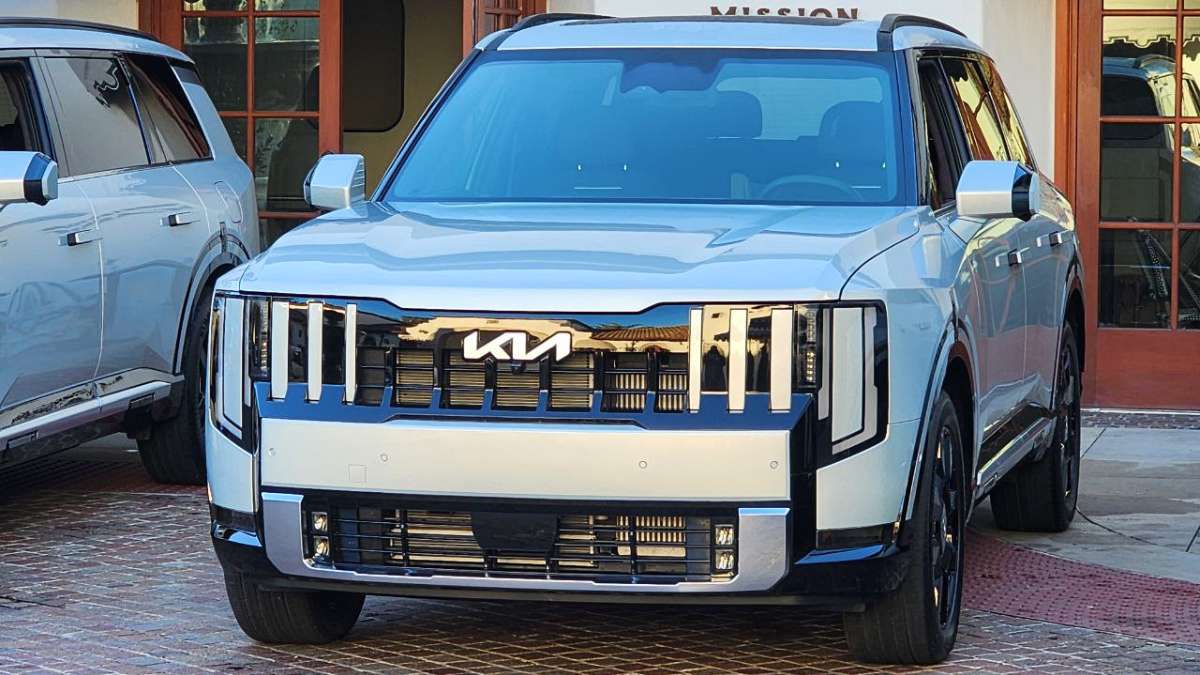
"So it's bringing together contrasting elements to create something new, to create tension, but also to have some harmony, to create some dynamic quality. Something we didn't have on the first Telluride. It wasn't our philosophy at that point, but we did have the big, bold, boxy formula that we felt like there was more story to tell about.
"So we used that formula, and then the 'Opposites United,' and then really upped - kind of exaggerated - the boxiness and the rugged aspect so that we could create not only an X-Pro trim that felt really natural to the overall shape, but also the more refined X-Line hybrid trims and the like to create more of a kind of a bookend of different flavors."
At this point Wager joined the conversation and said, "in addition to that, we saw with the previous generation that people were buying the highest trim levels, whether it was our Nightfall Edition or X-Lines. So we started also looking and benchmarking some of the premium brands as well, which is why when you're inside the car, you see a lot of other new addition refinements making it even more upscale in addition to the exterior."
That answer is unexpecting for one simple reason. Kia didn’t chase another brand when designing the new Telluride. They chased their own success.
Those two responses together are more significant than they might initially sound. And this is where it gets really interesting.
Why Benchmarking Yourself Is Actually the Smartest Move
When Kahl said "the first generation Telluride," I was kind of surprised as it was an unusual answer. Other car companies in this situation point to a competitor they are trying to beat. They say things like "we benchmarked the Explorer" or "we looked very carefully at the Highlander." Kia said: we looked at ourselves.
That is not arrogance. That is discipline. It tells you that Kia understood something very specific: the first generation Telluride was already exceptional, and the risk of chasing competitors was the risk of losing what made it special in the first place. The big, bold, boxy formula was not just a style choice. It was an identity. And Kahl's team decided that identity was worth amplifying, not abandoning.
This is actually a valuable lesson that goes far beyond car design. When you have built something that genuinely works, the wisest move is not to discard it for novelty's sake. It is to understand what made it great and then have the courage to go further with it. Whether you are designing an SUV, building a business, or raising a family, protecting the core of what works while honestly evolving what does not - that is the kind of decision-making that creates lasting value.
What "Opposites United" Actually Means for Your Buying Decision
Now let me translate Kahl's design philosophy into plain language, because it matters directly to your wallet and your satisfaction as a potential 2027 Telluride buyer.
"Opposites United" is Kia's overarching design language. Think of it this way: it is the idea that rugged and refined, bold and elegant, angular and smooth, can all exist in the same vehicle without fighting each other. On the 2027 Telluride specifically, Kahl said his team exaggerated the boxiness and ruggedness on purpose. Why? So that the X-Pro trim, the off-road focused model, feels completely natural and native to the shape of the vehicle. It is not a sticker package slapped on a soft crossover. The X-Pro looks like it belongs there because the entire design was conceived with that intentional tension in mind from day one.
But here is the flip side, and this is what Kahl meant by "a bookend of different flavors." Because the shape is genuinely rugged and bold at its core, the more refined trims, the X-Line Hybrid and the higher luxury trims, also look appropriate and credible. They do not look soft or out of place. The same bones that make the X-Pro look at home on a trail make the top-tier hybrid trims look genuinely upscale rather than simply expensive.
That is a design achievement worth noting. It is not easy to pull off. Most SUVs in this segment drift one direction or the other. They either look too soft for off-road duty or too rough for premium buyers. Kia found a middle ground that serves both audiences without compromising either.
Over the years, Torque News has watched the Telluride's design identity develop from its earliest days. When we covered the first look at the new Kia Telluride as a good choice in the midsize SUV wars, the big, boxy silhouette was already turning heads. What Kahl and his team have done with the 2027 generation is take that silhouette and make it impossible to ignore.
The Premium Brand Benchmarking: What It Means Inside the Cabin
Now let's talk about what Wager said because that second half of the answer is where the 2027 Telluride becomes even more compelling for serious buyers.
Wager revealed that Kia observed a clear pattern with first-generation buyers: they were consistently gravitating toward the highest trim levels. Nightfall Editions. X-Lines. The loaded SX-Prestige configurations. Buyers were not shopping the base Telluride and walking away satisfied. They were reaching for the top of the range. Every time.
That data point told Kia's marketing team something critical. The Telluride was competing in a space where buyers had expectations that were creeping into near-luxury territory. So Kia responded not just by making the exterior bolder, but by benchmarking premium brands for the interior experience.
Wager did not name those premium brands specifically in our conversation, and that is fine. What matters is the intent and the result. When you sit inside the 2027 Telluride, you are supposed to feel that the materials, the layout, the details, and the refinement reflect something aspirational. Not just competitive with the Pilot or the Pathfinder, but actually competitive with vehicles that cost significantly more.
This connects to something Torque News noted when we reviewed the 2024 Telluride SX-Prestige X-Line V6 AWD, which rivaled the very best in its segment. Even the outgoing generation punched above its weight class at the upper trims. The 2027 version is designed to close that remaining gap completely, particularly inside the cabin where premium buyers notice every detail.
The Opposites United Philosophy and the EV9 Connection
What makes this design approach especially meaningful is that it is not just a Telluride story. It is a Kia story. If you have seen the Kia EV9, you already know this language. Torque News covered how Kia's new flagship electric SUV that will help redefine its segment was one of the first vehicles to fully express the Opposites United philosophy in production form. The angular body, the digital lighting grille, the tension between mass and detail - that is the same vocabulary Kahl's team brought into the 2027 Telluride, adapted to a body-on-frame-adjacent SUV rather than an EV platform.
This matters to you as a buyer because it means the 2027 Telluride is not a one-off design experiment. It is the expression of a fully realized, brand-wide visual identity that Kia has been building and refining across multiple vehicles. When you drive it, you are driving a Kia that knows exactly what it wants to be.
What the X-Pro Buyer Needs to Know Specifically
If you are looking at the 2027 Telluride X-Pro in particular, Kahl's explanation should give you real confidence. The off-road trim was not an afterthought. The entire exterior architecture was designed with the X-Pro in mind from the very beginning. That means the wider fender flares, the aggressive lower fascia, the commanding stance - none of it feels forced or tacked on. It feels like the vehicle was always going to end up there.
Torque News has long documented why the X-Pro trim is a standout choice for buyers who actually use their SUVs in demanding conditions. Back when we examined six ways Kia designed the Telluride X-Pro to be amazing in winter, the capability was already there. Now that capability is wrapped in a design that was architected around it from the ground up.
What This Means if You Are Shopping Right Now
Here is the practical takeaway for potential buyers sitting on the fence about the 2027 Telluride.
Design of the vehicle influences:
- visibility
- cargo space
- interior comfort
- and long-term resale value
A well-proportioned SUV tends to age better visually and hold its appeal longer.
The design of this vehicle was not built by looking sideways at the competition. It was built by looking honestly at what the first generation got right, identifying where the story had not been fully told, and then telling it with more conviction. That kind of self-awareness in a product development process is not common. And it tends to produce vehicles that age well, because they are not chasing a trend. They are deepening an identity.
If you were a buyer who loved the look of the first generation but always wished it were just a little bolder, a little more commanding, a little more upscale inside, the 2027 Telluride was designed with you specifically in mind. And if you have been watching Torque News track the Kia Telluride's journey from a handsomely styled SUV at a bargain price point to one of the most refined three-row SUVs at any price, this second generation feels like the natural culmination of that entire journey.
The Bigger Lesson Here
I want to leave you with something beyond the car itself, because I think Kahl and Wager demonstrated something genuinely worth carrying into your own life and decisions.
The most tempting thing, when you are redesigning something successful, is to abandon what worked in favor of what is new. Novelty can feel like progress. But Kia's design team did the harder thing. They went back and asked: what is the soul of this vehicle? What promise did we make with the first generation that we have not fully kept yet? And then they built the second generation around that answer.
That kind of honest, inward reckoning before a big decision - whether it is a product redesign, a career change, or a major purchase - tends to produce better outcomes than chasing what everyone else is doing. The 2027 Telluride is the result of Kia having the discipline to trust its own instincts. That is worth more than any benchmark study of a competitor.
Now I want to hear from you directly in the comments below.
If you owned or currently own a first-generation Telluride, does knowing that Kia benchmarked its own vehicle rather than competitors make you more or less confident in what the design team has delivered with the 2027 generation?
And for those of you considering the 2027 Telluride, does the revelation that Kia studied premium luxury brands when developing the interior experience change how you feel about the value proposition at the top trim levels?
Tell us your personal experience and your thoughts in the comments section below. Your perspective is exactly what this community is built on.
Also see what the 2027 offroad accessory Telluride can do here at our Torque News Youtube channel.
Images by Armen Hareyan.
About The Author
Armen Hareyan is the founder and Editor-in-Chief of Torque News and an automotive journalist with over 15 years of experience writing car reviews and industry news. Now based in the Charlotte region (Indian Land, SC, he founded Torque News in 2010, which since then has been publishing expert news and analysis about the automotive industry. He can be reached at Torque News on X, Linkedin, and Youtube. Armen holds three Masters Degrees, including an MBA, and has become one of the known voices in the industry, specializing in the landscape of electric vehicles and real-world stories of actual car owners. Armen focuses on providing readers with transparent, data-backed analysis bridging the gap of complex engineering and car buyer practicality. Armen frequently participates in automotive events throughout the United States, national and local car reveals and personally test-drives new vehicles every week. Armen has also been published as an automotive expert in publications like the Transit Tomorrow, discussing how will autonomous vehicles reshape the supply chain, and emerging technologies in vehicle maintenance.
Set Torque News as Preferred Source on Google
Follow us today...