
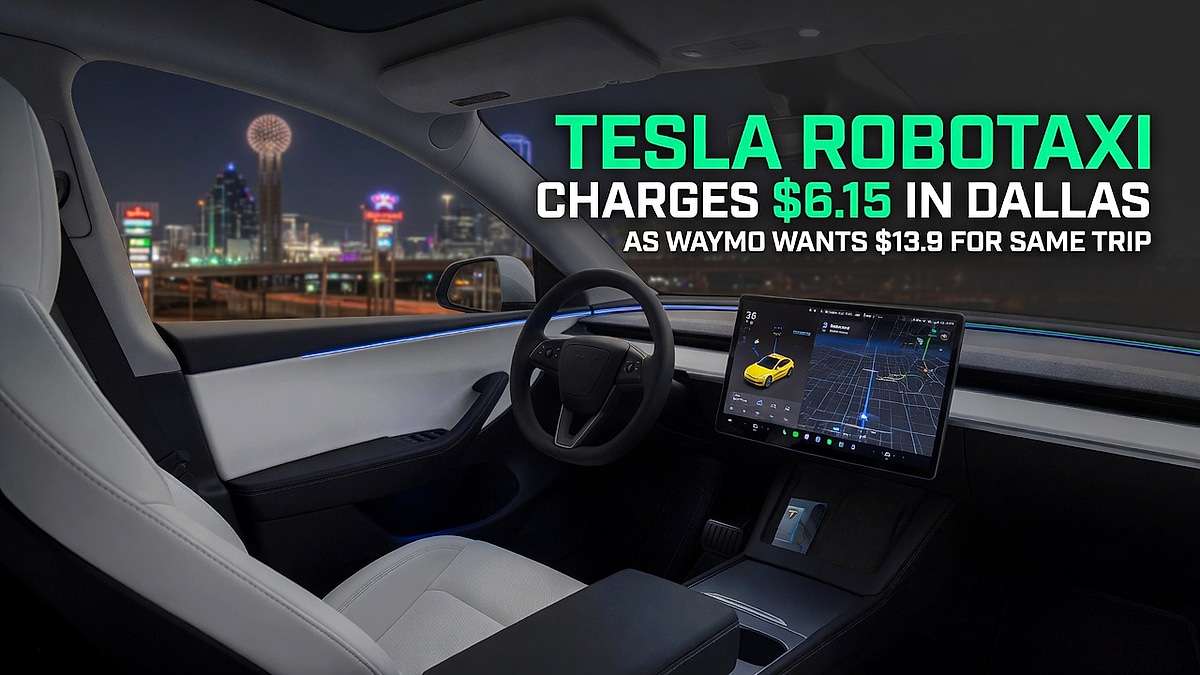

- Tesla's Dallas Robotaxi charged $6.15 for a 2.25-mile ride that Waymo quoted at $13.93, a 56 percent gap rooted in structural economics, not promotional pricing.
-
Dallas launched as a fully unsupervised service from day one, skipping the safety monitor phase Tesla used in Austin, covering roughly 30 to 35 square miles in the urban core and Park Cities
- At $2.73 per mile, Tesla is already competitive with Uber and Lyft, and with the Cybercab at $30,000 per vehicle vs. Waymo's $160,000 retrofit cost, the price gap is only going to grow
Dallas residents are waking up to something big right now. A driverless Tesla just pulled up to a curb in the Park Cities area of Dallas, picked up a passenger, drove 2.25 miles through city streets, and delivered the rider to their destination in seven minutes, all for $6.15. No driver. No safety monitor. No human anywhere in the front seats. Just a Model Y and a receipt that may have quietly changed transportation as we know it. If you have been following how Tesla's autonomy roadmap has evolved from Ark Invest's bold projections and why analysts believed Tesla's Robotaxi vehicle could deliver five times the value of a regular car, this week's launch in Dallas makes both arguments look conservative.
What Happened in Dallas on Day One
On April 18, 2026, Tesla launched its fully unsupervised Robotaxi service in Dallas and Houston. Unlike earlier Tesla Robotaxi operations, Dallas and Houston launched as fully unsupervised services from day one. The car arrived and navigated to the destination with no human hand-holding whatsoever. That is not a small distinction. That is everything.
One early rider opened both apps side by side and compared the price for the exact same trip. The TeslaInsider Facebook page captured the data from a real receipt. A 2.25-mile, seven-minute ride cost $6.15 on Tesla, compared to $13.93 that Waymo quoted for the exact same trip. That is a 56 percent difference. And as the TeslaInsider post explained, "That's not a temporary promotional discount, it's structural unit economics showing up in real customer data."
One number on one receipt. That is all it took to make the argument real.
Why Is Tesla So Much Cheaper Than Waymo
Here is the heart of the story, and it matters for every Dallas resident. The price difference is not a sale. It is not a promotional stunt. Tesla's fleet runs fully unsupervised with no safety driver behind the wheel and no remote operator babysitting each ride, while Waymo still embeds human supervision costs into every fare.
Waymo has disclosed that roughly 35 remote operators assist its fleet, with operators who provide guidance during rides.Every one of those operators costs money. That cost lands on your receipt.
Tesla removed that cost entirely. That is not a software trick. That is a structural business advantage that compounds with every mile driven. Think about it like a restaurant. If your competitor must pay a cook, a manager, and a supervisor to make one dish, while you have automated that entire process, you will always beat them on price at scale.
Is $2.73 Per Mile a Real Deal for Dallas Riders
Let us talk actual dollars. At around $2.73 per mile, Tesla is already competitive with traditional rideshare pricing from Uber and Lyft. This means it is not just about beating Waymo but potentially replacing human-driven rides entirely.
The current introductory pricing in Dallas follows a formula of a $3.25 base fare plus $1.00 per mile. FOX 4 Dallas-Fort Worth So a short hop across town of three miles lands you around $6.25. That is cheaper than most sit-down lunches right now.
For regular commuters in the Dallas area, this matters enormously. If you have ever read how the original TorqueNews discussion of whether Tesla would make Uber and Lyft obsolete played out, the answer is now arriving on city streets, not just on Twitter threads.
How Do You Actually Use Tesla Robotaxi in Dallas
This is what Dallas residents are searching for right now, so let us give you the straight answer. Users can hail a driverless ride directly through the Tesla app, and the service runs from 6 a.m. to 2 a.m. You open the Tesla app, request a ride, and a Model Y comes to you. You get in. You go.
The Dallas service area covers a complex trapezoid-shaped region that includes much of the city's urban core and the Park Cities, encompassing roughly 30 to 35 square miles. If you live or work in Highland Park, Uptown, or parts of downtown Dallas, you may already be inside the zone. Check the Tesla app to confirm your specific pickup location qualifies.
The service is not citywide yet. But here is the thing about Tesla's growth pattern. When the Austin service first launched, it covered just 20 square miles. Today, that Austin geofence has expanded to approximately 245 square miles, growing over 12 times its original size. Dallas is almost certainly on the same trajectory.
What About Safety After the Austin Incidents
Let us be direct here because Dallas residents deserve an honest answer. Tesla is moving forward with its Texas rollout despite lingering safety concerns from its Austin debut, where the fleet logged 14 crashes and several reports of erratic driving. That is a real data point that deserves attention.
On the other hand, TorqueNews has covered what the Austin crash data really means for Tesla's Robotaxi trajectory, and any honest assessment must weigh both the incidents and the millions of miles completed without incident. A William Blair analyst who rode the Tesla Robotaxi described the driving as smooth and human-like, with the vehicle recognizing and patiently waiting for pedestrians, switching into less crowded lanes, and patiently waiting to execute safe turns.
The same report from William Blair noted that by comparison, Waymo felt more robotic. Two trained observers, two different impressions. That is worth knowing before you climb in.
The Cybercab Factor That Changes Everything
Here is where the story gets even more interesting for long-term observers. Every Tesla Robotaxi operating in Dallas today is a Model Y, a car that costs around $40,000 to build. But Tesla is preparing something far more disruptive. As one commenter on the TeslaInsider post pointed out bluntly, "A Waymo car is an expensive car with an expensive retrofit, like 160k total cost. You can't scale at that cost if fleets and fleets of Cybercabs will be running around, vehicle cost 30k a pop. Tesla is coming for all of their lunches."
The Cybercab is purpose-built for this mission. No steering wheel. No pedals. TorqueNews has reported on the early Cybercab design details and what the vehicle signals about Tesla's long-term rideshare ambitions, and the vehicle represents a cost structure that traditional automakers simply cannot replicate.
Wolfe Research has projected Tesla's Robotaxi service could reach $250 billion by 2035, estimating a cost per mile of $1.00 with 50 percent market share. That would make the rideshare industry look entirely different from what it does today. For reference, TorqueNews covered the broader competitive landscape in its analysis of Tesla's robotaxi vehicle compared to Waymo and Uber, and the math keeps pointing in the same direction.
What This Means for Uber and Lyft Drivers
This is a part of the story that rarely gets discussed with enough honesty. Every ride a Tesla Robotaxi completes is a ride that does not go to a human driver. This is not a criticism of Tesla. It is an economic reality that deserves acknowledgment.
Tesla has reportedly completed nearly 700,000 total paid Robotaxi rides since launching the service in Austin, and that number is growing daily. Each one of those was once a potential Uber or Lyft booking. The transition is not hypothetical. It is already running on city streets in Texas right now.
TorqueNews covered how a Cybertruck owner envisions his vehicle picking him up autonomously as part of this broader trend, and that future is arriving faster than most imagined. The question is not whether autonomous rideshare will displace traditional rideshare. The question is when and how fast.
Electrek, a leading EV-focused publication, has also been tracking this launch closely, noting that the Dallas geofence centers around the Highland Park area and that the announcement from Tesla's official account provided minimal details on fleet size and initial operational specifics.
The Seven Cities Plan and What Comes Next
Dallas is not the end of this expansion. It is barely the beginning. Tesla's Q4 2025 earnings guidance outlined a broader first-half 2026 rollout across seven U.S. cities, including Phoenix, Miami, Orlando, Tampa, and Las Vegas. That rollout is happening on schedule, maybe even ahead of it.
The Dallas and Houston launches appear to have skipped the supervised phase entirely, which Morgan Stanley called the single most important catalyst in validating Tesla's Robotaxi strategy. Electric Vehicles When Wall Street starts using words like "material evolution," the market is telling you something worth listening to. TorqueNews reported on the federal regulatory framework that cleared the path for fully autonomous vehicles, and that regulatory clarity is now paying dividends in real cities with real passengers.
The Moral Worth Remembering Here
There is a lesson embedded in this single Dallas receipt that goes beyond transportation economics. The people who called Tesla's Robotaxi promises fantasy just two years ago were not wrong to be skeptical. Healthy skepticism protects us from bad decisions. But there is a difference between skepticism and stubbornness.
The data is now real. The rides are real. The receipts are real. The wisest thing any of us can do, whether we are investors, commuters, or professionals in industries this technology will touch, is to look at evidence honestly and update our views when the facts change. That is not weakness. That is the kind of clear thinking that helps you make better decisions for yourself and the people who depend on you.
The future does not always announce itself loudly. Sometimes it just pulls up quietly at the curb in Dallas and asks where you want to go.
Two Questions for You
If Tesla Robotaxi expanded to your city tomorrow at $2.73 per mile, would you use it instead of Uber or Lyft for your daily commute, and what would it take to make you trust a completely driverless car with your ride?
Also, do you think this first-day Dallas pricing data signals the permanent collapse of Waymo's premium pricing strategy, or does Waymo still have a safety and reliability argument that justifies the higher fare? Share your honest thoughts in the comments section below.
Armen Hareyan is the founder and Editor-in-Chief of Torque News and an automotive journalist with over 15 years of experience writing car reviews and industry news. Now based in the Charlotte region (Indian Land, SC, he founded Torque News in 2010, which since then has been publishing expert news and analysis about the automotive industry. He can be reached at Torque News on X, Linkedin, Facebook, and Youtube. Armen holds three Masters Degrees, including an MBA, and has become one of the known voices in the industry, specializing in the landscape of electric vehicles and real-world stories of actual car owners. Armen focuses on providing readers with transparent, data-backed analysis bridging the gap of complex engineering and car buyer practicality. Armen frequently participates in automotive events throughout the United States, national and local car reveals and personally test-drives new vehicles every week. Armen has also been published as an automotive expert in publications like the Transit Tomorrow, discussing how will autonomous vehicles reshape the supply chain, and emerging technologies in vehicle maintenance.
Set Torque News as Preferred Source on Google
Follow us today...


Comments
It means absolutely nothing…
Permalink
It means absolutely nothing. None of the companies, including Tesla, are setting the price of rides based on their current costs. They set prices to experiment, to see how riders respond to the prices.
Also, what makes you think the Tesla does not have a (remote) safety driver or remote operator? It would be very, very strange if they did not. All self-driving companies, including Waymo, Zoox, Cruise etc. have had full time remote monitors in the first several months after they removed an in-vehicle employee. Do you think they would wave goodbye to the vehicles and hope they came back without watching? Waymo and Zoox have declared they have ceased full time remote monitoring some time ago. Tesla never says anything about what they do except sometimes to hype, it seems, and so everybody is very skeptical of any claims. Do you have a reason not to be skeptical?
This sounds like the way…
Permalink
This sounds like the way Uber prices were cheaper than taxis at first in order break into the market and now Ubers are the same price as regular taxis. Also comparing Tesla Taxis with Waymo is maximal Apples and Oranges. Not me saying but Tesla's own safety reports saying it. Even when they actively try to mislead people.
Not only that Tesla's "self driving" is much worse than Waymo but Tesla's "self driving" is worse than human drivers. So the least they could do is be cheaper.
Game changer and paradigm…
Permalink
Game changer and paradigm shift. In 10 years auto mobile ownership will be a luxury item. Car insurance will be what kills affordable ownership. Transportation will be autonomous ride share and Tesla will be the winner because of vertical interaction. They will build the car, wrote the software and collect the fees. Once regulatory restrictions are removed; Tesla has the ability to output one million robotaxis a year at a cost of 1/3 of Waymo. Tesla will replace Waymo and Uber within a year of autonomous regulation approval. Tesla has billions in cash assets on hand and millions of current customers who will be allowed to put their private vehicles on the platform and make money. The future is bright for Tesla. (Yes I own two teslas and a lot of the stock).