

Electric vehicles have reached a point where the conversation has matured. Instead of debating whether EVs are practical or reliable, more owners are now focused on how they can fit their lifestyle. Sedans, crossovers, and trucks all offer distinct advantages, and choosing between them often comes down to lifestyle rather than loyalty or dissatisfaction. Some switches are not driven by regret at all, but by the pull of something that better matches how someone wants to drive and live.
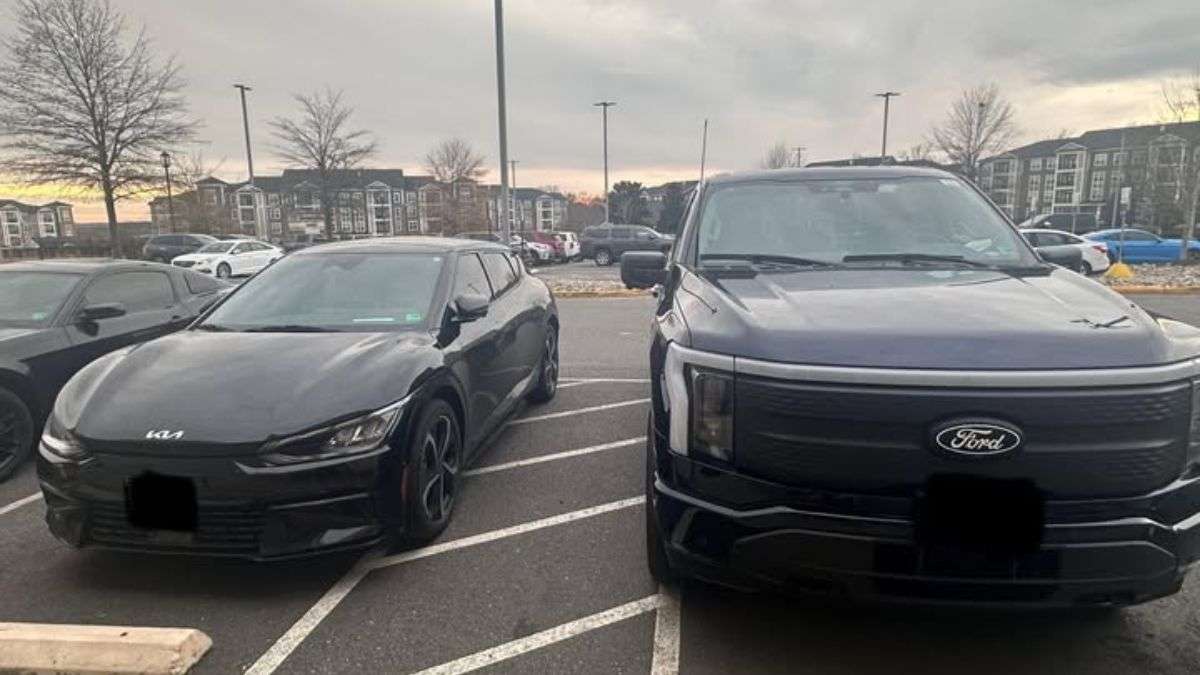
That perspective was visible in a post I came across in the “KIA EV6 Owners USA” group on Facebook by Eric Vetro. Eric shared that he recently traded in his Kia EV6 for a Ford F‑150 Lightning and not because the EV6 fell short, but because he had always wanted an electric pickup truck. What made his post stand out was how thoughtfully he compared the two vehicles after living with both, explaining where the Lightning fits his needs better, where the EV6 still shines, and why Kia continues to hold a special place in his garage alongside his family’s EV9.
“It’s a bittersweet day as I left the EV6 world and traded it in for a F‑150 Lightning. I don’t have anything against the EV6 (it’s a great car), but I always wanted a pickup truck.
Here’s a few comparisons:
• It’s surprisingly peppy for a big truck; a tad slower than my GT Line (but not by much).
• Has more range (due to its battery size) but about 1 mi/kWh less in comparative environments.
• Much slower charging times.
• BlueCruise > HDA (but is a monthly subscription); without the subscription, Kia’s HDA > Ford adaptive cruise control and lane‑keeping assist.
• Kia’s app is better and you can do more, but Ford’s is free.
• No separate V2L adapter, but the truck has anywhere from six to eight 120‑volt outlets, with a 240‑volt outlet available depending on the package.
• The frunk is HUGE. Almost as big as the entire EV6 cargo area.There’s much more customization with Kia in driving experience: ambient lighting colors, acceleration sound type and volume, sensitivity of regen braking and acceleration, eco/normal/sport, auto regen and one‑pedal drive. The F‑150 does not. You have normal and sport (as well as off‑road and towing modes not applicable to the Kia), one‑pedal drive, and standard deceleration that feels more like an ICE car, with nothing in between.
I’m happy with the F‑150, but the EV6 will always have a special place in my heart, and it’s still next door to the EV9 family with my wife’s car.
P.S. Yes, I know about Ford’s announcement. It’s no big deal because I got an extended warranty, and I’m excited to see what they do with the EREV.”
Performance and Efficiency Tell Two Different Stories
Eric’s comment about performance is telling. The F‑150 Lightning is a large, heavy truck, yet it still delivers quick acceleration that comes close to the EV6 GT Line. That kind of responsiveness is part of what has helped convince skeptics that electric trucks are not inherently slow or compromised. At the same time, Eric noticed that efficiency takes a hit. While the Lightning offers more total range thanks to its larger battery, it delivers about one mile per kilowatt‑hour less efficiency than the EV6 in similar conditions.
That tradeoff is common among electric trucks. Size, weight, and frontal area all work against efficiency even as large battery packs help mask the difference in real‑world range. Owners who prioritize nimble handling and efficiency tend to appreciate vehicles like the EV6, while those who value capability and space often accept the efficiency penalty as the cost of admission.
Charging Speed Becomes a Real Divider
One of Eric’s clearest drawbacks with the Lightning was charging speed. Compared to the EV6’s faster charging capability, the Lightning’s slower DC fast‑charging times stood out immediately. This is not just a convenience issue. For drivers who road‑trip frequently, charging speed shapes the entire travel experience.
We have seen how charging behavior and expectations vary widely depending on vehicle type and usage, especially with those explaining how the Ford F‑150 Lightning has reshaped daily driving and energy costs for work and business use. For those drivers, charging often happens at home or overnight making peak DC charging speeds less critical. For others, especially long‑distance travelers, slower charging becomes harder to overlook.
Software and Driver Assistance Philosophy Matters
Eric’s comparison between Kia’s Highway Driving Assist and Ford’s BlueCruise highlights another important ownership difference. BlueCruise offers a more hands‑free experience on approved highways, but it comes with a subscription fee. Without that subscription, Eric actually preferred Kia’s HDA over Ford’s standard adaptive cruise control and lane‑keeping assist.
This distinction matters because it reflects two very different philosophies. Kia emphasizes built‑in functionality and customization while Ford is increasingly leaning toward feature subscriptions. This is a tradeoff that has drawn criticism in other real‑world ownership experiences, including one Ford fan’s frustration with BlueCruise's performance. Neither approach is universally right or wrong, but it can significantly shape how satisfied an owner feels over time.
Utility Is Where the Lightning Pulls Away
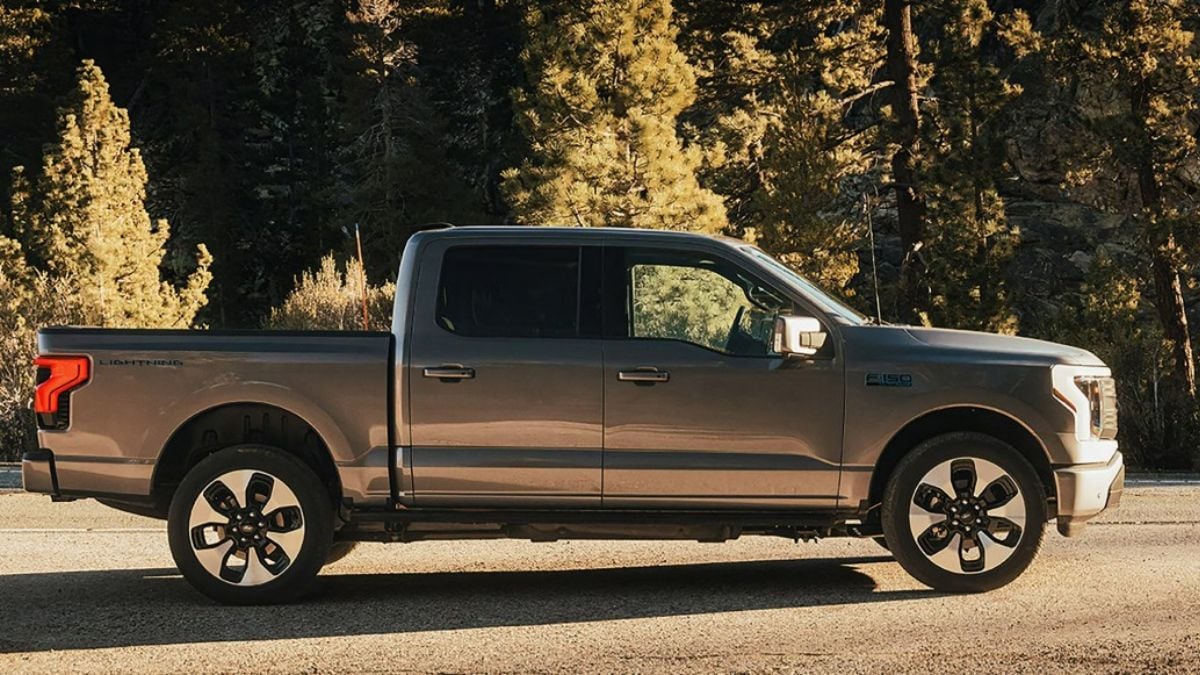
Where the F‑150 Lightning clearly separates itself is utility. Eric pointed out that the truck does not require a separate vehicle‑to‑load adapter. Instead, it offers multiple built‑in power outlets including six to eight 120‑volt outlets and an available 240‑volt outlet depending on configuration. For anyone who camps, works on job sites, or needs backup power, that capability is transformative.
The frunk also left a strong impression. Nearly matching the EV6’s entire cargo area, the Lightning’s front trunk adds secure, weatherproof storage that many owners quickly come to rely on. These practical advantages help explain why some drivers ultimately choose electric trucks even if they miss the efficiency and agility of smaller EVs.
One EV truck owner even ultimately found that after owning a wide range of electric trucks including Rivian and the GMC Sierra EV, the Ford F‑150 Lightning struck the best balance between capability, comfort, and real‑world usability.
Customization Versus Simplicity Behind the Wheel
Eric’s comments on driving customization capture one of the most overlooked differences between Kia and Ford. The EV6 offers extensive control over ambient lighting, regenerative braking strength, acceleration behavior, sound design, and driving modes. The Lightning, by contrast, keeps things simpler. Drivers choose between normal and sport modes, enable one‑pedal driving if desired, and otherwise experience a more traditional deceleration feel similar to an ICE vehicle.
For some drivers, that simplicity is refreshing. For others, especially those who enjoy tailoring every aspect of the driving experience, it can feel limiting. Again, neither approach is objectively better, but they appeal to different personalities.
What Other Owners Are Saying
The comments under Eric’s post added important context from owners who are facing similar decisions.
Rich Adams wrote, “Our two EV6s have been flawless. But after owning a Tacoma and a couple of Tundras, I really miss having a truck. So a Lightning will probably be next for us as well. Enjoy your new ride.”
Rich’s comment reinforces a recurring theme. Sometimes the pull toward a truck has less to do with dissatisfaction and more to do with familiarity and lifestyle needs built over years of ownership.
Ron Barnett shared a different perspective, saying, “I have both the GT and Lightning. I have lived with the Lightning since September 2024. I’ve put almost 30,000 miles on it since it was new and decided I wouldn’t mind an EV car as well. I love both.”
Ron’s experience highlights that this does not always have to be an either‑or decision. For households that can support multiple vehicles, pairing a performance‑focused EV with an electric truck can deliver the best of both worlds.
Massimo Delli raised a more technical concern, writing, “I love the Lightning, but I just can’t get over the 400‑volt architecture. I like to travel, and I need level‑3 charging to be 30 minutes or less.”
What Charging Architecture Really Means for Buyers
Massimo’s comment opens the door to a broader conversation about charging architecture and expectations. Vehicles like the EV6 benefit from faster charging curves that make long trips easier to plan. The Lightning’s 400‑volt architecture prioritizes durability, towing capability, and thermal stability, but it can result in longer charging stops on road trips.
That tradeoff does not make the Lightning a bad truck. However, real‑world ownership data has also shown that keeping a Ford F‑150 Lightning warm in winter conditions can come with higher energy costs than some owners expect, prompting some drivers to rethink how and when they precondition or store the truck. The challenge is aligning expectations. Drivers who frequently road‑trip may prioritize charging speed, while those who charge at home and value utility may see winter energy use as a manageable tradeoff.
I think this story captures an important moment in the EV market as discussions continue around Ford’s F‑150 Lightning discontinuation and why they reflect marketing challenges rather than it being a bad truck. The EV6 represents efficiency, customization, and fast charging. The F‑150 Lightning represents capability, simplicity, and versatility. Neither choice is wrong, but understanding those differences upfront prevents disappointment later.
Key Takeaways
• EV‑to‑EV switches are about lifestyle, not failure. Many owners change vehicles because their needs evolve, not because something went wrong.
• Charging speed shapes road‑trip experience. Faster charging can matter more than raw range for frequent travelers.
• Utility comes with tradeoffs. Built‑in power and cargo space often mean lower efficiency and slower charging.
• Software philosophy affects satisfaction. Subscriptions versus built‑in features influence long‑term ownership perceptions.
• No EV is one‑size‑fits‑all. Matching the vehicle to daily use matters more than headline specs.
What About You?
Have you ever switched from one EV to another because your needs changed even though you liked your previous vehicle?
And if you were choosing today, would you prioritize faster charging and customization or everyday utility and truck capability?
Please don't hesitate to let us know what you think in the comments below.
Aram Krajekian is a young automotive journalist bringing a fresh perspective to his coverage of the evolving automotive landscape. Follow Aram on X and LinkedIn for daily news coverage about cars.
Image Sources: The “KIA EV6 Owners USA” Facebook group and Ford’s gallery, respectively.
Set Torque News as Preferred Source on Google
Follow us today...



Comments
ERRATA: The Redditor did not…
Permalink
ERRATA: The Redditor did not say charging SPEED. They pointed out charging TIME. That's because the F-150 has a friggin giant battery by comparison. We're in a similar situation with a Volvo XC40 Recharge and a Lightning. Just plugged in to Level 1, 120 volts at the wall overnight, it's a rare day that the XC40 hasn't topped up to 90%, but the Lightning takes a lot longer.
20% of the XC40 is 15.6 kWh - or 9.5 hours charging overnight from 70-90%.
20% of the Ford is 26.2 kWh - or 15.5 hours charging overnight from 70-90% - or 63% longer TIME at the same SPEED...which is what the Reddit poster was talking about.
That said - I've charged the Lightning at our local 350 KW charger, and went from 40% (75 miles) to 80% (190 miles) in less time than it took me to walk over to the adjacent Burger King and have lunch. (24 minutes) - so charging time, while maybe taking longer than an EV6 just due to the sheer size difference of the battery, doesn't seem to be onerous.
24 minutes to get just 40%…
Permalink
In reply to ERRATA: The Redditor did not… by JB (not verified)
24 minutes to get just 40% charge is way too much time for me. My gas truck goes from 0 to 100% in about 3 minutes. I grab food and eat and drive. If my stop is longer than 8 minutes I feel trapped.