


The Cybertruck was never meant to be subtle, but a recent owner-led analysis suggests one of its shortcomings may be easiest to miss and hardest to unhear. According to a Cybertruck owner who also owns a Model Y, professional audio measurements show the stainless pickup delivers significantly less low-end bass than Tesla’s crossover. Not by feel or opinion, but by data.
The owner, posting under the name Jbrazda, set out to quantify something he had suspected for months. Using Room EQ Wizard, a widely respected acoustic measurement program, paired with a calibrated MiniDSP UMIK-1 microphone, he measured the in-cabin frequency response of the Cybertruck’s stereo system. The setup was methodical. Microphone positioned at ear level. A full frequency sweep from 0 to 20,000 Hz. Focus narrowed specifically to the sub-100 Hz region where true bass lives. The resulting graph was then compared directly to a prior measurement taken in a 2021 Model Y.
“I used a program called REW (Room EQ Wizard). I used it with a Mini DSP Umik-1 calibrated mic. I set the mic up at ear level and ran a frequency sweep from 0-20,000hz. The program then gives me a graph of the frequency response. I only llookedat 100hz and below as I was testing for the bass response. I then compared it to a 2021 Model Y measurement. The model Y is significantly louder between 30 and 40 Hz. I have been saying that the Cybertruck lacks low bass for a while. Now I have proof. The Cybertruck is about 10db less at 30hz than it is at 40hz. A 6db difference is double.”
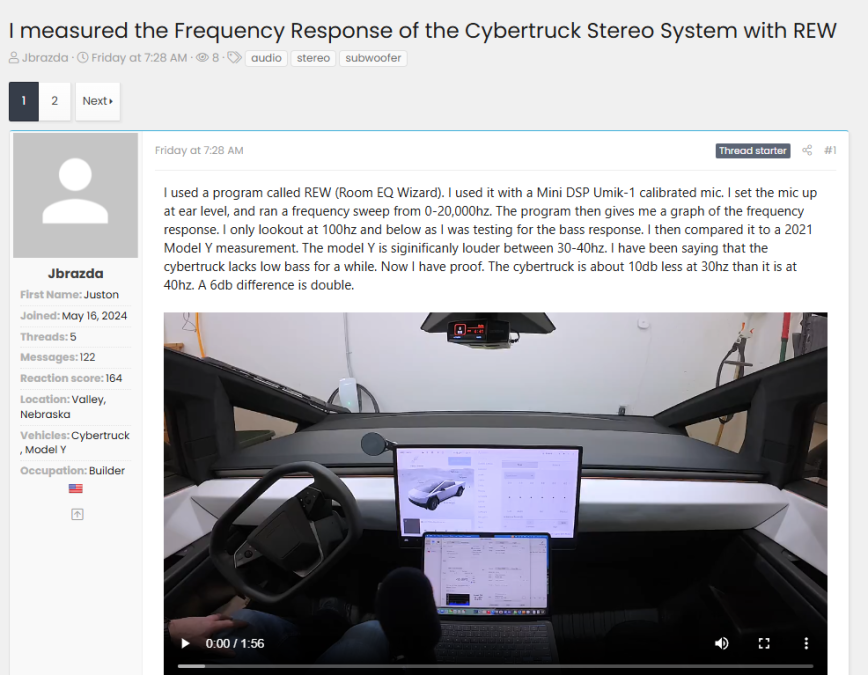
The result was not subtle. At roughly 30 Hz, the Cybertruck measured nearly 10 dB lower than the Model Y. In acoustic terms, that is not a rounding error. A 6 dB drop represents roughly half the perceived output. Ten decibels is the difference between presence and absence. The Cybertruck’s bass response climbs as frequency increases, but the deepest notes simply are not there in the same way they are in the Model Y.
Tesla Cybertruck: Design Style
- The Tesla Cybertruck is a fully electric pickup with no gasoline option and relies entirely on battery power.
- Its design uses straight lines and flat surfaces, making it instantly recognizable compared with traditional trucks.
- The truck includes a lockable, covered bed that keeps cargo hidden and protected from the weather.
- Most driving and vehicle settings are controlled through a central touchscreen rather than physical buttons.
This distinction matters because 30–40 Hz is where bass stops being a thump and starts becoming physical. It is the low-end foundation that gives music weight, scale, and atmosphere. According to the measurements, the Cybertruck is not just quieter in this range. It appears intentionally limited. The response curve shows a clear roll-off below 40 Hz, suggesting either tuning decisions, enclosure constraints, or subwoofer limitations rather than a calibration error.

Forum responses reflected both curiosity and resignation. One user asked whether the system could be recalibrated to restore output in that range. The answer was blunt. There is no real software fix. Tesla provides a basic bass and sub adjustment, but without knowing which frequencies those controls target, there is only so much headroom available. Equalization cannot create bass that the hardware cannot physically produce. Below 40 Hz, the Cybertruck simply does not move enough air.
That reality points toward packaging rather than neglect. The Cybertruck’s interior architecture is radically different from other Teslas. The cabin is vast, angular, and filled with hard surfaces. The subwoofer enclosure is constrained by a stainless exoskeleton, under-seat packaging, and utility-driven design priorities. Deep bass requires enclosure volume, cone excursion, and tuning flexibility. Trucks are not immune to physics, even futuristic ones.

The comparison to the Model Y is especially revealing because the Model Y is not marketed as an audio benchmark. Yet its smaller cabin, more traditional enclosure placement, and softer interior surfaces appear to give it an advantage in low-frequency reinforcement. In short, the Model Y cabin helps the subwoofer do its job. The Cybertruck cabin fights it.
What makes this analysis resonate is its restraint. There is no brand-bashing here, no exaggeration. The owner simply measured, compared, and reported. His conclusion is clear and difficult to argue with. The Cybertruck’s sound system lacks meaningful bass below 40 Hz, and no amount of EQ tweaking will change that. Anyone seeking the kind of low-end authority found in the Model Y will need to consider aftermarket solutions.
This fits a pattern seen across the Cybertruck. Tesla prioritized durability, visual impact, and structural novelty over refinement in certain areas. Road noise, ride tuning, and now deep bass all reflect that tradeoff. For many buyers, that is acceptable. For others, especially those accustomed to Tesla’s traditionally strong audio systems, it is a noticeable regression.
The Cybertruck looks like it should hit hard in every sense, including audio. The measurements suggest otherwise. And once you know where the bass disappears, you may never stop listening for it.
Image Sources: Tesla Media Center
Noah Washington is an automotive journalist based in Atlanta, Georgia. He enjoys covering the latest news in the automotive industry and conducting reviews on the latest cars. He has been in the automotive industry since 15 years old and has been featured in prominent automotive news sites. You can reach him on X and LinkedIn for tips and to follow his automotive coverage.
Set Torque News as Preferred Source on Google
Follow us today...






Comments
The audio quality of my 2026…
Permalink
The audio quality of my 2026 Model Y Juniper is less impressive and enjoyable than the 2022 Model 3 Tesla. This might be the trend with the newer Tesla Models and may not limited to the Cyber truck only.
30Hz is sub bass, not bass…
Permalink
30Hz is sub bass, not bass. It's so low that it's nearly inaudible. About it giving the music "weight," this is really only true for genres with extreme low end like dubstep. The majority of genres have nearly no information as low as 30Hz. The bass "feel" tends to come from 40-50Hz, and the bass sound is around 60-90Hz.
Just when you thought the…
Permalink
Just when you thought the lives of CT owners couldn't get any more pitiful...