
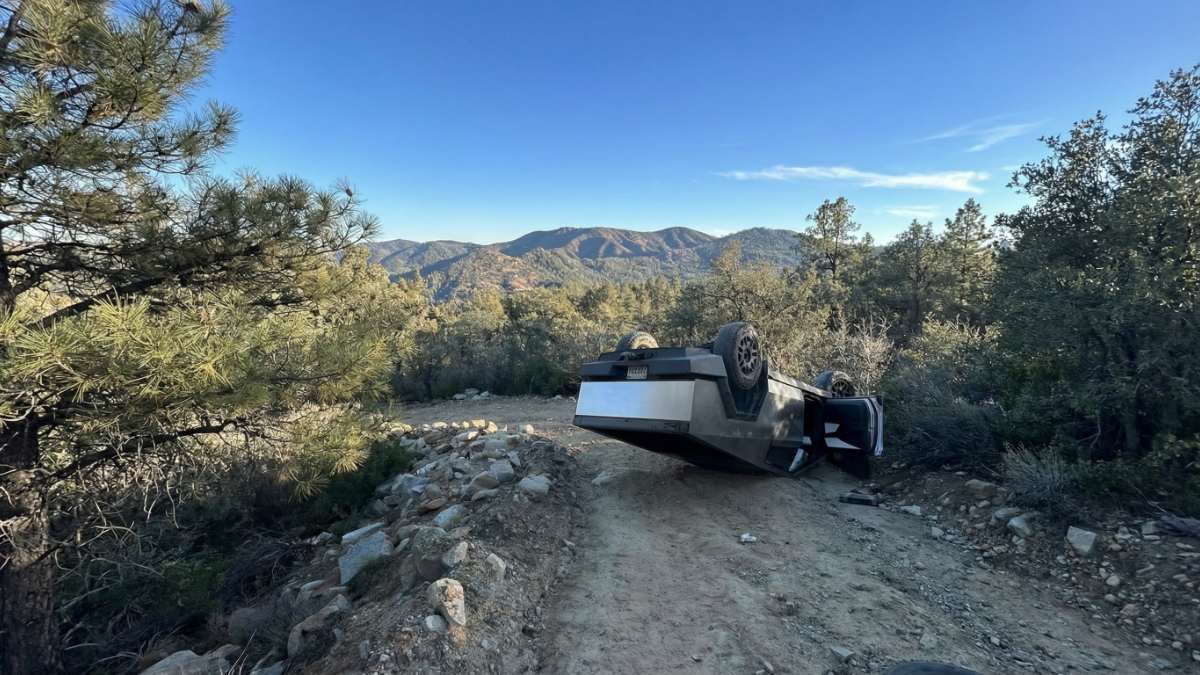

There are moments in the life of any vehicle when theory gives way to gravity, friction, and split-second decision-making. One such moment surfaced recently in a Cybertruck Owners Only Facebook group, where owner Joe Sawyer described an incident that shows how quickly control can become consequence, even at low speeds. His account is not a declaration of failure, nor a condemnation of technology, but a sober reminder that edge cases matter most when the margins disappear.
Sawyer explained that while descending a steep 26-degree downhill section, he experienced difficulty stopping his Cybertruck from what began as a very low speed. According to his post, the truck continued to gain speed from roughly 5 mph to more than 12 mph despite braking input, forcing him into an impossible choice between a controlled impact and the risk of tumbling down a mountainside.
He chose the former. The vehicle rolled, yet he walked away with only minor injuries, and the truck itself showed limited damage considering the circumstances.
“Had an issue stopping my Cybertruck from a low speed the other day and had to make a choice to crash it or risk going tumbling down a mountain to probable death. Sucks to see, but it held up well and only had a few minor scrapes and bruises.
Still going over every choice made and trying to understand why it would not stop and was gaining speed from 5 mph to 12+ while on the brakes. ABS was probably hurting more than helping on this 26° downhill angle. Hoping to be able to talk to someone at Tesla, as I have the crash recorder data already.”
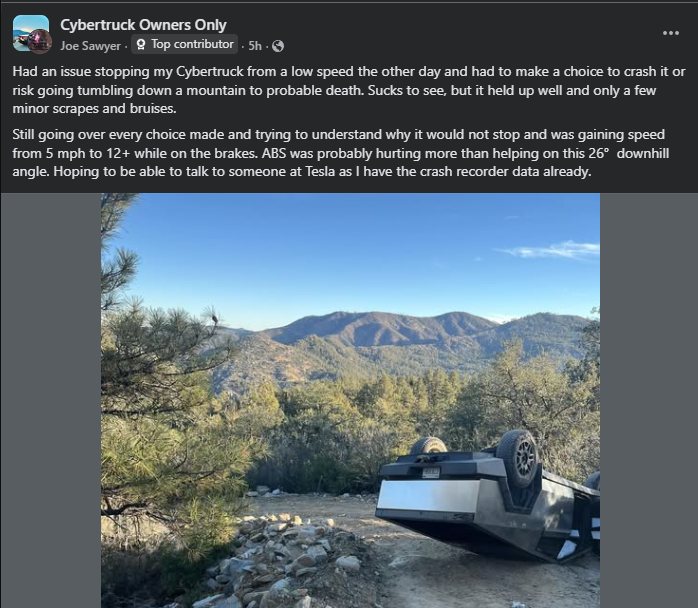
What makes the account notable is Sawyer’s measured tone. He did not rush to assign blame, nor did he frame the event as proof of a systemic defect. Instead, he focused on understanding what happened. He speculated that ABS behavior on such a steep, low-traction downhill may have reduced braking effectiveness, a known challenge in extreme grades where wheel slip and stability algorithms must balance competing priorities. His intention, he said, was to review the crash recorder data and speak directly with Tesla Cybertruck engineers.
Tesla Cybertruck: The Engineering Behind It
- The Cybertruck’s exterior relies on thick stainless steel panels that eliminate paint but introduce constraints in shaping, resulting in flat surfaces and sharp angles that define both its appearance and repair considerations.
- Its large footprint is paired with steer-by-wire and rear-wheel steering, reducing low-speed turning effort while creating a steering response that can feel unfamiliar compared with conventional pickups.
- The suspension is tuned to support heavy loads and towing, which helps maintain stability under weight but can lead to a firmer ride over uneven pavement when unladen.
- Cabin design follows an extreme minimalist approach, with nearly all controls integrated into a central touchscreen, limiting physical redundancy for frequently adjusted functions.
The response from the community revealed the full spectrum of modern owner discourse. Some demanded video evidence, reflecting a growing expectation that data must accompany any claim. Sawyer replied that the crash recorder did not capture video until after the vehicle had rolled, a limitation that itself raises questions about how incidents are documented and later analyzed. Others expressed skepticism about whether Tesla would investigate at all, while a few dismissed the venue as inhospitable to critical discussion.
Sawyer’s follow-up responses were telling. He made clear that he considers himself pro-Tesla, but not opposed to scrutiny. If something went wrong, he wants it understood and corrected. If it was simply an unfortunate alignment of conditions, he wants to know that too. That posture is significant. It reflects a maturing relationship between drivers and highly automated vehicles, where loyalty does not preclude accountability.
From a technical perspective, steep downhill braking is one of the most complex scenarios any vehicle can face. Weight transfer, brake modulation, tire grip, and software-governed systems like ABS and traction control are all operating simultaneously, sometimes with conflicting goals. Electric vehicles add another layer, as regenerative braking may be reduced or unavailable under certain conditions, placing full demand on the friction brakes. None of this implies fault, but it does explain why such situations are studied carefully when data is available.
Equally important is what the outcome demonstrated. The Cybertruck’s structure protected its occupant in a rollover scenario, and Sawyer was able to exit with relatively minor injuries. That is not incidental. It is the result of design priorities that place occupant protection at the top of the engineering brief, especially in vehicles expected to operate in rugged environments.
The larger value of Sawyer’s post lies in its transparency. By sharing an experience that was frightening, unresolved, and still under review, he contributed something more useful than certainty. He contributed information. In an era when vehicles are defined as much by software as steel, real-world incidents become critical data points, not just for manufacturers, but for other owners navigating similar terrain.
Progress in the automotive world has never been linear or free of hard lessons. It advances through moments like this, when drivers survive, questions are asked, and systems are examined rather than dismissed. Whether Sawyer’s experience proves to be a rare convergence of conditions or something that leads to deeper insight, it stands as a reminder that the most important conversations about safety begin after the dust settles, not before.
Image Sources: Tesla Media Center
Noah Washington is an automotive journalist based in Atlanta, Georgia. He enjoys covering the latest news in the automotive industry and conducting reviews on the latest cars. He has been in the automotive industry since 15 years old and has been featured in prominent automotive news sites. You can reach him on X and LinkedIn for tips and to follow his automotive coverage.
Set Torque News as Preferred Source on Google
Follow us today...


Comments
Now that's a pretty weird…
Permalink
Now that's a pretty weird development. I've driven my Model S's through the Sierras, on I-80, streets and highways. No problems at all, and regen braking worked perfectly every time.