
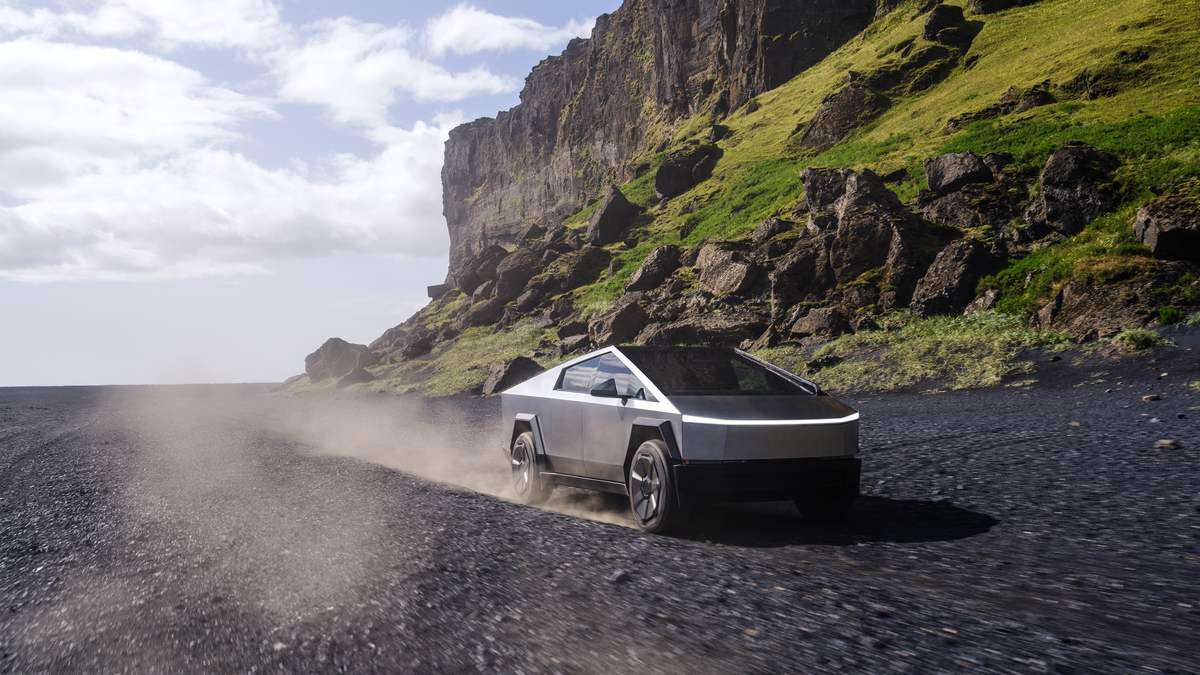

The Tesla Cybertruck was never going to live an ordinary life, and that extends to the consumables bolted beneath it. Tires, on this vehicle, are not just rubber and steel. They are a statement about intent. Highway comfort versus off-road credibility. Efficiency versus grip. And in the Cybertruck owner community, few things spark more measured curiosity than a real-world tire swap backed by actual data instead of speculation.
That curiosity is what brought one owner, posting under the name Shygar, to document his experience after replacing the factory Goodyear all-terrain tires with a full set of BFGoodrich KO3s. After nearly 31,000 miles on the original Goodyears, with 4 to 6 thirty-seconds of tread remaining, the decision was not driven by failure but by seasonality. Rain and snow were coming, and the truck saw a mix of long highway runs and occasional off-road use.
“I just hit 31k on my Goodyear AT tires. I still had about 4-6/32nd on the Goodyears, but with the rain and snow finally coming, I thought I'd go ahead and switch. I do a lot of highway driving, but also do the occasional off-roading for fun. I've only just got the tires today, but so far I really like them. Garage smells like rubber again when I first got the truck almost 2 years ago.
I went to America's Tire (discount tire), about an hour away from me, since they had them in stock there. So I took the opportunity to record watts per mile there and back.
I used FSD both ways on hurry, and there was some traffic on the way back, which may have accounted for the better mileage. I'll try to keep this updated with how they do, but so far I really like them compared to stock Goodyears. I do hear slightly more noise at highway speeds, and I noticed at one point my scroll wheels were vibrating. But they don't seem any rougher than stock Goodyears.”
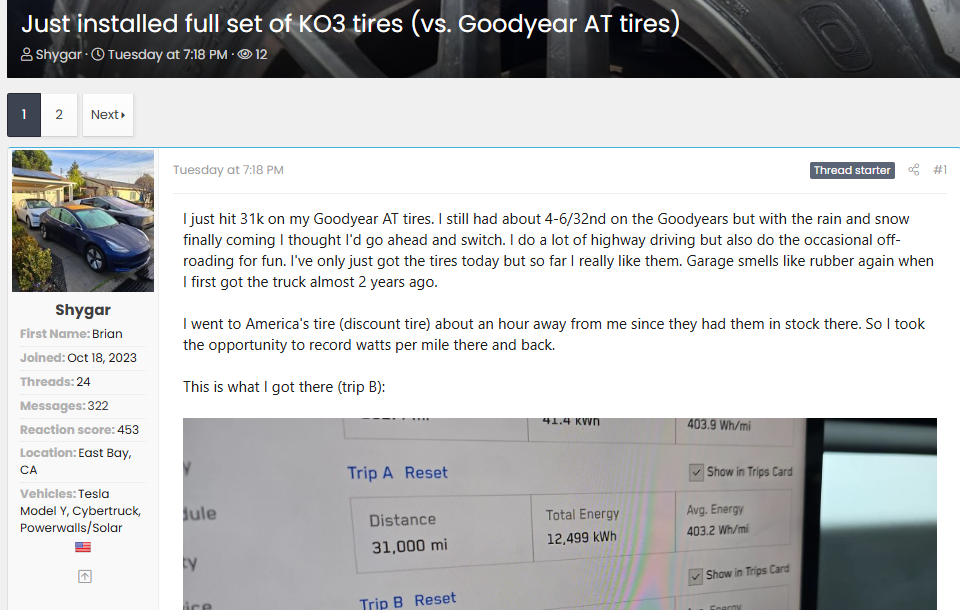
What elevates the story beyond a simple tire review is the owner’s decision to treat the swap as an experiment. America’s Tire was an hour away, which created a convenient out-and-back loop. Before the KO3s were installed, Trip B was reset. After installation, the same route was driven back under similar conditions. Full Self-Driving was used both ways, set to “hurry,” with traffic slightly heavier on the return trip. This was not a laboratory test, but it was honest, repeatable, and grounded in how the truck is actually used.
Tesla Cybertruck: Engineering & Interior Design
- The stainless steel exterior replaces conventional painted panels, improving resistance to minor cosmetic damage while limiting design curvature and complicating repair processes.
- Steer-by-wire and rear-wheel steering reduce low-speed maneuvering effort, though the steering response differs noticeably from conventional pickup systems.
- Interior layout is highly minimal, with nearly all vehicle functions accessed through a central display, reducing visual clutter but increasing dependence on software interaction.
- The enclosed, powered bed emphasizes security and weather protection, trading some of the quick-access flexibility found in traditional open-bed designs.
The numbers tell a nuanced story. On the outgoing leg with the original Goodyear all-terrains, the Cybertruck recorded an average energy consumption of just over 400 watt-hours per mile. On the return trip with the KO3s fitted, the figure nudged higher, landing in the low 430 watt-hours per mile range. That delta will not surprise anyone who understands tire construction. The KO3 is more aggressive, heavier, and designed with durability and off-road traction in mind.
What matters more is the size of that price. This is not a dramatic efficiency collapse, nor does it fundamentally change the Cybertruck’s long-distance usability. Over tens of thousands of miles, a few dozen extra watt-hours per mile add up, but they do not rewrite the vehicle’s mission. For an owner who values all-weather confidence and off-pavement capability, the tradeoff appears measured rather than excessive.

Subjectively, the feedback aligns with expectations as well. Road noise at highway speeds is slightly more pronounced, and there was a brief moment where vibration could be felt through the scroll wheels. Yet the ride itself was described as no rougher than stock, and nothing approached what seasoned truck owners would call objectionable. This is an important distinction. Many all-terrain upgrades promise toughness at the expense of civility. Here, the Cybertruck’s stiff structure and suspension tuning seem to absorb much of the tire’s added character.
There is also something quietly revealing about the use of Full Self-Driving throughout the test. The system removes throttle variability from the equation, allowing the tires themselves to play a larger role in the results. It is an unintended benefit of modern driver assistance that it can turn owner experiments like this into cleaner data sets, even if the intent was simply to make the drive less tedious.
Threads like this are why owner forums remain indispensable, even in an age of polished reviews and influencer impressions. No manufacturer is going to publish efficiency deltas for tire swaps that were never part of the homologation plan. No press event will linger on the smell of new rubber or the subtle hum at 70 miles per hour. That texture comes only from people living with the machines they bought.
The Cybertruck, like the pickups before it, invites owners to tailor it to their needs. In this case, the BFGoodrich KO3s appear to deliver exactly what they promise: more capability, slightly lower energy use, and a character shift that feels deliberate rather than accidental. For a truck that was always meant to be polarizing, that balance feels just about right.
Image Sources: Tesla Media Center
Noah Washington is an automotive journalist based in Atlanta, Georgia. He enjoys covering the latest news in the automotive industry and conducting reviews on the latest cars. He has been in the automotive industry since 15 years old and has been featured in prominent automotive news sites. You can reach him on X and LinkedIn for tips and to follow his automotive coverage.
Set Torque News as Preferred Source on Google
Follow us today...




Comments
Wait...you're getting only…
Permalink
Wait...you're getting only 31k miles out of your tires? What's wrong with your vehicle? I'm getting 70k out of mine, and I drive a performance vehicle.
Efficiency didn't "drop" it…
Permalink
In reply to Wait...you're getting only… by Buzz Wired (not verified)
Efficiency didn't "drop" it increased. wh/mi ≠ efficiency
It was a confusing article. …
Permalink
In reply to Efficiency didn't "drop" it… by Augusto (not verified)
It was a confusing article. The headline says energy use DECREASED by ~3% (403 to 390. Then the article says it increased by ~7% (403 to 430). But nex it says "the BFGoodrich KO3s appear to deliver exactly what they promise: more capability, slightly lower energy use".
Electric vehicles are heavy…
Permalink
In reply to Wait...you're getting only… by Buzz Wired (not verified)
Electric vehicles are heavy and as ugly as these are, they are quick, so add that together and they eat tires
You're a troll for this…
Permalink
In reply to Wait...you're getting only… by Buzz Wired (not verified)
You're a troll for this comment, jabroni... Huffy's are not performance vehicles, neither are Schwin's, Mongoose's, or your 99 Chevrolet Malibu. Dope....
Considering they used “Hurry…
Permalink
In reply to Wait...you're getting only… by Buzz Wired (not verified)
Considering they used “Hurry” mode to test, I wouldn’t be surprised how they drive normally.
He saw efficiency increase…
Permalink
In reply to Wait...you're getting only… by Buzz Wired (not verified)
He saw efficiency increase not drop. Also a cyber beast can beat a porsche while towing a porsche for at least an eighth of a mile.
It is a Tesla. What do you…
Permalink
In reply to Wait...you're getting only… by Buzz Wired (not verified)
It is a Tesla. What do you expected? It was a good idea. Emphasis on "was".
Definitely not doing…
Permalink
In reply to Wait...you're getting only… by Buzz Wired (not verified)
Definitely not doing something right lol. I just put new all terrain tires on my F-150 and they come with a 70,000 mile warranty. If he's getting 31,000 miles on tires, there's something iffy going on. Hell, I've put 80,000+ miles on tires with only 20,000 mile warranty lol. Dude probably curbing it or has bigger suspension issues he's neglected. He probably doesn't know that rotating is a thing....sad.
Weight of vehicle is more. …
Permalink
In reply to Definitely not doing… by Do better (not verified)
Weight of vehicle is more. With that much torque probably can't resist burning them off
403 wh/mile???? I have a M3…
Permalink
403 wh/mile????
I have a M3 and I get 350wh/mile on a good day..
Do they measure miles or wh differently for a cyber truck?
Bfg ko3's are bad tires and…
Permalink
Bfg ko3's are bad tires and overpriced. There are way better tires from nitto and toyo that cost less, but considering that they were put on a underperforming and overpriced cybertruck, maybe it makes sense. Lol
I'm amazed that you'd write…
Permalink
I'm amazed that you'd write a full article based on a single, highly unrepresentative, out and back trip.
You should check the sea…
Permalink
You should check the sea level elevation at both locations. I’m sure this would impact the difference in battery discharge while driving each leg. If there is a publicly available constant you would make your experiment more meaningful. I applaud you for effort though.
You are comparing a nearly…
Permalink
You are comparing a nearly worn out tire to a new one. You would have to compare a new set of Goodyear to the new set of bfgoodrich to have an accurate comparison.
It's likely not the style of…
Permalink
It's likely not the style of tires that dropped the efficiency. New tires always drop mileage slightly, whether it's an ICE vehicle or an electric. The deeper tread has more flex and creates more rolling resistance. Your best fuel/electricity mileage will be from half tread to worn out, regardless of which tires you're running, because of decreased rolling resistance.
If you read the headline,…
Permalink
In reply to It's likely not the style of… by Robert (not verified)
If you read the headline, energy/mi DROPPED, 403 to 390. Then the article says it increased (403 to 430).
But that is followed by this "the BFGoodrich KO3s appear to deliver exactly what they promise: more capability, slightly lower energy use"
It's likely that the style…
Permalink
It's likely that the style of tire on the truck is not solely responsible for the drop in fuel efficiency. New tires, regardless of the style or brand, will cause a slight decrease in fuel efficiency because of the depth of the tread. Deeper tread flexes more which increases the rolling resistance and results in slightly less fuel economy. Your best fuel mileage will be with your tires at half tread or less because of that tread flex. Recheck your fuel efficiency at about half tread and I think you will see it return to previous levels.
What a bullsh*t test. A)…
Permalink
What a bullsh*t test. A) traffic was all different, B) it could have been uphill one way and downhill back, C) the wind EASILY could throw that off (headwind one way, tailwind back) especially with such a sh*tty coefficient of drag that that pig-truck has… useless article.
Efficiency didn't drop. …
Permalink
Efficiency didn't drop. Efficiency increased.
On the one hand I wouldn't…
Permalink
On the one hand I wouldn't want to lose that milage in bad weather, or off-roading. But that's a better alternative than not having the tires.
An even better alternative would be a car better suited to everything than a cybertruck.
31,000 kilometers, not 31…
Permalink
31,000 kilometers, not 31,000 miles. For us Americans that's 18,000 miles. Plus, the tires he bought cost $2500 if you include road hazard. $1250 in tires ever 9000 miles. Truly is no real savings in electric vehicles.
It's odd the headline said…
Permalink
It's odd the headline said the return was MORE efficient at 390Wh/mi NOT 430
This isn't newsworthy. You…
Permalink
This isn't newsworthy. You always lose vehicle-calculated efficiency with new tires, because worn tires have a smaller diameter and trick the car into thinking you're going farther. When you get full tread back, it goes back to normal. The only real way to test is using new tires back to back with external instrumentation to account for differences in revolutions per mile.
Is there an elevation change…
Permalink
Is there an elevation change between the tire shop and your home? An elevation change could explain the difference in power consumption.
Thats not a flex.. the…
Permalink
Thats not a flex.. the average lifespan of A/T and mud terrain tires that I run on a 3/4 ton pick up last an average of 100,000-130,000 kms with much abuse offroad and on hwy...
Just goes to show how non efficient the electric vehicles are will all that weight.
I would expect this to…
Permalink
I would expect this to happen even if the exact brand and type of tire replaced the tires removed from the car. Why? Because the extra tread thickness of the new tires compress more and raises the rolling resistance of the tires.