
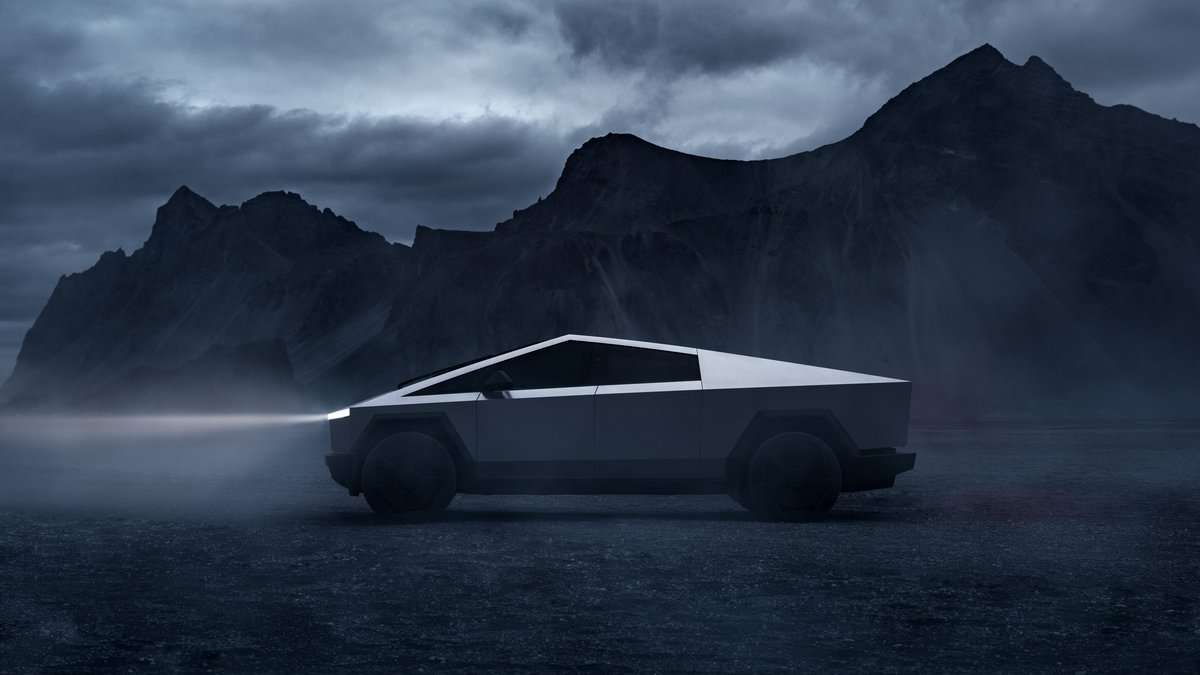

Progress has never waited for consensus. It arrives awkwardly, sometimes noisily, and often challenges long-held assumptions about who can drive and how well. The Tesla Cybertruck fits squarely into that tradition. Its sharp-edged design attracts debate, but the more consequential story sits behind the wheel, where new technology is quietly changing how quickly confidence and competence can develop. At the center of this shift is Tesla’s Full Self-Driving system, not as a replacement for human judgment, but as a tool that lowers the intimidation factor of modern driving.
That reality came into sharp focus in a Facebook post shared by Cybertruck owner David Murray, who described letting a 15-year-old neighbor with little driving experience take the wheel at night on hilly, twisting farm roads.
“I bumped into the neighbors (fellow farmers) at dinner last night. Our friendship spans 55 years (three generations) when their son turned 15.5, and I had just purchased my Model S, I’d let him practice driving to his private school in their busy season, especially. ( orchard) So last night it seemed fair that their daughter get equal time, so I asked her if she wanted to drive my Cybertruck back to her farm. Didn’t take her a second to say, “Heck yes.” Somehow, though, her mom thought it was harder to drive in the dark, which she hadn’t because of parental fear. Driving a CT is like driving NO OTHER VEHICLE, and it took several trips around a near-empty parking lot before the all-wheel steering clicked into her head and could perfectly hold travel lanes in the parking lot. We then headed onto the main drag, going in and out of FSD a couple of times for her to feel the perfect track of the CT on the road. Heading back to the orchard, we took the absolute hilliest twisting road back, and K and I made her drive 90% of it, letting her experience FSD in a few spots. The whole trip was maybe 2 miles, but in arriving back to the orchard,d I can honestly say I was totally impressed with how quickly an inexperienced driver adapted perfectly to operating a Cybertruck!”
After a short familiarization in an empty parking lot, she transitioned to public roads, alternating between manual control and brief demonstrations of FSD. Over a total distance of roughly two miles, Murray watched her adapt to the Cybertruck’s all-wheel steering and precise road tracking with a speed that surprised even him. His conclusion was simple and telling: the learning curve collapsed far faster than expected.
Tesla Cybertruck: Ride Quality
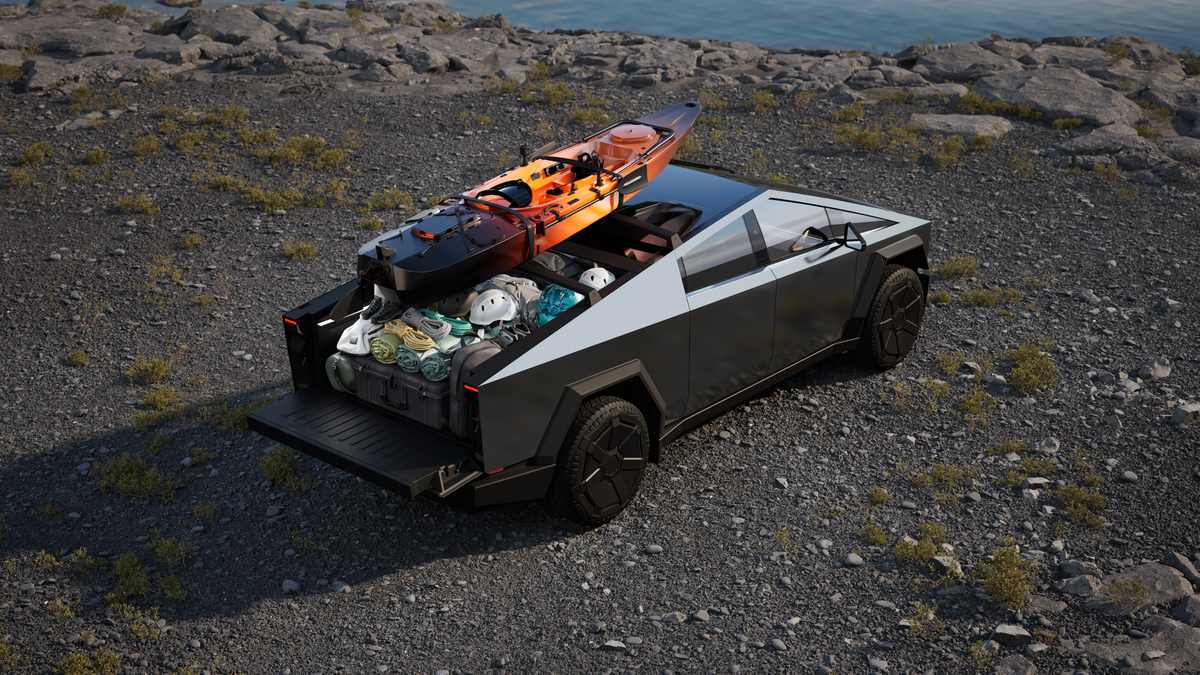
- The rear cargo bed integrates a powered tonneau cover that improves security and weather protection, though its mechanism adds weight and limits flexibility compared to removable or soft-cover solutions.
- Ride quality reflects a balance between payload capability and daily usability, with the stiff structure managing heavy loads well but transmitting more road texture on uneven urban surfaces.
- Visibility from the cabin benefits from a high seating position and a large windshield, while the sharply sloped roofline and thick pillars create tradeoffs for rearward sightlines.
- Charging and ownership logistics remain closely tied to Tesla’s charging ecosystem and software updates, offering seamless integration for some users while reinforcing reliance on the brand’s proprietary infrastructure.
What makes the story compelling is not novelty or spectacle, but context. Night driving, elevation changes, and unfamiliar controls represent the very conditions that typically overwhelm new drivers. Yet the Cybertruck’s steering system, which reduces turning radius at low speeds while improving stability at higher ones, provided immediate feedback that made the vehicle’s size feel manageable. Instead of fighting the truck, the driver learned to place it accurately, an experience that historically takes many hours behind the wheel.
The brief use of Full Self-Driving played a key role in that process. Rather than removing the human from the equation, it acted as a reference point. Smooth lane centering, predictable cornering, and disciplined signaling offered a real-time demonstration of best practices. For a new driver, seeing correct behavior executed consistently can be more instructive than verbal coaching alone. It turns abstract rules into observable patterns, which are easier to internalize under pressure.
The online discussion that followed Murray’s post introduced thoughtful caution, particularly around regenerative braking. Drivers accustomed to deceleration through throttle lift can develop habits that do not immediately translate to conventional vehicles. This is a legitimate concern, but not a new one. Every major automotive advance, from power brakes to stability control, has required drivers to recalibrate. The key distinction is that these systems change how quickly a driver can reach baseline competence, not whether they can.
Others focused on FSD’s consistency, noting how reliably it signals, positions itself in lanes, and maintains spacing. These are small details, but they represent the fundamentals of safe driving that humans too often neglect. By modeling that behavior relentlessly, the system reinforces habits that benefit everyone sharing the road. It does not encourage recklessness or disengagement, but instead normalizes discipline.
There is also a generational dimension to this conversation. Parents thinking ahead to when their children will drive express a sense of reassurance rather than apprehension. The idea that advanced driver assistance will be commonplace suggests a future where early mistakes are less likely to result in serious consequences. That is not about lowering standards, but about acknowledging reality. Inexperience is unavoidable. Preventable harm should be.
The Cybertruck itself amplifies this effect. Its visibility, predictable torque delivery, and unconventional steering geometry create a platform that is unusually forgiving for learners. Combined with software that actively demonstrates proper technique, it becomes less a blunt instrument and more a collaborative machine. The driver remains responsible, but no longer unsupported.
What unfolded over those two miles on a dark rural road was not a stunt or a marketing vignette. It was a quiet demonstration of how technology, when applied with restraint, can expand access without diluting responsibility. The Cybertruck will continue to spark arguments about aesthetics and philosophy, but stories like this cut through the noise. They suggest that the future of driving may be less about proving who belongs behind the wheel and more about helping more people belong there safely.
Image Sources: Tesla Media Center
Noah Washington is an automotive journalist based in Atlanta, Georgia. He enjoys covering the latest news in the automotive industry and conducting reviews on the latest cars. He has been in the automotive industry since 15 years old and has been featured in prominent automotive news sites. You can reach him on X and LinkedIn for tips and to follow his automotive coverage.
Set Torque News as Preferred Source on Google
Follow us today...


Comments
FSD is not all it's cracked…
Permalink
FSD is not all it's cracked up to be. I was on 75 Northbound in Southwest Florida near Fort Myers. Exit 131 is notorious for having a short merge Lane. I watched a cyber truck driver with no hands completely ignoring merging traffic as he sped along in the outermost Lane, it's clear from this interaction that driver courtesy and intuition is not baked in FSD.
Another made up fake story…
Permalink
Another made up fake story that's actually a crappy ad to try to help sell a pos vehicle that has been a joke since it came out
Soooo.. a 15 year old…
Permalink
Soooo.. a 15 year old learned to drive a vehicle. Tell me where there's something newsworthy here🤔
And in a parking lot at that…
Permalink
In reply to Soooo.. a 15 year old… by Chris (not verified)
And in a parking lot at that. No real traffic, no real everyday dangers of the road, and he thinks his 15 year old mastered that lmao. Now put the 15 year old on a real hwy with the rest of us and have them deal with bs of real everyday driving and watch them fold like a lawn chair and panic lol. I have a business partner who owns one and rarely drives it due to constant issues and annoying software updates that render it useless. These things are not what they're made out to be.
Not impressed. Seen 18year…
Permalink
Not impressed. Seen 18year olds "pilot" a Bradley just on the voice of the BC, without sight, after a little bit of familiarization
Next, to demonstrate how…
Permalink
Next, to demonstrate how easy the latest medical rib-spreaders can be used, David Murray is letting his 15 year old neighbor perform his open heart surgery operation.