
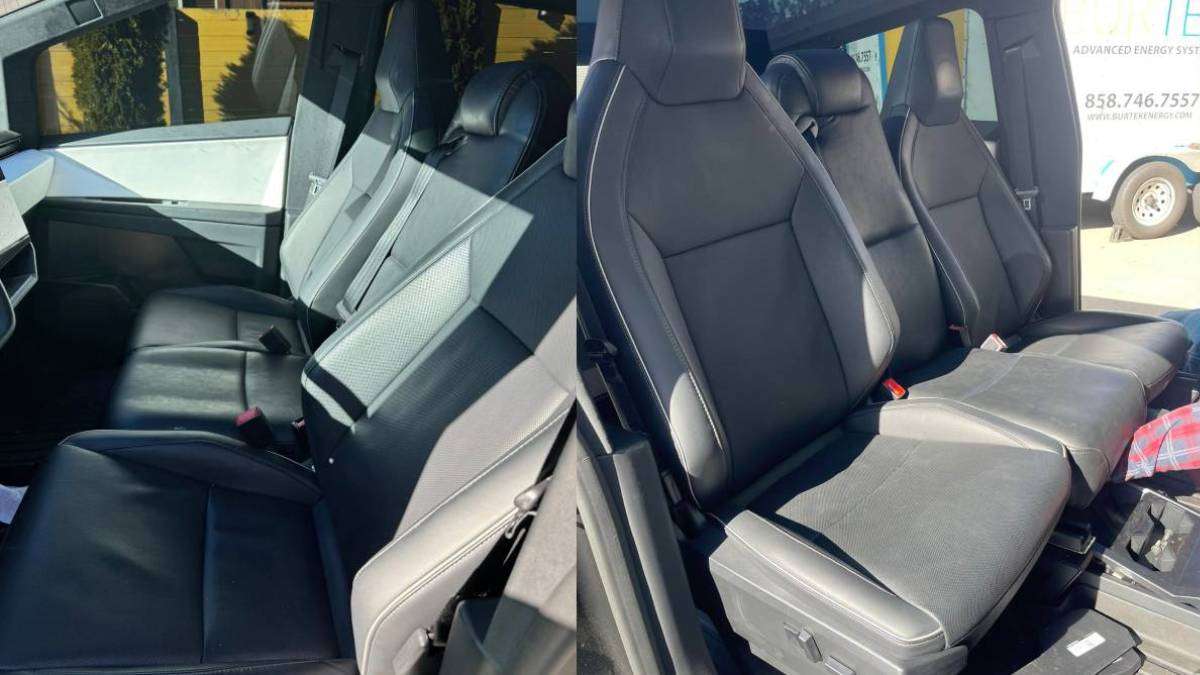

There is something about the Cybertruck that seems to invite boundary testing, as if its angular stainless bodywork gives implicit permission to ask questions other vehicles never provoke.
A recent post in the Cybertruck Owners Only group does exactly that, showcasing a custom center front seat installed for a customer with four kids and asking the community, plainly, what they think. The answers reveal a fault line between creativity, practicality, and the hard limits of vehicle safety design.
At first glance, the modification taps into a familiar nostalgia. Older pickups once offered bench seats up front, squeezing three across and turning the cab into a social space rather than a cockpit.
For families trying to maximize seating without stepping up to a larger SUV, the idea is emotionally understandable. The Cybertruck’s wide, minimalist interior almost looks like it could accommodate such a solution, at least visually.
“What do you think of this center front seat we just did for a customer with 4 kids?”
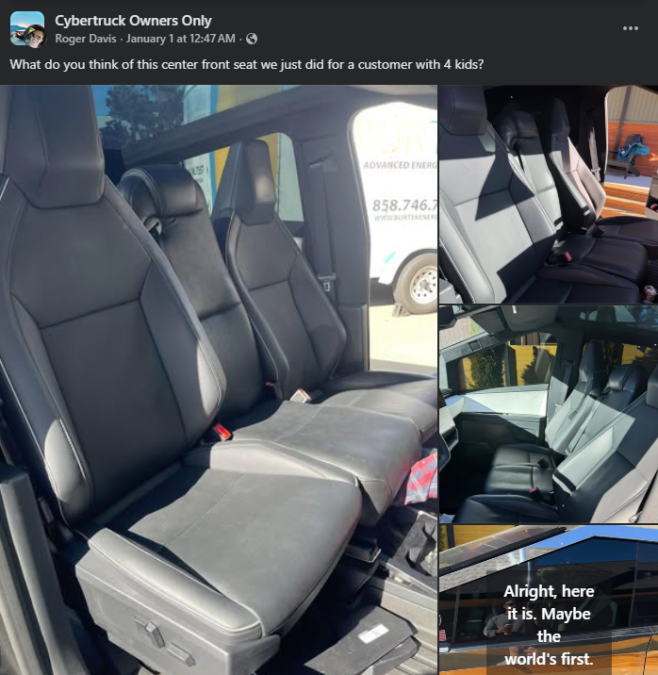
The pushback was immediate and unsurprising. Several commenters questioned both comfort and safety, arguing that the Cybertruck was never engineered for a front-center passenger. One bluntly suggested the customer should have chosen a Model X instead, a reminder that vehicle choice is often about accepting inherent design tradeoffs rather than trying to engineer around them after the fact. Comfort is subjective, but crash physics are not.
Tesla Cybertruck: Visual Design Style & Controls
- The Tesla Cybertruck is an all-electric pickup truck and does not use gasoline or diesel in any configuration.
- It has a distinctive angular design that sets it apart visually from traditional pickup trucks on the road.
- The Cybertruck features a lockable truck bed with a powered cover, allowing cargo to be stored securely and protected from the weather.
- Most vehicle controls are accessed through a large central touchscreen, with minimal physical buttons inside the cabin.
The safety concerns cut deeper than aesthetics. One commenter pointed out that Tesla’s original Cybertruck prototype featured three front seats, but the idea was abandoned because engineers could not package a functional airbag where the center screen now lives. That detail matters. Modern restraint systems are not optional accessories. They are deeply integrated into the structure, sensors, and interior layout of the vehicle. Without a properly designed airbag, a front-center seat is not merely unconventional; it is fundamentally compromised.
Questions about insurance liability naturally followed. Would insurance pay out if that center passenger were injured? Some argued yes, noting that insurers routinely cover injuries even when occupants exceed seating capacity. That may be true in a narrow sense, but it sidesteps the more serious issue of whether the modification itself introduces legal or liability exposure beyond insurance payouts. Coverage does not equal safety, and reimbursement does not undo injury.
One comment raised an interesting but common misunderstanding, asking why an airbag is required up front but not for rear seats. The answer lies in crash dynamics. Front occupants are closer to the primary impact zone and experience different deceleration forces, making frontal airbags a critical component of occupant protection. Rear seats rely on different restraint strategies, including seat structure, belts, and distance from the point of impact. You cannot simply transpose one logic onto the other.
What this discussion ultimately highlights is the tension between customization and compliance. The Cybertruck’s design already pushes regulatory and conventional boundaries, but it still exists within a tightly defined safety framework. Adding a seat where no restraint systems were designed to protect an occupant crosses from personalization into risk creation. The truck may be capable of carrying the person physically, but that does not mean it can protect them when things go wrong.
None of this diminishes the intent behind the modification. Wanting to fit a family into a vehicle you already own is a reasonable impulse. So is admiration for creative fabrication. But modern vehicles are not blank canvases. They are carefully engineered systems where every seat, belt, and airbag works in concert. Remove or bypass one part of that system, and the whole equation changes.
The comments tell a consistent story. The center front seat looks clever, but clever is not the same as safe. The Cybertruck may look like it could do almost anything, but even it cannot escape the realities of crash safety and human vulnerability. Sometimes, the most responsible modification is recognizing when a vehicle’s original design is already answering the question you are trying to solve.
Image Sources: Tesla Media Center
Noah Washington is an automotive journalist based in Atlanta, Georgia. He enjoys covering the latest news in the automotive industry and conducting reviews on the latest cars. He has been in the automotive industry since 15 years old and has been featured in prominent automotive news sites. You can reach him on X and LinkedIn for tips and to follow his automotive coverage.
Set Torque News as Preferred Source on Google
Follow us today...



Comments
That sounds dangerous, when…
Permalink
That sounds dangerous, when the cybertruck is already a low safety rate for passengers