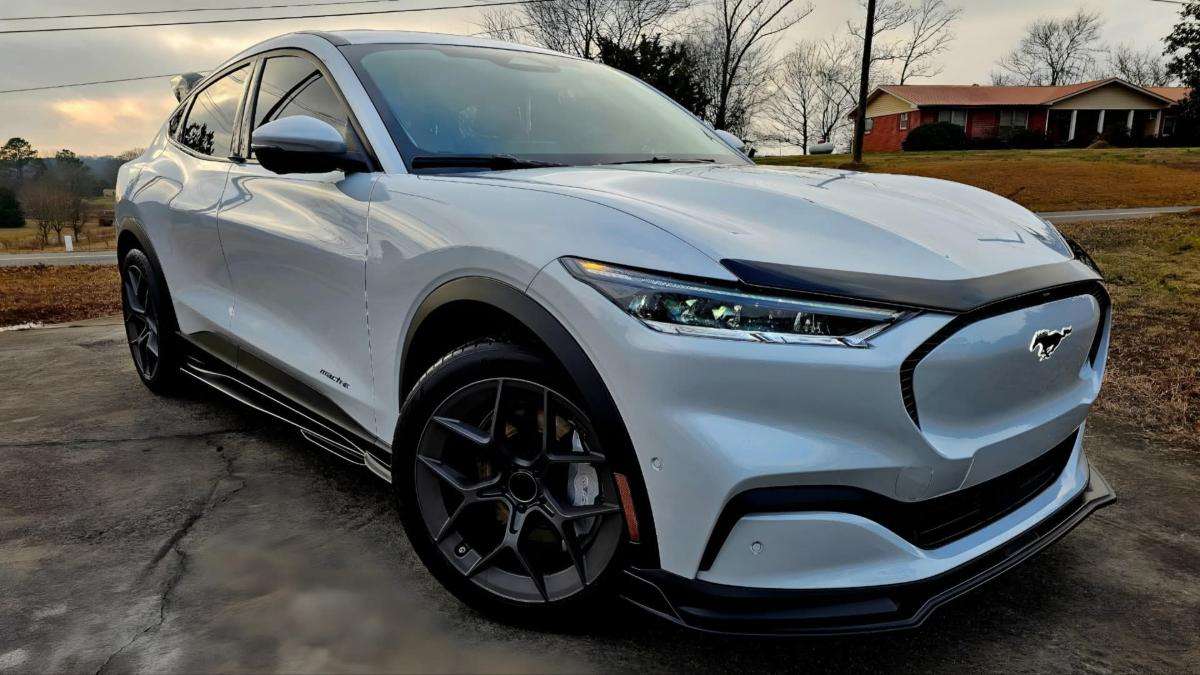

The promise of the modern electric vehicle is confidence. Quiet confidence, instant response, and the belief that a family crossover with a performance badge can deliver drama only when you ask for it. The Ford Mustang Mach-E has often done exactly that, blending brisk acceleration with stable manners and the kind of day-to-day ease that turns skeptics into casual converts. But confidence is a fragile commodity, and it can be punctured in a single moment when a vehicle that feels thoroughly contemporary suddenly becomes thoroughly immobile.
That is the scenario Brandon Biddy describes in a detailed Facebook post to the “Mustang Mach-E Owners” group, laying out a timeline that begins with a hard “thunk” from the rear and the dreaded dashboard command: “Stop Safely Now.” The problem, as he tells it, was not a reduced-power limp mode or a warning that allowed him to nurse the car to a shoulder.
“Sun Nov 23rd:
Pulled out on a major highway, heard and felt a "thunk" from the rear, and got the dreaded "stop safely now. The issue is that I couldn't go at all. Almost got rear-ended, and I had my wife and two small children in the car. Luckily, the police were able to stop and direct traffic. Called Ford roadside, and they were 4 hours out, so the local police called someone to tow. Luckily, I educated the guy on how to tow the car properly, and we were able to tow it to my local dealer. 31k miles 22' select rwd. I tried multiple times turning it off/on, and it never would get out of "stop safely now" mode.
Wed Dec 3rd:
Ford called and said they will need to replace pretty much every module in the High Voltage Battery. While my bumper-to-bumper warranty ended back in October, this one is luckily covered under the battery warranty. The battery was shot at 31k miles. They also need to replace the 12v battery (I will have to pay). They asked if I had noticed anything odd recently, and I really haven't. Range was still spot on, and it charged and such just fine. They told me that it looked like a nuke was set off in it and that we were lucky it didn't catch fire.
Mon Dec 8th: Dealer called and told me to come pick up a loaner. Gave me a very heavily smoked 2025 Escape as a loaner. Said I should have my Mach E back by Friday.
Fri Dec 12th:
The dealer called and said that they broke off some bolts but got the new modules installed. Said I would have the car back Monday evening when they got the replacement bolts in.
Advertising
Wed Dec 17th:
The dealer didn't call me on Monday or Tuesday. Called me today at noon and said they can't get the broken bolts out and will need to replace the entire battery tray. They ordered one, but said it would be after the new year before it came in. Said they are hoping they can just swap everything over to the new tray, but aren't sure (what??).
Fri Dec 19th:
No new updates as they are waiting on the tray. My biggest issue is what if they can't get it fixed? What happens? The dealer was frank with me and said theydon'tt really know if they can get it working again or not. Based on my state laws, it doesn't qualify for a lemon anymore due to years/miles being exceeded, but the parts they are fixing are under the 8 yr/100k mi factory warranty. Do I need to go over the dealer and call Ford directly? The dealer has been great in getting me the loaner and even told me that if I need to use it for travel this holiday season, they won't ding me for it for going over the daily miles.”
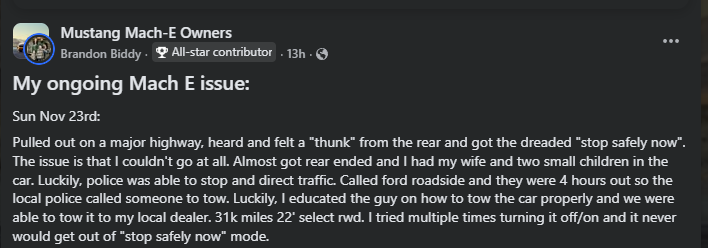
The Mach-E would not go at all. He was on a major highway, nearly rear-ended, with his wife and two small children in the car. The immediate rescue came not from clever electronics but from police stopping traffic and a tow operator who, thanks to Biddy’s guidance, moved the car properly to a local dealer.
What makes the story gripping is not simply that something failed, but the way it failed. EVs are marketed, fairly, as mechanically simpler in many respects, yet they are also heavily dependent on tightly coordinated systems that must agree with one another before the vehicle will move. When a fault crosses a certain threshold, the safest decision may be a shutdown, even if it leaves the vehicle stranded. That is a rational design philosophy, but it collides with the messy reality of traffic, limited shoulders, and human vulnerability. In Biddy’s account, the safety system did its job by demanding a stop, yet the situation became safe only because other people intervened quickly.
Ford Mustang Mach-E: Performance Identity
- The Mach-E blends electric acceleration with a low center of gravity, giving it a planted feel that distinguishes it from many EV crossovers.
- Styling draws selectively from Mustang heritage while adapting proportions that support everyday practicality.
- The driving experience leans toward responsiveness, with immediate torque shaping how the vehicle behaves in traffic and on highway ramps.
- Interior design centers on a large touchscreen interface, signaling Ford’s shift toward software-led vehicle interaction.
Then came the diagnosis, which reads like the kind of call no owner expects at 31,000 miles. Biddy says Ford determined that “pretty much every module” in the high-voltage battery needed replacement. He notes that his bumper-to-bumper warranty had ended, but the battery work would be covered under the longer battery warranty. He also says the dealer told him the pack “looked like a nuke was set off in it” and that they were “lucky it didn’t catch fire,” a blunt assessment that is both reassuring in its candor and unsettling in its implication. Even more frustrating, he reports no obvious warning signs beforehand: range appeared normal, charging behavior normal, and day-to-day operation unremarkable until the moment it was not.
The repair plan, on paper, sounds methodical. Replace modules, verify systems, and return the Mustang Mach-E. In practice, it turned into the kind of modern service ordeal that tests patience and raises questions about readiness across the industry. According to Biddy’s timeline, the dealer installed new modules but broke bolts in the process, then struggled to extract the broken hardware. That complication escalated the job from an internal battery rebuild to replacing the entire battery tray, with parts backordered until after the new year. By mid-December, he reports the dealer was frank that they did not really know whether they could get it working again, which is an extraordinary thing to hear about a mainstream vehicle supported by a major manufacturer.
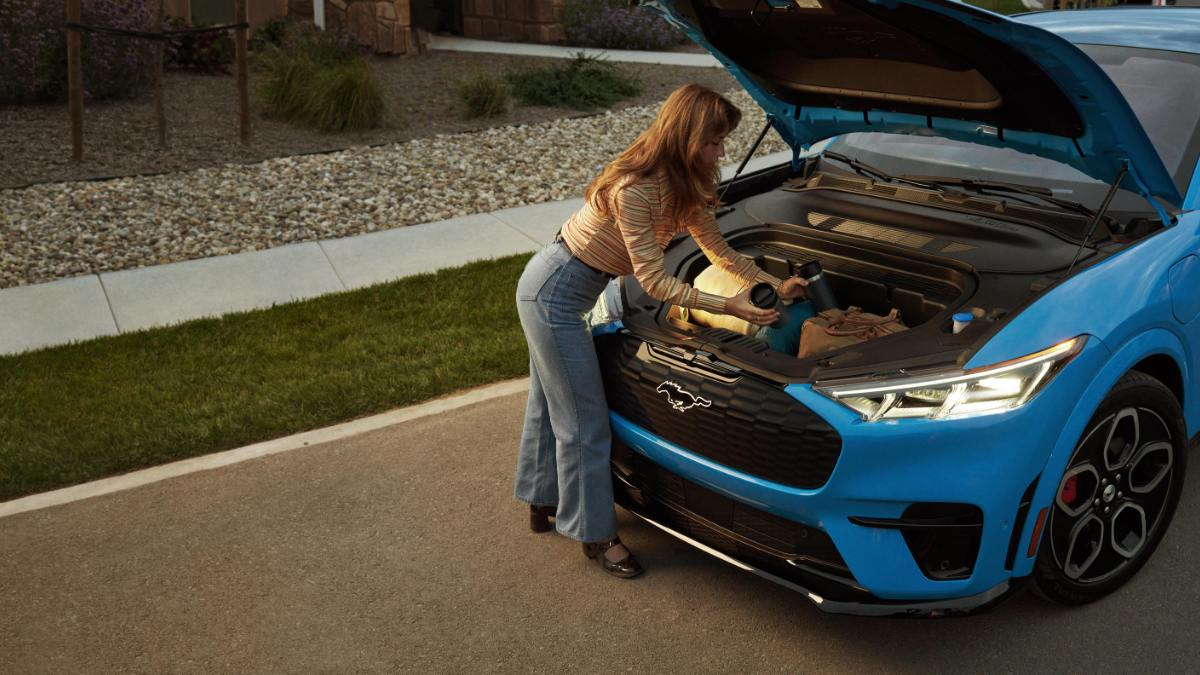
There is a larger lesson here about how EV packs are constructed and serviced. Battery systems are not just a collection of cells; they are structural components integrated into the vehicle’s floor, sealed against water intrusion, engineered for crash protection, and assembled with fasteners that must be removed without compromise. When everything goes smoothly, that integration delivers rigidity and safety. When something goes wrong, service becomes closer to major surgery than routine maintenance, and a single broken fastener can turn a scheduled repair into an extended immobilization. None of this is an indictment of electric vehicles. It is simply the reality of high-voltage architecture meeting the practical constraints of tools, training, and parts supply.
The small-print realities of ownership also loom in the background. Biddy notes that he will have to pay for a 12-volt battery replacement even as the high-voltage components fall under battery warranty coverage. That split is common across the industry: the traction battery and related components typically receive extended coverage, while wear items and auxiliary batteries may not, depending on timing and terms. He also points out a particularly uncomfortable corner of consumer law: his car may no longer qualify under his state’s lemon law due to age or mileage, even if the covered battery repair becomes protracted or uncertain.
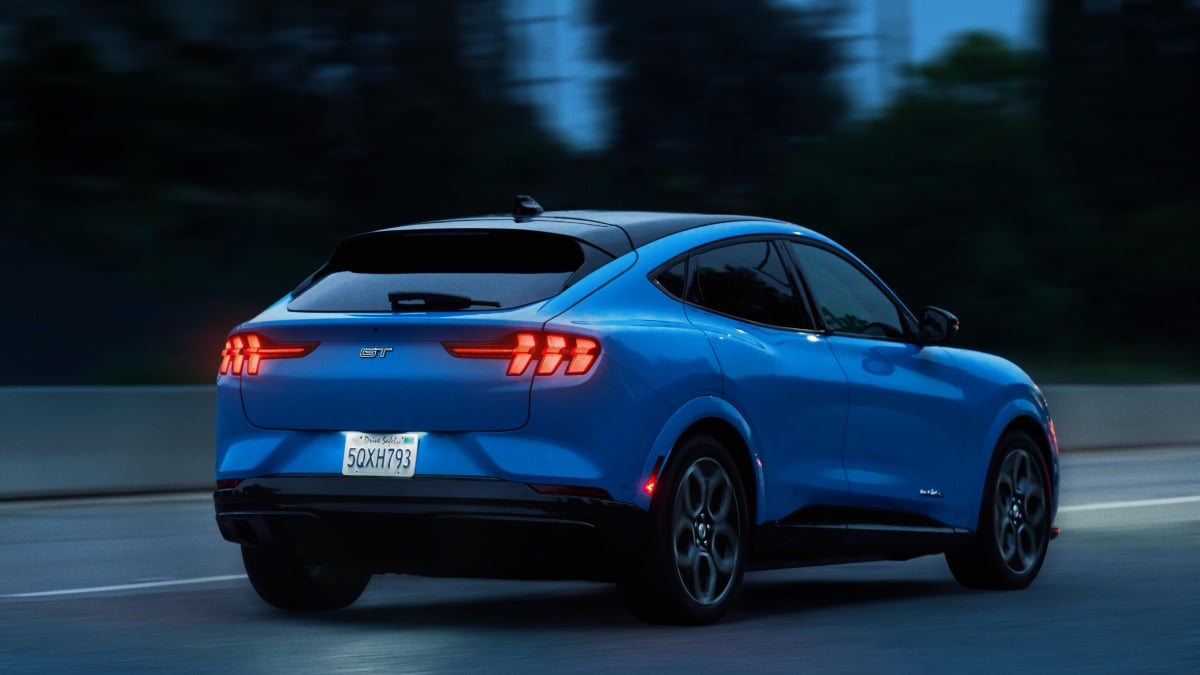
To the dealer’s credit, Biddy emphasizes accommodations that matter to a family trying to keep life moving. He was provided a loaner and told that holiday travel would not be penalized for exceeding daily mileage limits. Even so, the loaner described as heavily smoked is its own kind of reminder that the customer experience can suffer even when intentions are good. What remains unresolved in his post is the question every owner asks once a repair drifts from days into weeks: when should you escalate beyond the dealership to the manufacturer for additional support, clearer commitments, or alternative resolutions? The fact that he is asking that question while the vehicle is still under battery warranty speaks to how powerless an owner can feel when the car’s most expensive component becomes a waiting game.
The Mach-E is, when it is healthy, a genuinely satisfying vehicle that can be quick, practical, and pleasantly composed in daily driving. That is precisely why stories like this land with weight. They are not arguments against electrification; they are reminders that the new age must be matched by new service competence, robust parts logistics, and a customer-support system that can resolve worst-case failures without leaving owners in limbo. If the future is electric, it has to be dependable in the moments that matter most, like a highway merge with a family aboard, when confidence is not a marketing word but a safety requirement.
Image Sources: Ford Media Center
Noah Washington is an automotive journalist based in Atlanta, Georgia. He enjoys covering the latest news in the automotive industry and conducting reviews on the latest cars. He has been in the automotive industry since 15 years old and has been featured in prominent automotive news sites. You can reach him on X and LinkedIn for tips and to follow his automotive coverage.
Set Torque News as Preferred Source on Google
Follow us today...