
The modern automobile industry loves to shout about features. Screens, modes, acronyms stacked like merit badges on a Boy Scout's sash.
But when I sat down with Zach Walker, the former Chief Engineer behind the Lucid Gravity, it became immediately clear that Lucid is playing a different game, one that would have made Detroit uncomfortable in its glory years.
“Features are very easy to get lost in,” Walker told me early on.
“If they don’t tell a full story, then it’s hard to know how to execute.”
That sentence alone explains why Lucid feels less like a tech company dabbling in cars and more like an old-school engineering outfit obsessed with how driving actually feels.
Take wind buffeting, for instance. Most automakers treat it like an annoyance, something you live with when the window goes down at highway speed. Lucid doesn’t. The Gravity, he explained, was engineered to account for what he calls “changing crosswinds,” particularly around 70 mph, the speed Americans actually drive.
“It’s super complex,” he admitted, “but the goal is ultimate efficiency and ultimate experience for as many scenarios as possible, which includes the window down.” That’s the kind of detail only noticed by people who actually drive their own cars.
This is something that isn't advertised but is talked about on forums - something I'm sure potential customers run into by accident. Here's an example of one I found in the wild:
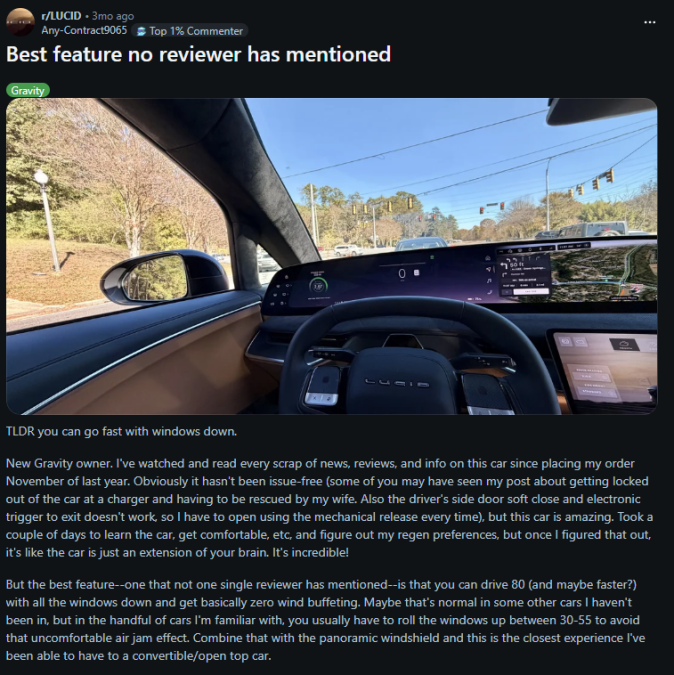
“TLDR: You can go fast with windows down.
New Gravity owner. I've watched and read every scrap of news, reviews, and info on this car since placing my order in November of last year. Obviously, it hasn't been issue-free (some of you may have seen my post about getting locked out of the car at a charger and having to be rescued by my wife. Also, the driver's side door soft close and electronic trigger to exit doesn't work, so I have to open it using the mechanical release every time, but this car is amazing. Took a couple of days to learn the car, get comfortable, etc, and figure out my regen preferences, but once I figured that out, it's like the car is just an extension of your brain. It's incredible!
Advertising
But the best feature, one that not one single reviewer has mentioned, is that you can drive 80 (and maybe faster?) with all the windows down and get basically zero wind buffeting. Maybe that's normal in some other cars I haven't been in, but in the handful of cars I'm familiar with, you usually have to roll the windows up between 30 and 55 to avoid that uncomfortable air jam effect. Combine that with the panoramic windshield, and this is the closest experience I've been able to have to a convertible/open top car.”
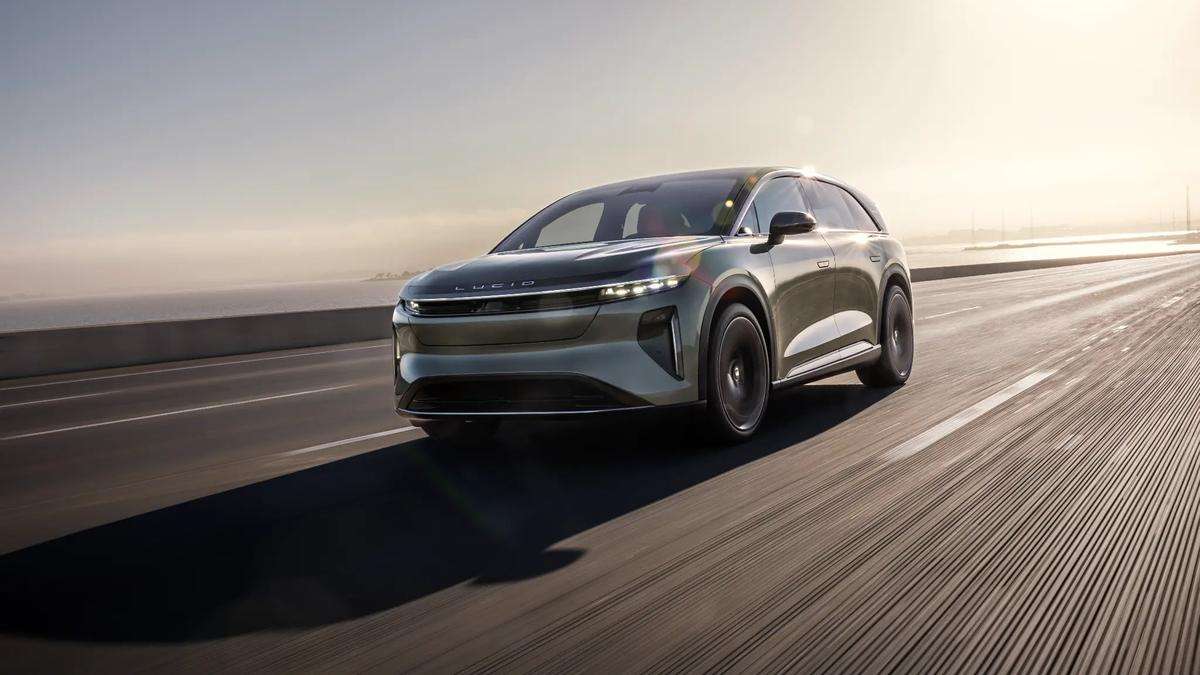
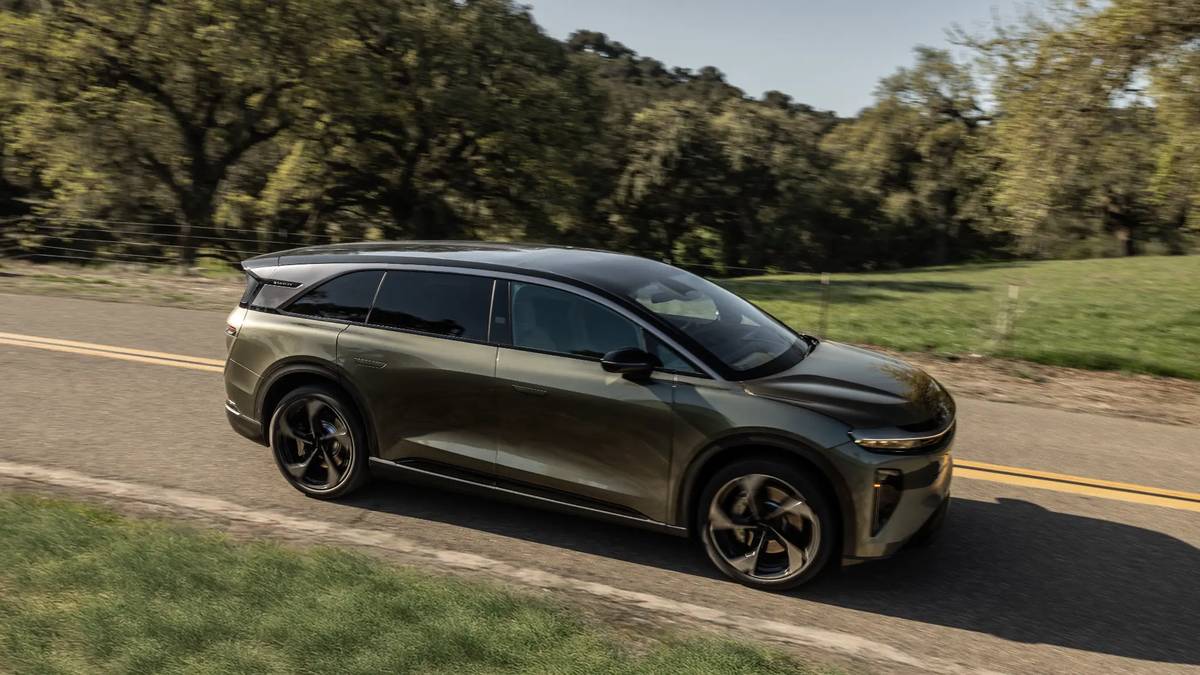
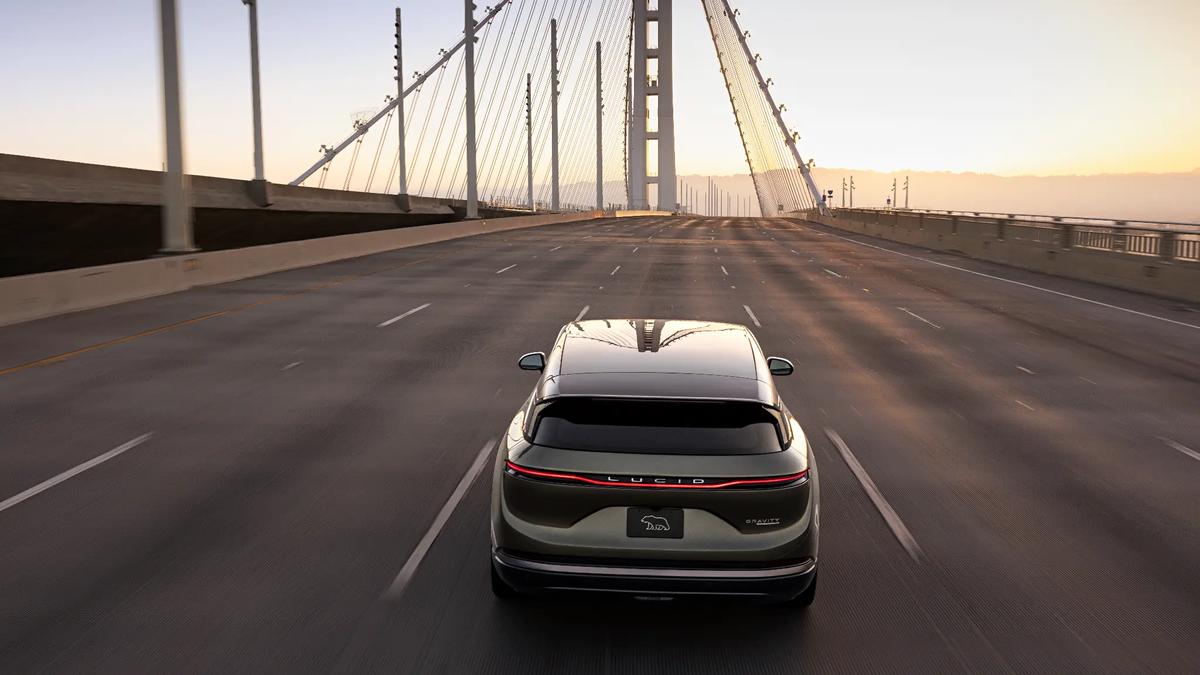
Lucid Gravity: Experience-Focused SUV
- The Gravity applies Lucid’s compact motor and battery technology to a larger SUV format, aiming to preserve efficiency and range despite increased size and weight.
- Its proportions balance interior volume with aerodynamics, using a tapered roofline and smooth body surfaces to reduce drag compared with more upright electric SUVs.
- Interior layout emphasizes flexibility, with configurable seating and a flat floor that supports both passenger comfort and cargo capacity.
- Driving dynamics prioritize refinement and stability, with suspension tuning that favors controlled highway behavior over aggressive off-road capability.
The EV industry has been full of confident talk about “Tesla killers,” and history shows most of them didn’t last long once the hard work of building cars at scale began. The list of fallen challengers year after year gets longer. The Cadillac ELR wrapped Volt hardware in couture pricing and found fewer than 3,000 buyers. Honda’s Fit EV lived a lease-only compliance-car life, the Smart Fortwo ED proved urban minimalism doesn’t guarantee demand, and even BMW’s i3, arguably the most forward-thinking of the bunch, ended its run having served more as a rolling research lab than a true Tesla rival. None of these cars were disasters; they simply ran headlong into the brutal realities of scale, cost, and timing.
Which brings the conversation back to Lucid, a company clearly aware of how many confident challengers came before it and quietly disappeared. Rather than chasing headlines or declaring war on Tesla, Lucid set out to build a luxury sedan with real sports-car handling, a challenge that required a high-quality chassis that could inform the development of future, more affordable models, very much in line with how GM and Toyota have long justified niche vehicles that share platforms with mainstream ones.
That same thinking now shows up clearly in the Gravity SUV. During our recent discussion, he explained, “I like to talk about experiences,” noting that the goal wasn’t to stack features, but to create situations owners actually want to be in, like camping or tailgating.
That philosophy even played out internally during development. One of the debates centered on the Gravity’s frunk seating. Walker admitted he initially thought it was gimmicky, saying he and his boss “used to fight about this a ton” because of how much re-engineering it required, moving headlamps, reshuffling components, and redesigning hardware just to make room for two people to sit up front. At the time, he didn’t believe customers would actually use it.
That changed the moment he took his own Gravity to Santa Cruz (No relation to Hyundai), proceeded to open the frunk, and sat there himself. He immediately called to admit it: the experience created an unexpected emotional connection and a sense of doing something no other vehicle could offer. His boss, of course, reminded him, “I told you.”
Advertising
“I didn’t think people would use this… and then the second I got my Gravity, I pulled up to Santa Cruz, opened the frunk, and sat there. I called him right away and told him he was right. It just felt special.”
And that’s where Lucid’s worldview sharpens. Gravity isn’t an off-roader in the Jeep Wrangler sense, where the trail itself is the sport. “The Gravity will get you where you need to go,” he said. Bigger wheels, bigger sidewalls, air suspension that drops low for highway efficiency and rises four inches when the pavement ends.
“There’s no adventure that’s off limits to you,”
He went on to say.
The Air, by contrast, remains the long-distance assassin. Lower drag, better efficiency, more range. “If you just need to get as far as possible and never want to see a charger,” he said, “that’s Air.” Gravity is what happens after you arrive, with people, gear, and the freedom to stay awhile.
That philosophy extends to Lucid’s understanding of freedom itself. “Freedom used to mean wind in your hair,” he said, invoking Mustangs and two-seat convertibles. “That’s not what it means anymore.” Today, freedom is time. It’s doing everything with one vehicle, hauling kids, gear, groceries, and still enjoying the drive. “That’s why SUVs make sense now,” he said, and why Gravity embodies a new American definition of liberty.
The fold-flat seats help define that experience, but the detail most people overlook is power, real, usable power. Gravity offers three 120-volt outlets, each capable of 1.8 kilowatts. As he put it plainly, that’s enough to run “like a microwave.” It’s a small quote, but it captures Lucid’s larger philosophy: not chasing hype, not calling anyone else out, but quietly building vehicles designed around how people actually live, travel, and camp.
This is where Lucid departs from the industry playbook. Customers can only ask for what they already know. They can’t request experiences they’ve never imagined. “These are hero moments,” he said, singular snapshots that help someone see themselves in the car.
Image Sources: Lucid Media Center
Noah Washington is an automotive journalist based in Atlanta, Georgia. He enjoys covering the latest news in the automotive industry and conducting reviews on the latest cars. He has been in the automotive industry since 15 years old and has been featured in prominent automotive news sites. You can reach him on X and LinkedIn for tips and to follow his automotive coverage.
Set Torque News as Preferred Source on Google
Follow us today...