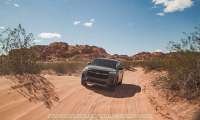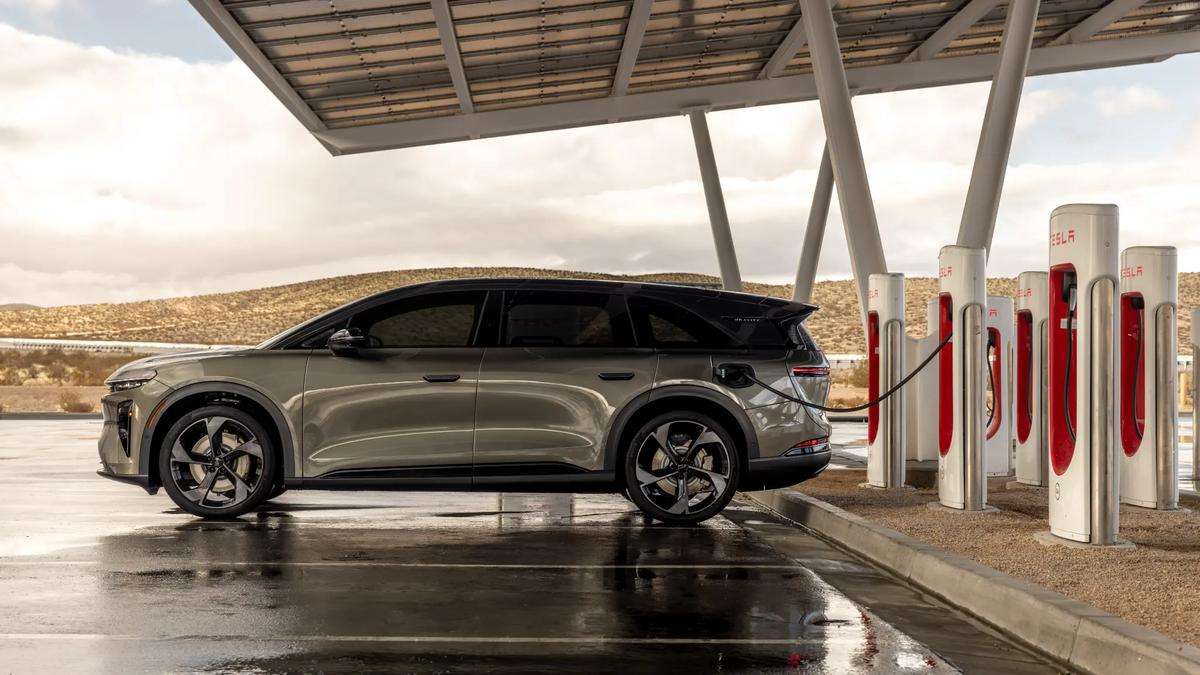

Long-distance road trips have a way of stripping away brand mythology and replacing it with lived experience, which is why one Lucid Gravity owner’s 1,500-mile round trip from Los Angeles to Park City reads less like a brag and more like a genuine systems test. This was not a carefully staged press drive.
It was a real owner, a dog in the back, winter weather ahead, and a charging network that would either show up or not. By the end of it, the takeaway was clear.
Tesla’s charging network carried the trip with confidence, even if the Gravity itself showed a few software cracks on the way home.
Preparation mattered. To get the vehicle sooner, the owner took delivery with the larger 22/23-inch wheel setup, then immediately swapped to a road-trip-friendly set of 21/22-inch Michelin all-seasons. The difference was not subtle. Ride quality improved, impact harshness dropped, and the tradeoff in looks felt minor once the miles started stacking up. It was a pragmatic choice that paid dividends over two long days in each direction.
“Just returned from a round trip to Park City in the GGT, which really was setting up as THE test for me and this vehicle, and I have to say the short version: a tremendous success.
I broke the trip up into two days, both ways, to make it easy on the body. The first thing I had to do was get a new set of wheels (to get the car quicker, I took an off-the-shelf GGT fully specked tech-wise and with the 22/23 option). Having already had to replace one of the Pirelli’s two weeks in due to a flat, figured I’d bite the bullet and get a road trip set (21/22 All Season Michelins) and either swap the 22/23’s back on when I know I’ll be city driving for an extended period or when I have to return the vehicle at the end of the two year lease with very little wear and tear, we’ll see.
The Michelins road like champs and made for a much smoother ride (and only slightly less attractive aesthetically). I’ll share the trip summary in bullet points for ease of reference:
Drive out was super smooth and had no major alerts or issues. Had to reboot once after charging simply because a chime I couldn’t diagnose went off and would not silence. Otherwise, every single thing in the car operated as intended, right down to the windows (will get to this in the return trip bullet point).
I’m a home charger, so this was a new experience for me. I started out hunting Electrify America, having heard about the 350kw stations. Despite that listed rating, found myself capped at about 175 on the EA charger the one time I used it. Used Tesla’s network the entire rest of the trip and found it super reliable and easy to use (especially having come from a Model Y).
Tesla Charging: Oddly, I found the 250kw stations gave me longer charges at the peak of 220kw. The 325kw-rated stations also hit 220kw, but it took them longer to ramp to 220kw, and the time at 220kw always seemed shorter for some reason (likely anecdotal, could’ve just been my luck). And egg on my face, but it took me a few stops to remember to check the Tesla app because at least 30% of the stalls at any given station were inoperable. Found charging to 85% to be WAY faster in the Gravity than in my Model Y, and it didn’t feel like a time burden at all to stop and charge; I would usually take the dog out for a walk, come back, and grab a coffee and hit the road. So chill.
The drive back was more buggy. Cruise Control would not engage to save my life (and using Cruise Control on the drive out DID save my life and was rock solid). About halfway back, I pulled over and searched through this forum and the Lucid Owner’s forum and found the solution of getting far enough away to allow the vehicle to sleep, and voila, all was right.
Advertising
Windows on the drive back were a total pain. The dog was freaking out, and occasionally letting down the windows would calm him (BTW, even at 85mph with the windows down, there is very little drag in this vehicle!). Of course, every time I went to put the windows back up, they would do that thing where they would go up… and then immediately back down (rinse, repeat). Annoying.
I tried Dream Drive a bit on the drive back. It’s fine, after a few legit scary experiences with self-driving in my Tesla, I’m still not ready to trust it. On a straightaway in the middle of the desert with little traffic around, it’s solid. But that’s about as much as I can trust.
Bluetooth Audio really let me down, but I assume this is going to be addressed in a big way very soon. Same with the key fob battery, which I made sure to replace before handing off to the valet.
My charging cap still occasionally needs to be locked and unlocked and relocked and unlocked, clearly a hardware thing, but now that I know what it is, I can deal with it just fine (and the damn thing looks and feels like I never had to rip it out of its joint at all =)
Got a TON of interested looks every time I charged and a few owners who even came over to chat me up about it. Given how well the car performed, I was happy to oblige and sing the vehicle’s praises for once.
There was a bit of ice on the ground, but only at the roadway edges and very little snow, so I can’t speak to that. The battery performed okay in the weather, though the efficiency definitely took a dip up there.
I fell in love with the car on this trip and was glad to be reaffirmed in taking the leap on it. Far and away the most comfortable experience I’ve ever had on a road trip of this length, and the drive out was total catnip, no alerts, no phantom notifications or rogue operations, just a rock-solid product where the software disappeared, and the engineering shone.
I see the new update is releasing imminently. That my experience here will only get better is a great sign indeed. Appreciate the folks on this forum for always engaging and keeping me from the brink. Had a rough first month with this vehicle, but this road trip was a super great experience.”
The outbound leg was close to ideal. Aside from a single reboot to silence a stubborn chime after charging, the Gravity behaved exactly as a premium EV should. No alerts, no phantom warnings, no systems acting possessed. Windows worked. Cruise control worked. The car faded into the background and let the engineering do the talking. That “software disappears” feeling is rare in modern vehicles, and it left a strong impression.
Lucid Gravity: Packaging & Design Language
- The Gravity is part of Lucid’s effort to translate its EV sedan efficiency mindset into a family-sized SUV, a challenging task since tall shapes naturally lose aerodynamic and energy advantages.
- Lucid’s packaging focus means the Gravity aims to be a three-row SUV without the “bus-like” footprint, targeting interior volume through engineering rather than sheer exterior size.
- The brand is known for exceptionally compact powertrain components, and that approach tends to free up cabin and cargo room compared with EVs using larger motor and inverter assemblies.
- Lucid’s design language usually prioritizes clean surfaces and reduced visual clutter, so the Gravity is expected to feel more “modern lounge” than “rugged SUV,” even if it competes in the same space.
Charging, for this owner, turned into an unexpected endorsement of Tesla’s infrastructure. After a brief stop at an Electrify America 350 kW station that capped at around 175 kW, the rest of the trip relied entirely on Tesla Superchargers. Reliability was the headline.
Plug in, charge, leave. No drama. Peak rates hovered around 220 kW, with the interesting observation that Tesla’s 250 kW stations seemed to hold that peak longer than the newer 325 kW sites, which took more time to ramp and fell off sooner. Whether anecdotal or not, the result was consistent charging sessions that never felt like a burden.

What stood out most was how quickly the Gravity charged to 85 percent compared to the owner’s previous Model Y. Stops felt natural rather than interruptive. Walk the dog, grab a coffee, get back on the road. The caveat, learned the hard way, was to check the Tesla app before pulling in. Roughly 30 percent of stalls at many locations were down, a reminder that even the best network still benefits from planning.
The return trip exposed a different side of the Gravity. Cruise control refused to engage at all, a sharp contrast to its flawless behavior on the drive out. The fix came not from a service menu, but from collective owner knowledge. Pull over, walk far enough away to let the car sleep, wait a few minutes, and everything resets. It worked, but it is the kind of workaround that reminds you this is still a young software platform.
Window behavior added to the annoyance. With a restless dog onboard, lowering the windows helped, but raising them triggered the familiar EV quirk where the glass goes up, then immediately back down. Over and over. At highway speeds, the Gravity impressed with how little drag and noise it generated even with the windows open, but the control logic itself was clearly not in a cooperative mood.
Driver assistance earned cautious praise. DreamDrive performed well on long, straight desert stretches, but lingering memories of unsettling Tesla self-driving moments kept expectations in check. The owner used it sparingly, preferring traditional cruise control once it was restored. Bluetooth audio and a finicky charge port cap were also noted as weak points, more irritating than deal-breaking.
And yet, despite the bugs, the conclusion was emphatic. This trip cemented the owner’s affection for the Gravity. It was the most comfortable long-distance drive they had ever experienced. The outward journey, in particular, showcased what the vehicle can be when everything is aligned. Quiet competence. Predictable behavior. Engineering first, software second. Even the social side made an impression, with curious onlookers and fellow EV owners striking up conversations at charging stops.

Tesla’s charging network earned genuine praise for being “super reliable” and stress-free across state lines. The Gravity earned praise for comfort, ride quality, and charging performance. At the same time, the owner did not gloss over the flaws. Cruise control failures, window glitches, and small hardware quirks were all part of the story.
This was not a flawless trip, but it was a convincing one. A new vehicle proved it could handle real miles, real weather, and real infrastructure. The owner came away confident because nothing went wrong, but because when things did, they were manageable. For a long-distance EV road trip, that may be the highest praise of all.
Image Sources: Lucid Media Center
Noah Washington is an automotive journalist based in Atlanta, Georgia. He enjoys covering the latest news in the automotive industry and conducting reviews on the latest cars. He has been in the automotive industry since 15 years old and has been featured in prominent automotive news sites. You can reach him on X and LinkedIn for tips and to follow his automotive coverage.
Set Torque News as Preferred Source on Google
Follow us today...