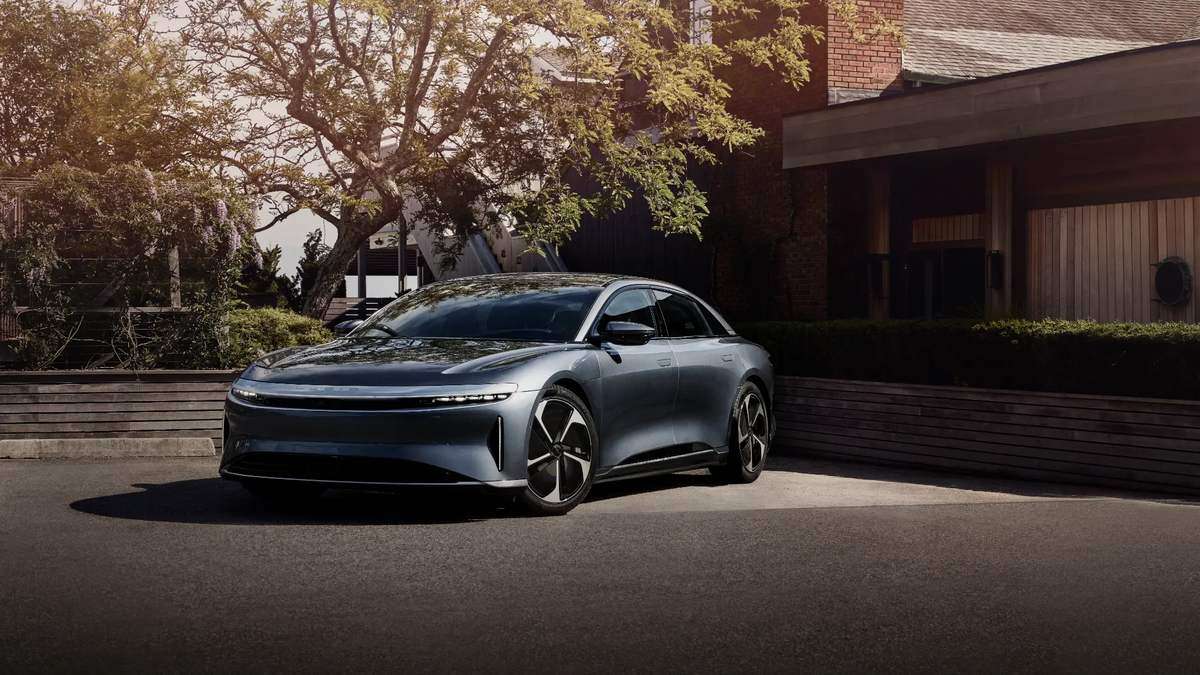

The promise of luxury electric vehicles often collides with the harsh realities of technology and manufacturing complexities.
One Lucid Air Dream Edition owner, initially thrilled with acquiring a discounted 2023 model, quickly found himself navigating a labyrinth of persistent technical malfunctions that plagued his ownership experience for months.
His journey from frustration to eventual satisfaction offers a rare glimpse into the challenges and potential resolutions faced by early adopters of cutting-edge EVs.
The owner, posting under the username Freemanh200, shared his detailed account:
"As short backstory: I was able to choose/buy a new company car that I'm also allowed to use fully private. So, the Lucid Air was my dream car since I heard about it the first time and test drove one a year ago. So, in July 2025, I went to the Lucid Center and ordered an Air GT online. After a few days, I got a call that they cannot deliver it before the end of 2025. But they made an offer that we can get the last available dream in Europe (from 2023) with a huge discount, so we got the dream for the price of the GT. Of course, I agreed, and 2 weeks later, I got it.
Then, as many of you can relate, the problems began... sensor failure, no radio, no navigation, no phone connection... all these things. I went to the service center, they checked it, and nothing changed. I took the phone as a hotspot in the hope of a software update that solves my connectivity problem. After 10k miles, nothing changed, while I had several error messages every ride. I had to soft and hard reset the car all the time. Door handlers shaking, not opening doors at all... Service center again, problems and errors stayed...
Then one day, they offered me a hardware (cheap) upgrade of the whole control unit to the 2026 version. I gave it a try because it could not get worse anyway.... then - somehow - they "ruined" the car... after changing the unit, they said the 12V batteries have to be replaced as well. Afterwards, all the sensors had no connection anymore. According to the service center, they replaced the fuse box and a part of the cable loom... it took about 3 weeks till i got the car back - after several calls and asking about...
Well - guess what: my car is working as it should :-) Everything works, I have a connection everywhere, I have navigation, no more error messages, and after 2k miles, not even one problem with opening the car.
So, there ARE solutions to these existing and annoying problems - it's a question if they are willing to invest their time and money. Of course, we just had to pay for the control unit update; the rest was on Lucid.
I'm very happy now with my car and also with the repairs and service they provided :-)."
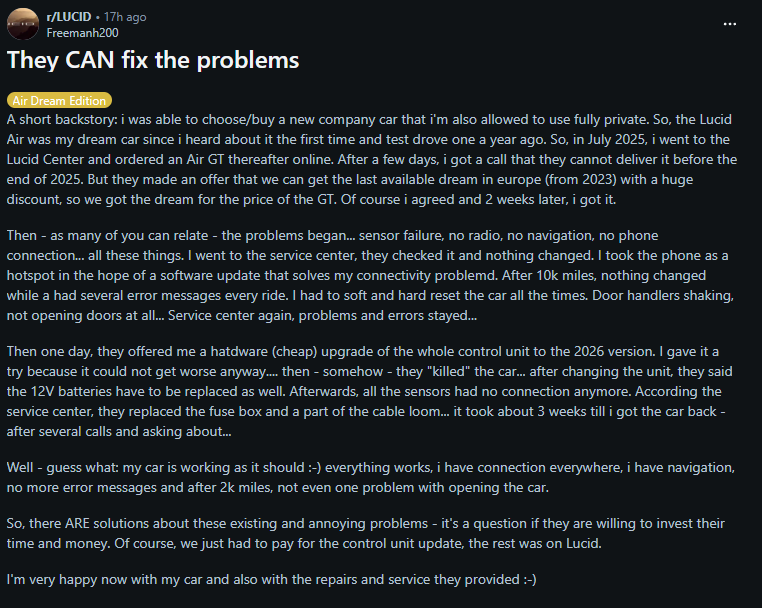
The litany of issues, from sensor failures and non-functional infotainment to unreliable door handles and constant error messages, paints a stark picture of the early Lucid ownership experience for some. This narrative is not unique to Lucid; many new automotive manufacturers, particularly those pioneering complex EV architectures, often stumble through initial production runs with quality control inconsistencies. The owner's repeated trips to the service center, yielding no lasting solutions, highlight a critical gap in diagnostic and repair capabilities that can plague even premium brands.
Lucid Air: Addressing Early Production Quality Control
- The Lucid Air Dream Edition, priced from $138,000, offers up to 1,111 horsepower and an EPA-estimated range of 520 miles in its most potent configurations. Its advanced powertrain and luxurious interior aim to redefine the premium EV segment.
- Early production models, particularly from 2023, have shown variability in build quality and software integration, leading to a range of issues from sensor malfunctions to connectivity problems. These inconsistencies are not uncommon in the initial phases of new vehicle platforms.
- The company has implemented hardware upgrades, such as the 2026 control unit, to address persistent electronic and connectivity issues in affected vehicles. This suggests an ongoing effort to refine and improve the vehicle's underlying architecture.
- Extensive repairs, including the replacement of 12V batteries, fuse boxes, and cable looms, highlight the complexity of diagnosing and resolving deep-seated electrical system faults in modern EVs. Such interventions are costly and time-consuming for both owners and manufacturers.
One commenter, "iamoninternet27," responded with a simple, "Patience is a virtue. I am glad everything works for you now." This sentiment, while well-intentioned, often glosses over the significant inconvenience and frustration endured by owners who have invested six-figure sums into a vehicle that fails to deliver basic functionality.
Expecting "patience" from a customer who has purchased a premium product that requires constant troubleshooting is akin to asking a Michelin-starred chef to tolerate a broken oven; it fundamentally misunderstands the value proposition.
The turning point for Freemanh200 came with the suggestion of a hardware upgrade to a 2026 control unit. This decision, initially fraught with further complications including a "ruined" car, replaced 12V batteries, a new fuse box, and part of the cable loom, ultimately proved successful. The extensive nature of these repairs, spanning multiple components and requiring three weeks, reveals that the initial problems were far from simple software glitches; they were deeply embedded hardware and integration failures.
Another commenter, "Darekbarquero," asked,
"Yay. Happy ending. And how do you like the car?"
The original poster, Freemanh200, replied,
"I love it :-) a little more space in the trunk would be great - bulky items will not fit, but it is how it is."
This exchange shows the enduring appeal of the Lucid Air's core attributes, even after a tumultuous start. It suggests that for many enthusiasts, the driving dynamics, design, and performance can outweigh significant initial reliability concerns, provided those concerns are eventually addressed.
This perspective, however, should not be mistaken for an endorsement of poor initial quality. While the owner's ultimate satisfaction is commendable, the journey to that point involved an unacceptable level of customer burden. A vehicle in this price bracket should not require a near-complete electrical system overhaul to achieve basic operational stability. This situation reveals a critical flaw in either Lucid's initial design validation, its manufacturing consistency, or its early service diagnostics, any of which would be a red flag in a more mature automotive ecosystem.
The discussion continued with "Calexio_," who observed,
"It always surprises me how different the ownership experiences are. I have had two 2023 GT’s now, which both have been essentially flawless. Aren’t these cars built on an automated assembly line with the same components? And all cars have the same software, right? How could some cars have so many issues while others are perfect?"
This question cuts to the heart of the matter.
Freemanh200, the original poster, responded directly to this, stating,
"Well, at the beginning I thought it must be software related... but as you say, all have the same software, so it really must be the hardware side and obviously the built quality varies a lot..."
This candid admission from an owner who has lived through the ordeal confirms what many automotive engineers understand: software can mask hardware inconsistencies, but it cannot fix fundamental manufacturing variances. The "build quality varies a lot" is a strong indictment for a brand positioning itself at the pinnacle of automotive luxury and technology.
The resolution, requiring a significant hardware upgrade and extensive follow-up repairs, indicates that Lucid is capable of rectifying these deep-seated issues. However, the cost and effort involved, both for the company and the customer, are substantial. The fact that the owner had to pay for the control unit upgrade, while Lucid covered the subsequent cascading failures, presents a murky picture of warranty responsibility.
This comes as news of GM hiring the new head of strategy from Lucid Motors, Claudia Gast.
Are you excited about the direction Lucid is going? Let us know in the comments below.
Image Sources: Lucid Media Center
Noah Washington is an automotive journalist based in Atlanta, Georgia. He enjoys covering the latest news in the automotive industry and conducting reviews on the latest cars. He has been in the automotive industry since 15 years old and has been featured in prominent automotive news sites. You can reach him on X and LinkedIn for tips and to follow his automotive coverage.
Set Torque News as Preferred Source on Google
Follow us today...