

What You Need to Know
- Kia CEO Ho Sung Song confirmed a US body-on-frame pickup at the April 2026 investor day.
- Target: 90,000 units annually by 2034, roughly 7% of the midsize truck segment
- The US truck will likely NOT be the Tasman, expect a clean-sheet design on a shared Hyundai platform.
- Hybrid (EREV) and all-electric powertrains are planned, with EREV specifically called "untapped territory."
- Kia is entering the EREV pickup category, where Toyota has no publicly announced competitor.
- Based on Kia's pricing history, a hybrid pickup could start in the high-$30,000 range.
- Georgia manufacturing would sidestep the 25% Chicken Tax on imported trucks.
Kia is coming for the Toyota Tacoma. And it's not bringing a compromise.
At Kia's annual investor day on April 9, 2026, CEO Ho Sung Song made the announcement that truck shoppers have been quietly anticipating: Kia will build a body-on-frame midsize pickup for the United States market. The timeline is "before 2030." The target is ambitious, roughly 90,000 units annually, which would give Kia about seven percent of the midsize truck segment by 2034.
"Accounting for approximately 20 percent of total demand, the U.S. pickup market represents a key strategic segment," Song said.
"Given its strategic importance, Kia will launch a new body-on-frame pickup model to broaden our customer base."
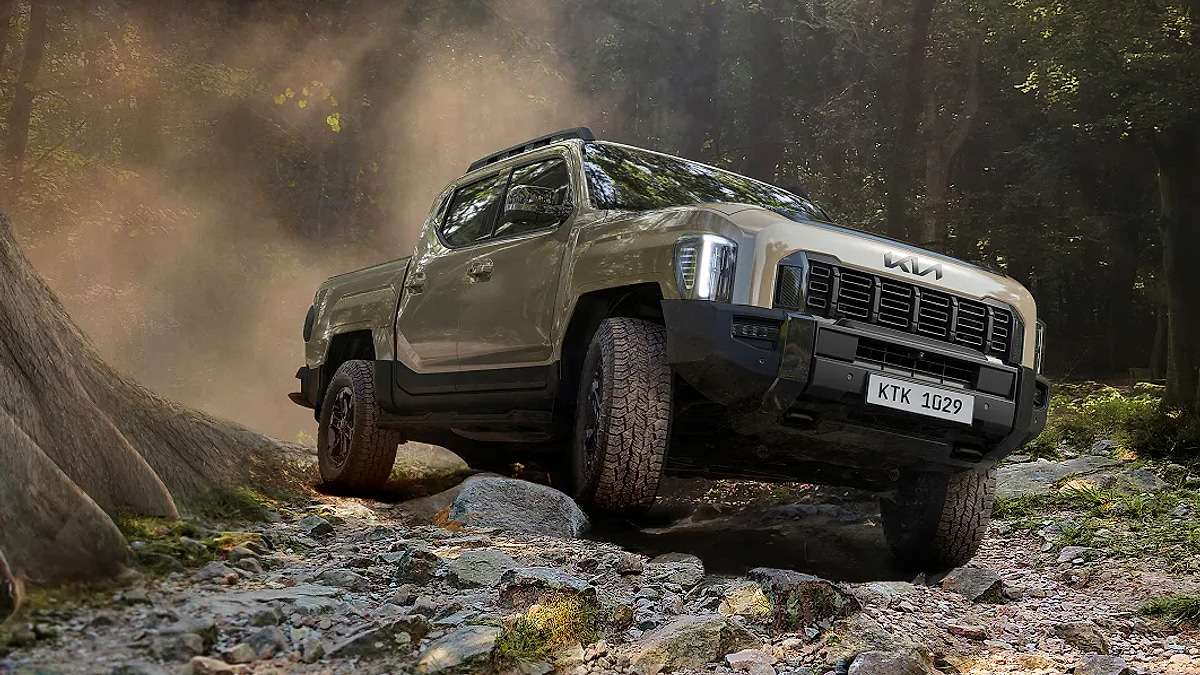
But here's where it gets interesting. Kia already makes a pickup truck. The Tasman launched globally last year to polarizing reviews, love-it-or-hate-it styling, a 2.5-liter turbo four making 277 horsepower and 310 lb-ft of torque, and a towing capacity of 7,716 pounds. On paper, the Tasman X-Pro outmuscles the Toyota Tacoma TRD Off-Road in payload (2,634 lbs versus 1,610 lbs) and towing (7,716 lbs versus 6,300 lbs). The Tacoma fights back with better ground clearance (11 inches versus 9.9) and a quicker 0-60 time (7 seconds versus under 8.5).

So the obvious question is: Will Kia simply bring the Tasman to America?
Probably not. And that's the angle nobody is covering.
TorqueNews reached out to Kia's U.S. media relations team for comment on whether the American truck will be based on the Tasman or a clean-sheet design, specifics on the hybrid powertrain, dealer preparation plans, and whether the timeline could accelerate past the "before 2030" window.
James Bell, director of corporate communications for Kia America, responded:
"In regards to a Kia pickup truck for the US market, Kia America does not have definitive news or timing to share at this time."
That statement creates tension. Kia's global CEO confirmed the truck on stage at the April 2026 investor day. But the U.S. division, the entity that would actually market, sell, and service the vehicle, says it has no timing to share.
Sister company Hyundai announced its own midsize truck plans at the New York International Auto Show, and it isn't basing its truck on anything currently in showrooms, a strategy TorqueNews detailed when Hyundai Wants to Rival Ford With a Larger, More Rugged Pickup Truck reported the Boulder-inspired design direction that will likely share architecture with Kia's eventual US truck. The Hyundai truck takes visual cues from the Boulder concept, a squared-off, retro-futuristic design that looks nothing like the Santa Cruz. If Hyundai is building something fresh from the ground up, it makes little sense for Kia to import the Tasman, which was designed for markets with different crash standards, buyer expectations, and size preferences.
The smarter bet is that Kia and Hyundai are developing a shared truck architecture with distinct styling. Think of it as the Telluride/Palisade relationship applied to body-on-frame pickups. Same bones, different bodies. Both would offer hybrid (EREV) and all-electric powertrains. Song specifically called EREV "untapped territory," which matters because Ford is already turning the F-150 Lightning into an EREV, and Scout Motors has collected over 160,000 pre-orders for its Traveler pickup, with 87 percent of buyers choosing the EREV variant over pure electric.
Toyota, meanwhile, sold 274,000 Tacomas last year. That's the mountain Kia is staring at. The Tacoma TRD Off-Road starts at $42,900 and carries forty years of brand equity. Kia has zero truck heritage in the American market. Zero.

But Kia has something else: a reputation for loading vehicles with standard features and backing them with warranties that make competitors look stingy. When Kia entered the three-row SUV space, the Telluride didn't just compete; it won awards and forced Toyota to refresh the Highlander early. When Kia entered the EV space, the EV6 established credibility before the Ioniq 5 even arrived at dealers. Our article, Kia is bringing an all-electric pickup to market, And It Should Be Coming To The US, signaled the company's intent to attack the truck segment even before CEO Song's April investor-day confirmation. The pattern is consistent: Kia identifies a segment dominated by complacent incumbents, then delivers more content for less money.
The midsize truck segment is practically begging for that treatment. The Ford Ranger feels dated. The Chevrolet Colorado has quality control headaches that owners document weekly on Reddit. The Tacoma is excellent but expensive, and Toyota's hybrid option still commands a premium that pushes well-equipped models past $50,000. A Kia truck with standard hybrid power, a potential sub-$40,000 starting price, and a 10-year powertrain warranty would not just compete, it would disrupt.
Of course, the skeptics have ammunition. Overcoming brand stigma in the truck space is "immense," as Autoblog's Sebastian Cenizo noted. Truck buyers are loyal to a fault. A Kia badge on a body-on-frame pickup will face headwinds that no amount of warranty coverage can fully neutralize. And Kia's 90,000-unit target assumes the company can build service infrastructure fast enough to support truck buyers who actually use their trucks, not just commute in them.
Then there's the competition timeline. By the time Kia's truck arrives, Scout Motors will be selling EREV pickups with retro styling and physical buttons (yes, really). Ford will have an EREV Lightning. Hyundai will have its Boulder-based truck. The "untapped territory" Song referenced won't be untapped for long. It will be a fiercely competitive field.
This is the formation of an entirely new vehicle category, the EREV pickup, and Toyota has no publicly announced EREV pickup in development.
The Tacoma's hybrid option is a mild-hybrid system. It helps with fuel economy but doesn't eliminate range anxiety or deliver EV-like torque. Toyota has not announced plans for a range-extender pickup. The 4Runner, which shares the Tacoma's platform, is similarly stuck with conventional powertrains. Toyota's entire truck and SUV lineup is built around internal combustion and mild electrification. That strategy has dominated for forty years. But EREV technology changes the equation entirely.
Scout's 160,000 pre-orders, with 87 percent choosing EREV over pure electric, prove that buyers want electric drivetrains without range anxiety. Ford's decision to convert the F-150 Lightning into an EREV proves that even the market leader sees pure-electric trucks as a tougher sell than range-extended ones. Kia and Hyundai entering simultaneously means the Korean manufacturing scale will drive EREV costs down fast. Within three years, the midsize truck segment could look like the compact SUV segment did after hybridization: buyers who once accepted 20 MPG as normal will suddenly expect 30 MPG with full towing capability.
Toyota has been here before. When Ford introduced the EcoBoost V6, Toyota stuck with naturally aspirated engines and lost market share. When hybrid crossovers took off, Toyota was ready with the RAV4 Hybrid and dominated. The question is whether Toyota has an EREV truck in development, and if not, how many Tacoma buyers will defect before one arrives.
Sam Fiorani, vice president of global vehicle forecasting at AutoForecast Solutions and a longtime industry analyst, told TorqueNews that Kia's entry timing is both an opportunity and a risk. "The midsize truck segment has been dominated by the same players for decades. But the shift toward electrification and hybridization is creating an opening. Buyers who want a truck but don't want a $60,000 price tag or 15 MPG are actively looking for alternatives. Kia's challenge is convincing those buyers that a Korean-brand truck can handle the same abuse as a Tacoma or Ranger."
The manufacturing question matters too. Kia operates a massive plant in Georgia that currently builds the EV9 and will add the EV6 next year. Adding a body-on-frame truck to that facility would give Kia domestic production credentials that resonate deeply with American truck buyers. It would also sidestep the 25 percent Chicken Tax on imported pickups, the same tariff that has complicated plans for other foreign trucks and added thousands of dollars to sticker prices. Hyundai's Santa Cruz is built in Alabama specifically to avoid that tax. A Georgia-built Kia truck would enter the market without that expensive handicap.
That credibility gap is exactly why Kia's warranty strategy matters. The company's 10-year, 100,000-mile powertrain warranty is the best in the business. For truck buyers who plan to keep a vehicle for 150,000 miles or more, that warranty isn't a marketing gimmick; it's financial protection. When a Tacoma's frame starts rusting at year eight or a Ranger's transmission develops a shudder at 80,000 miles, the owner pays. When a Kia hybrid truck's battery degrades or its electric motor needs service, the owner doesn't. That value proposition resonates with practical buyers.
The hybrid powertrain specifics remain unclear, but industry sources suggest Kia is leaning toward a range-extender architecture similar to what Scout is developing: a small gasoline engine acting as a generator, feeding electric motors that drive the wheels. This setup eliminates range anxiety while delivering EV-like torque and efficiency. For truck buyers who tow on weekends but commute during the week, it's the best of both worlds.
The pricing question is where this story gets really interesting. Kia has not announced a target price, but the company's history provides clues. The Telluride launched at roughly $10,000 less than a comparably equipped Toyota Highlander while offering more standard features. The EV6 undercut the Tesla Model Y by several thousand dollars at launch. If Kia applies that same formula to trucks, and there's no reason to believe it won't, a well-equipped Kia hybrid pickup could arrive in the high-$30,000 range. That would undercut the Tacoma TRD Off-Road by nearly $5,000 and the Ford Ranger Raptor by closer to $20,000. At that price, brand loyalty starts looking expensive.
The dealer network question is another hurdle Kia hasn't publicly addressed. Most Kia dealerships are configured for cars and crossovers, not body-on-frame trucks that require different lifts, larger service bays, and staff trained on frame repairs and towing equipment. Adding a truck to the lineup means retrofitting hundreds of dealerships nationwide or accepting that service capacity will be limited in the early years. That concern is not theoretical. My $65,000 Kia EV9 Has Been Sitting at the Dealer Since December 2nd. Over a rat, and Their Sluggish Pace of Work documented how service delays at a single dealership turned a minor issue into a months-long ordeal, suggesting Kia's dealer infrastructure needs strengthening before it can handle truck buyers who depend on their vehicles for work.
Toyota has earned its position through reliability and resale value, but those advantages erode quickly when buyers can get a similarly capable hybrid truck with more features, a longer warranty, and a lower monthly payment. The truck market has seen this movie before. When Ford introduced the F-150 PowerBoost hybrid, it didn't just add an option; it redefined what buyers expected from a full-size truck. Kia could do the same in the midsize segment. A hybrid truck that tows 7,500 pounds, returns 30 MPG, and starts under $40,000 would force every competitor to respond.
Kia's CEO says the truck is coming. The specs suggest it could compete. And Toyota hasn't said much at all.
In this business, silence is sometimes the loudest answer.
Image Sources: Kia Media Center
About The Author
Noah Washington is an automotive journalist based in Atlanta, Georgia, covering sports cars, luxury vehicles, and performance culture. His reporting focuses on explaining the engineering, design philosophy, and real-world ownership experience behind modern vehicles.
Noah has been immersed in the automotive world since his early teens, attending industry events and following the enthusiast communities that shape how cars are built and driven today. His work blends industry insight with enthusiastic storytelling, helping readers understand not just what a car is, but why it matters.
Noah is also a member of the Southeast Automotive Media Association (SAMA), a professional organization for automotive journalists and industry media in the Southeast.
His coverage regularly explores sports cars, luxury vehicles, and performance-driven segments of the automotive industry, including the evolving culture surrounding Formula Drift and enthusiast builds.
Read more of Noah's work on his author profile page.
You can also follow Noah here:
Set Torque News as Preferred Source on Google
Follow us today...






