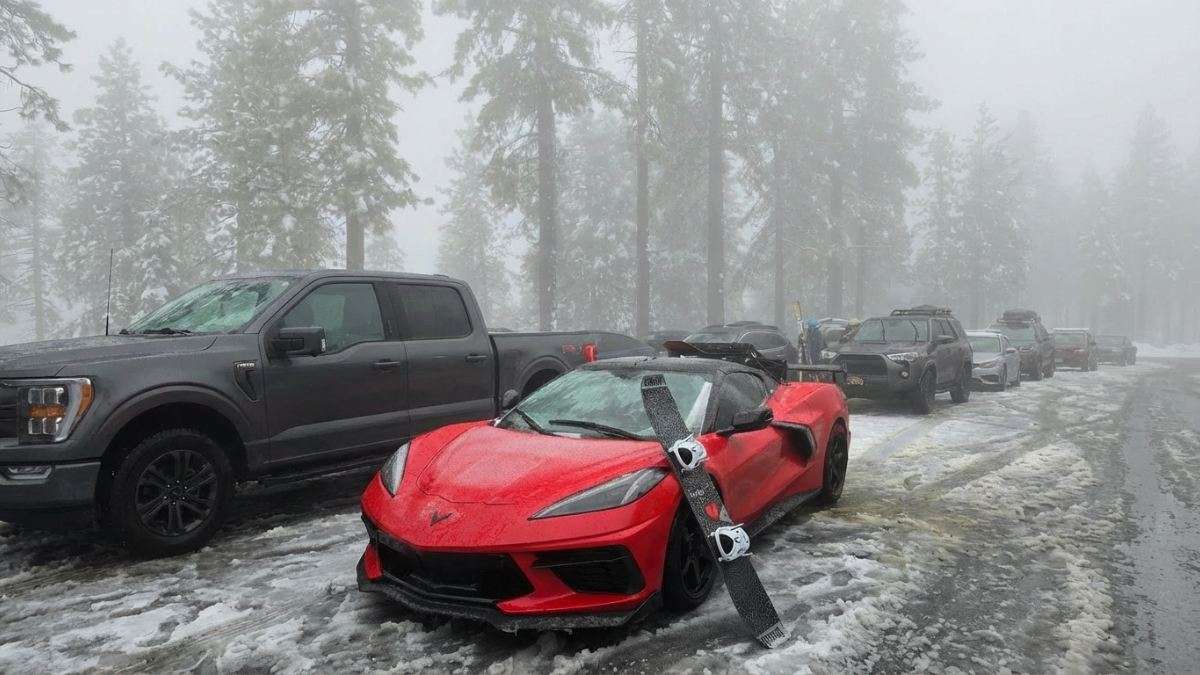

There is a certain romance in watching a sports car refuse to accept the boundaries drawn around it by polite society. For decades, the Corvette has battled a reputation for being a fair-weather companion, something to polish more often than drive. Yet the C8 arrived with a different kind of swagger. It was designed to be used. It was engineered to work. It invited drivers to treat it not as a fragile relic but as a real machine.
The mid-engine layout, the balanced chassis, and the quietly impressive road manners turned it into something far more versatile than its predecessors. What followed was a cultural shift, one that elevated the idea of the Corvette as an everyday partner rather than a temperamental plaything.
“Anyone try taking their c8 in the snow? I know y'all gonna call me crazy, but I just got these snow socks, gonna see how it goes tomorrow morning lol.
Update: these snow socks suck, kept coming off every 200 feet, even when keeping it under 10mph, but even with summer tyres I was fine with only an inch of snow on the road
I saw some snow socks on other people's cars that cover the whole outside of the wheel and not just the tire; those looked to hold on a lot better than the ones I got.”
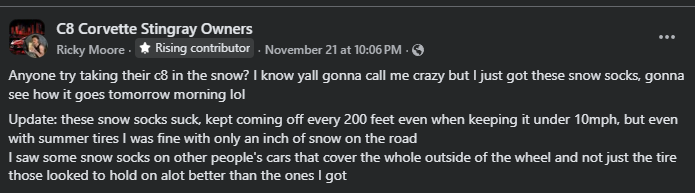
The Facebook post landed with the sort of blunt honesty that comes from someone who had already committed to the experiment before asking anyone’s opinion. Ricky Moore did not attempt to glamorise his snowy adventure. He simply shared what happened when he took a mid-engine sports car into a winter morning and let the chips fall where they may. The group’s reactions arrived with predictable variety. Some offered warnings, some offered encouragement, and some simply enjoyed the spectacle of a Corvette wearing snow socks. It felt like watching an impromptu town hall meeting where everyone spoke from the heart, regardless of expertise.
The practical voices weighed in first. Michael Herczeg asked the obvious question about risking summer tyres in cold weather and raised concerns about traction loss. His caution was rooted in genuine care, the sort of advice that has kept many performance car owners out of ditches over the years. Then Matthew Geiger responded with a clarification that surprised a few readers. He explained that summer tyres may not grip in these temperatures, but they would not be damaged by the cold alone, while winter tyres would suffer prematurely if used in warm seasons due to their softer compounds. Their exchange became a small reminder that automotive knowledge is often shaped by half-truths, ones that get repeated until someone decides to challenge them.
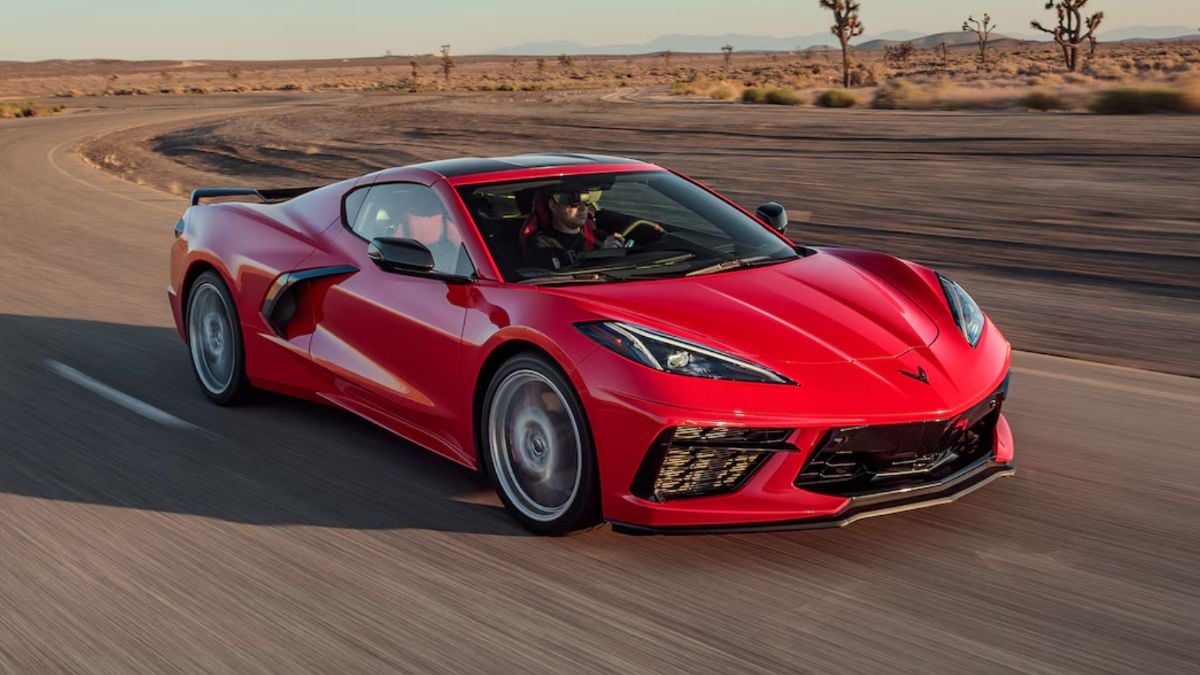
Some comments shifted from technical to philosophical. Albert Santos reminded the group that cars are made to be driven. His point resonated because it captured something essential about performance machines. A Corvette that never braves a little water or a brisk morning is a Corvette denied the life it was built for. That idea fits the spirit of the C8 perfectly. Chevrolet endowed the car with enough electronic oversight and mechanical balance to help it survive these imperfect moments. Weather mode exists for a reason. Even with summer tyres, even with snow socks that refused to stay put, the car remained composed enough to carry its driver through an inch of snow without theatrics.
Then came the more light-hearted observations. Bob May noticed a snowboard leaning against the Corvette in the photo and pointed it out with the same incredulity a museum docent might feel if someone rested a coffee cup on a sculpture. It added a layer of charm to the scene. There was something wonderfully ordinary about a winter sports accessory casually propped against a mid-engine sports car. It spoke to the confidence of an owner who viewed his Corvette not as an untouchable monument but as a tool that can exist in the real world.
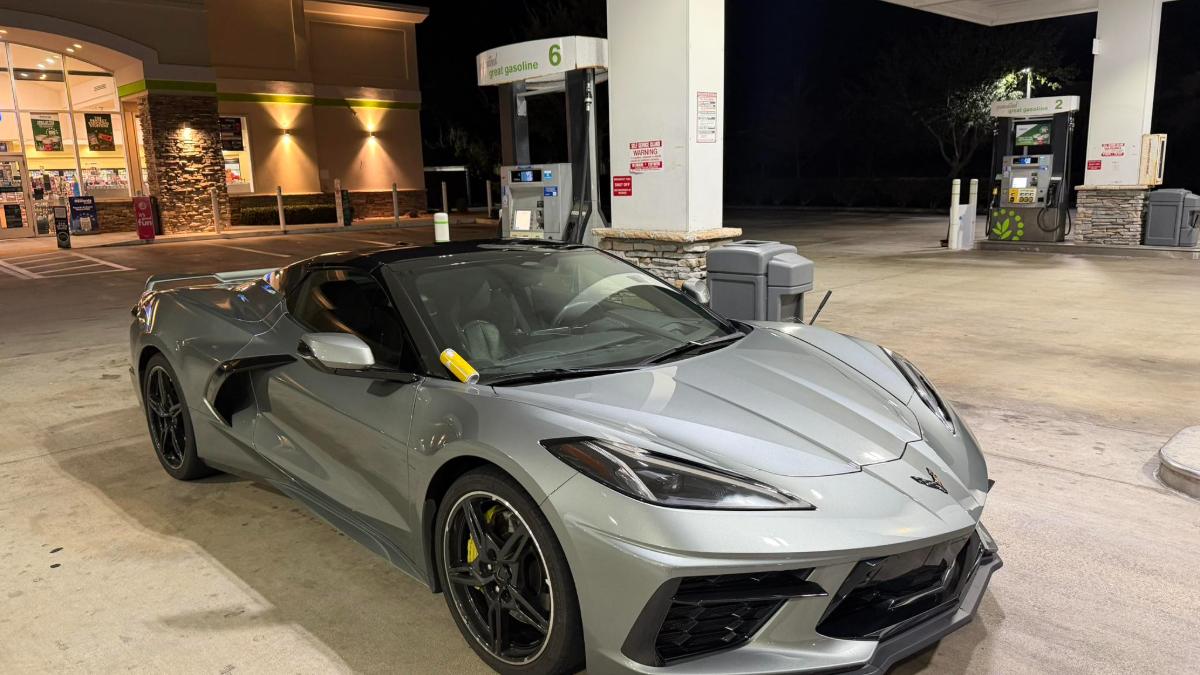
Others made the familiar argument that if you can afford a Corvette, you can afford a winter beater. David Max expressed that viewpoint clearly and without judgment. It is practical advice found in nearly every performance car community. Yet the C8 complicates that logic. With its stable weight distribution and its well-tuned stability control system, it can navigate mild winter conditions more gracefully than many expect. The car’s composure in Moore’s brief snowy drive was not a fluke. It was a quiet demonstration of the engineering depth that often gets overshadowed by the headline figures of horsepower and lap times.
In a way, this small winter adventure underscored the broader achievement of the C8 Corvette. The car delivers supercar speed and precision, but pairs it with road manners that encourage actual use. It has enough refinement to serve as a commuter and enough strength to handle track work. Now we can add another line to its resume. Under certain conditions, it can even manage a winter morning on summer tyres. That is not a recommendation so much as a testament to the vehicle’s capability. It shows that the engineers were not content with building a mid-engine attention magnet. They wanted a sports car that could handle the imperfections of daily life.
What this story reveals is that the C8 Corvette remains loyal to its heritage even as it pushes into new territory. For decades, the Corvette has embodied the American belief that performance should be accessible and usable, not locked behind exclusivity. Ricky Moore’s snowy experiment captured that spirit with unusual clarity. He drove his Corvette into real weather, learned something about its limits, and proved something about its strengths. In doing so, he reminded the community that these cars gain character when they are allowed to live, not when they are protected from experience. The C8 handled the moment with more grace than many expected, and in that outcome, we find a new appreciation for what it truly is: a sports car built to be driven wherever life takes it.
Image Sources: Chevrolet Media Center
Noah Washington is an automotive journalist based in Atlanta, Georgia. He enjoys covering the latest news in the automotive industry and conducting reviews on the latest cars. He has been in the automotive industry since 15 years old and has been featured in prominent automotive news sites. You can reach him on X and LinkedIn for tips and to follow his automotive coverage.
Set Torque News as Preferred Source on Google
Follow us today...