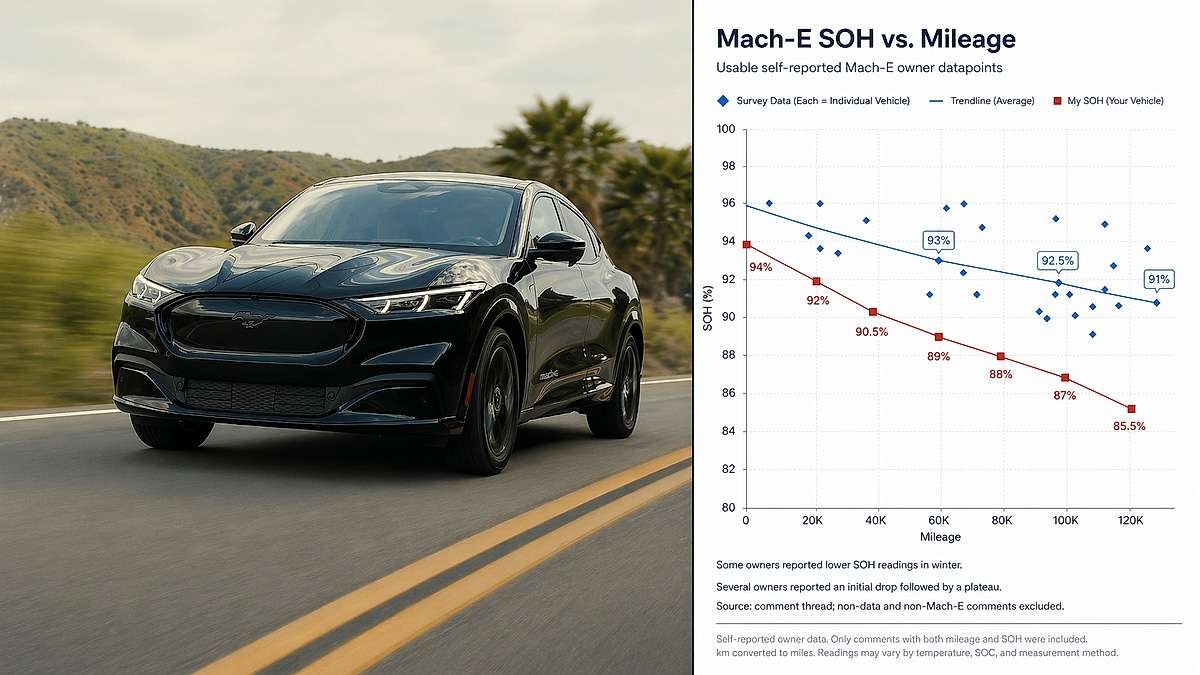

Stephen Cihanek thought he was being careful. He bought a 2021 Ford Mach-E used at 16,000 miles with 91.5% battery health. He charges to 80%, avoids DC fast charging when possible, and tracks every percentage point. At 54,000 miles, his battery shows 88.5% state of health. He posted a chart to the Mach-E community asking a simple question: Is that degradation normal? The thread has drawn dozens of owner responses with detailed mileage and state-of-health data.
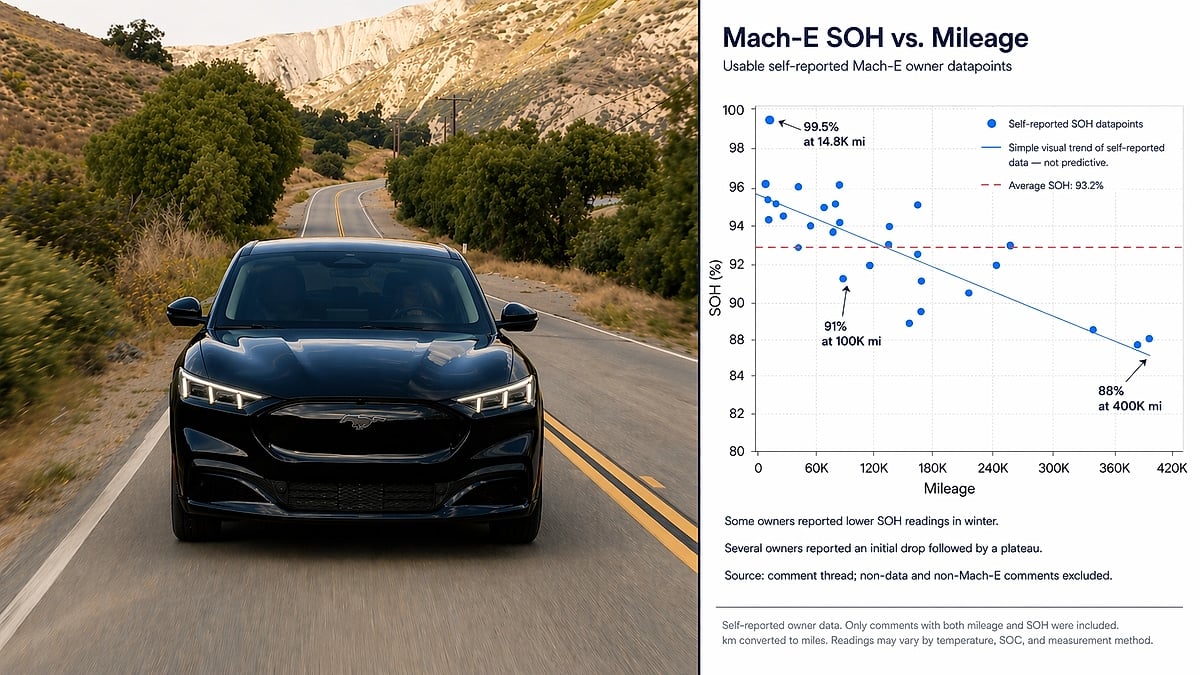
Ed Sellers, a Mach-E owner with 100,000 miles on his 2021 Select AWD standard battery, reported 91% battery health. Jonathan Budd, at 37,000 miles on a 2022 Premium Extended Range, reported 96.5%. Luke Wilson hit 135,000 miles on a 2022 SR AWD and still shows 90%. Even Pantovic Aleksandar, who has driven 400,000 kilometers (roughly 248,000 miles) on his Mach-E GT, reports 88% state of health. That is the same figure Cihanek sees at one-fifth the mileage.
Cihanek's degradation line, shown in red on his community chart, is steeper than almost every data point contributed by other owners. The blue trendline representing the community average sits noticeably above his personal trajectory. For a driver who takes every precaution, the gap between his results and everyone else's is either alarming or explainable. The community believes it is the latter.
Cihanek bought his Mach-E used. He does not know what the state of health was when the vehicle rolled off the assembly line. The 91.5% reading at 16,000 miles suggests the previous owner may have already degraded the battery through frequent DC fast charging, consistent 100% charging, or extreme climate exposure. Without the original factory baseline, Cihanek cannot calculate his true degradation rate. He can only measure from the point he took ownership.
Craig Phillips, another Mach-E owner with 48,000 miles, reported that his state of health reads 87% in winter and 93% in warmer months. That is a 6 percentage point swing based on temperature alone. Lithium-ion batteries perform worse in cold weather, and the battery management system's SoH calculation can read artificially low until the pack warms. If Cihanek took his 88.5% reading in cold weather, a summer retest could show 92% or higher without any actual change in battery capacity.
Several owners in the thread noted that the Mach-E's state-of-health reading is not always accurate without periodic recalibration. Jonathan Budd provided a specific five-step process: record the current SoH, charge to 100%, and let the cells balance (which can take hours after the gauge hits 99%), drive down to approximately 15% state of charge, charge back to the normal 85-90% target, and recheck the SoH. This process forces the battery management system to recalculate its reference points.
Calvin Sung, another owner at 42,000 miles, reported a similar experience. His car showed 88.5% state of health, but had read 90% just weeks earlier when the weather was warmer. Mark Dinges, with only 14,847 miles, reported 99.5% state of health. Nor Norr, at 22,000 kilometers on a 2024 model, reported 99%. Those low-mileage figures establish what a healthy Mach-E battery looks like. The question is not whether 88.5% is normal at 54,000 miles. The question is whether 88.5% is an accurate measurement.

Ford's battery warranty covers the Mach-E's high-voltage battery for 8 years or 100,000 miles. The warranty typically guarantees 70% state of health or higher during that period, though owners have reported that getting dealers to test and verify SoH accurately can be as frustrating as the Kia service delays documented when a single dealership turned a minor rodent issue into a months-long ordeal for one EV9 owner. At 88.5%, Cihanek is well above the warranty threshold. Even if the reading is accurate, Ford would not replace his battery under warranty. But the psychological impact of watching a $50,000+ vehicle's battery health tick downward is real. Every percentage point represents range anxiety for owners who depend on their EV for daily commuting.
The community data suggests Cihanek's concern may be premature. A 250,000-mile Mach-E with 92% battery health shows that Ford's battery thermal management holds up under extreme use, and the Pantovic data point at nearly 250,000 miles aligns with that longer-term durability story. If he follows the recalibration process and retests in warmer weather, his SoH could jump back into the low 90s. And if it does not, his degradation rate of roughly 3 percentage points over 38,000 miles is still well within industry norms for lithium-ion batteries. Most EV manufacturers expect 10-20% degradation over the life of the vehicle. Cihanek would hit 10% degradation at approximately 126,000 miles based on his current trajectory. That is better than average.
State of health readings are snapshots, not verdicts. A Mach-E battery failure at 31,000 miles demonstrates how individual packs can fail early even when fleet data is strong, which is why Ford's warranty exists and why Cihanek's 88.5% reading deserves context rather than panic. Temperature, charging habits, software calibration, and measurement timing all affect the number. A single 88.5% reading in February tells you less than a 91% reading in June after a full recalibration cycle.
For prospective Mach-E buyers, the data is more reassuring than alarming, especially when owners follow Mach-E charging recommendations that help maximize battery longevity, and when compared to early EV adopters who faced steeper degradation curves in vehicles like the Nissan Leaf before liquid cooling became standard. A 2021 Select AWD with 100,000 miles still holds 91% state of health, which compares favorably to other EVs in the segment and suggests Ford's battery thermal management is holding up under real-world use. A 2022 SR AWD with 135,000 miles holds 90%. And a GT with nearly 250,000 miles holds 88%. Those are not the numbers of a vehicle with a systemic battery problem. They are the numbers of a battery chemistry that degrades predictably and plateaus after the first few years.
Cihanek's chart went viral in the Mach-E community because it touched a universal EV owner fear, the same anxiety that has driven Tesla owners to document every percentage point of battery degradation across hundreds of thousands of vehicles. Fear makes people post. The community's response shows that fear may be based on a measurement quirk, not a mechanical failure. A software reading on a cold day can make a healthy battery look sick.
Recalibrate in warm weather. Track the trend over months, not weeks. And remember that 88.5% today does not mean 70% tomorrow. Degradation is not linear. It is a curve that flattens over time.
Image Sources: Ford Media Center
About The Author
Noah Washington is an automotive journalist based in Atlanta, Georgia, covering sports cars, luxury vehicles, and performance culture. His reporting focuses on explaining the engineering, design philosophy, and real-world ownership experience behind modern vehicles.
Noah has been immersed in the automotive world since his early teens, attending industry events and following the enthusiast communities that shape how cars are built and driven today. His work blends industry insight with enthusiastic storytelling, helping readers understand not just what a car is, but why it matters.
Noah is also a member of the Southeast Automotive Media Association (SAMA), a professional organization for automotive journalists and industry media in the Southeast.
His coverage regularly explores sports cars, luxury vehicles, and performance-driven segments of the automotive industry, including the evolving culture surrounding Formula Drift and enthusiast builds.
Read more of Noah's work on his author profile page.
You can also follow Noah here:
Set Torque News as Preferred Source on Google
Follow us today...