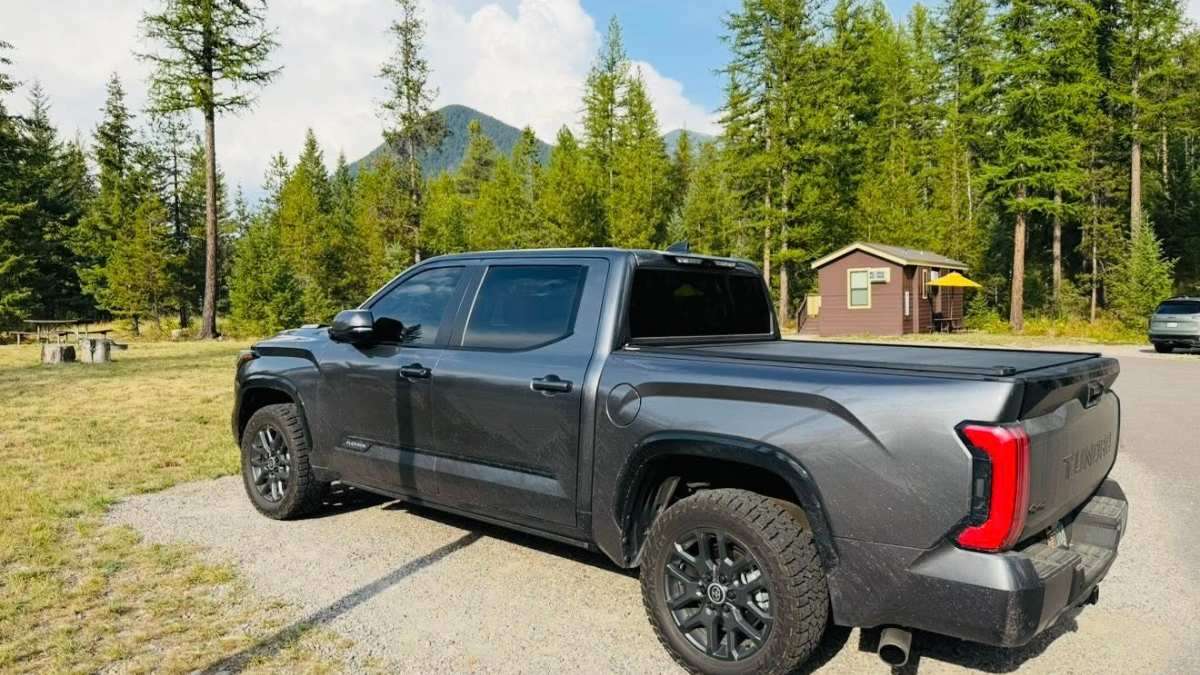

There is a strange tension in the current Toyota Tundra world. Owners of the newest generation find themselves caught between the reputation of a brand known for longevity and a swirl of modern recall notices that have fueled a superstition all their own. Some drivers have begun treating their trucks as if the next press of the starter button might light a fuse, creeping away from stoplights and feathering the accelerator with a gentleness more suited to a borrowed classic than a full-size pickup. A handful of early engine issues gave rise to enough online alarm that, in many corners of the community, the truck has become something to tiptoe around. It is a curious mood for a machine that weighs more than three tons and carries a lineage built on work, not worry.
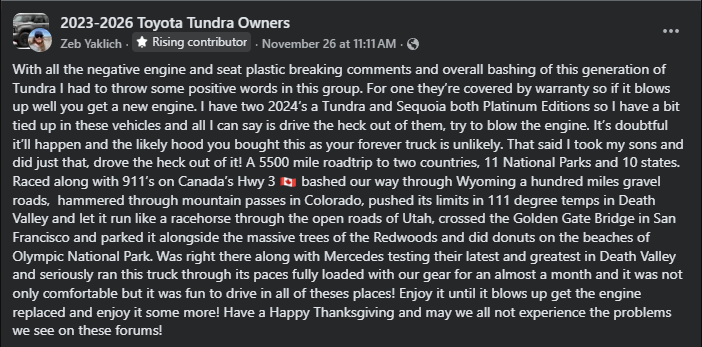
The counterargument arrived with force when one owner decided he had read enough gloom and doubt and felt compelled to bring his own experience to the table. The entire post reads as follows:
“With all the negative engine and seat plastic breaking comments and overall bashing of this generation of Tundra, I had to throw some positive words in this group. For one, they’re covered by warranty, so if it blows up well you get a new engine. I have two 2024s, a Tundra and Sequoia, both Platinum Editions, so I have a bit tied up in these vehicles, and all I can say is drive the heck out of them, try to blow the engine. It’s doubtful it’ll happen, and the likelihood you bought this as your forever truck is unlikely. That said, I took my sons and did just that, drove the heck out of it! A 5500 road trip to two countries, 11 National Parks, and 10 states. Raced along with 911’s on Canada’s Hwy 3 🇨🇦 bashed our way through Wyoming a hundred miles gravel roads, hammered through mountain passes in Colorado, pushed its limits in 111 degree temps in Death Valley and let it run like a racehorse through the open roads of Utah, crossed the Golden Gate Bridge in San Francisco and parked it alongside the massive trees of the Redwoods and did donuts on the beaches of Olympic National Park. I was right there, along with Mercedes, testing their latest and greatest in Death Valley and seriously ran this truck through its paces fully loaded with our gear for almost a month, and it was not only comfortable, but it was fun to drive in all of these places! Enjoy it until it blows up, get the engine replaced, and enjoy it some more! Have a Happy Thanksgiving, and may we all not experience the problems we see on these forums!”
The reaction in the owner community was swift. Some saw it as the kind of clear-eyed perspective that has been missing in a world where online posts often skew toward worst-case scenarios. One comment praised his “style” and reminded everyone that Toyota has always stood behind its products. Others offered stories of their own. One driver described rolling more than sixty thousand miles before needing an engine replacement, yet reported that even during the seal failure that triggered the repair, the truck never out-and-out stranded him. Another owner recounted traveling from Edmonton to Wink, Texas, with a fully loaded bed and one hundred thousand kilometers showing on the odometer, noting that his most significant issue so far had been a cracked seat cover. These are the kinds of experiences that speak more directly to the real nature of a truck than the online thunderclaps of rumor and speculation.
Toyota Tundra: Trim Levels Compared
- Its twin-turbo V6 (or hybrid-assisted) powertrain is strong and smooth: many trims deliver ~389 hp and ~479 lb-ft of torque, giving the Tundra plenty of muscle for everyday driving, hauling, and towing.
- The ride quality and comfort are improved vs older full-size trucks: thanks to coil-spring rear suspension and modern cabin features (like a 14-inch central touchscreen and more refined controls), the Tundra feels more civilized for daily use.
- The bed uses composite materials to resist dents/scratches, and the overall build aims for versatility, suitable for work, towing, or family+gear hauling.
- Some interior materials (especially in lower trims) feel cheap or less premium than you might expect given the price. There have also been reports of rattles, squeaks, or inconsistent build quality among owners.
That does not mean the concerns are unwarranted. One commenter asked the question that many quietly consider. He wanted to know what happens if a second engine fails after the warranty has expired. It is the sort of practical inquiry that keeps risk in perspective. Others voiced a preference for the older V8, not as a criticism but as an acknowledgment that simpler engines often inspire a different kind of confidence. These conversations reflect a community working through the reality of a modern powertrain that is far more complex than its predecessor. Toyota has said that replacement engines incorporate updated components, and while this brings reassurance, no single statement can carry the weight of long-term ownership reality all by itself.
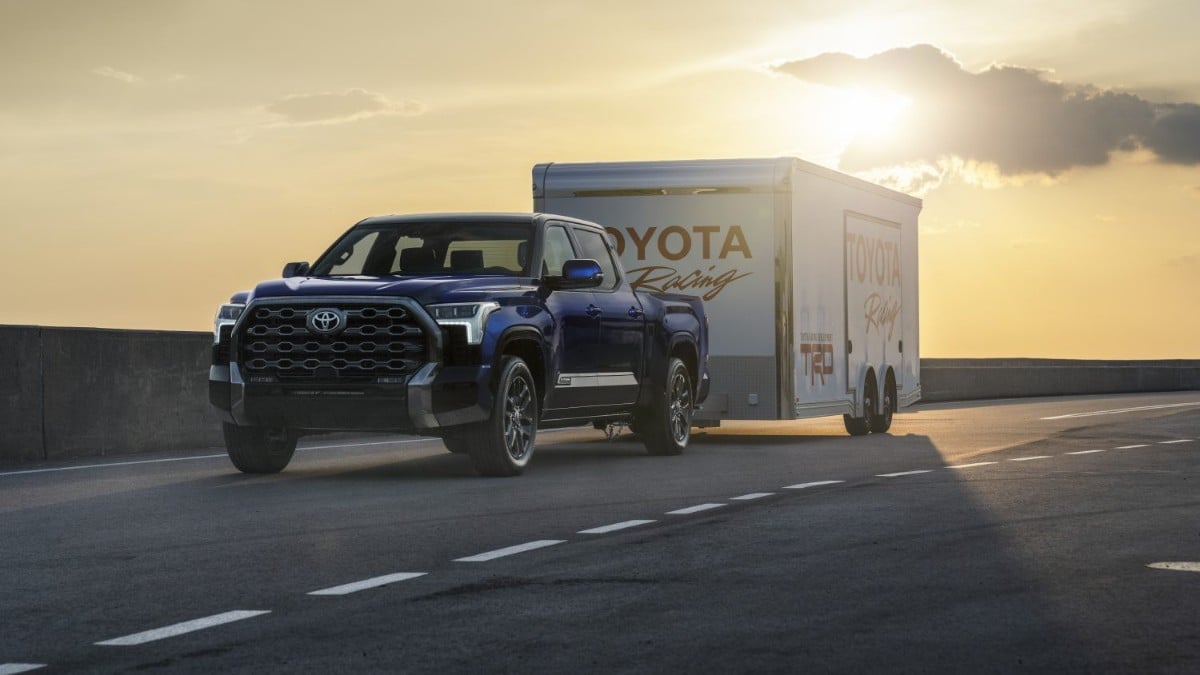
Despite all of this, a particular energy is emerging among the most adventurous owners. They have chosen to use their Tundras the way they believe they were intended to be used, crossing borders, towing heavy loads, exploring remote parks and backroads, and trusting that the warranty exists for a reason. This is not carelessness. It is confidence informed by experience. They understand that mechanical things may fail, but that failure is not the defining characteristic of a machine unless the owner allows worry to overshadow use. They see a full-size truck not as something fragile but as something designed to meet the road head-on.
The Tundra’s shift from its long-running V8 heritage to a twin-turbo V6 was always going to bring an adjustment period. Powertrains change, expectations evolve, and manufacturers refine their products. The early stumbles became louder online than they were statistically across the ownership base, and the resulting storm made it easy to forget that Toyota has a long history of vehicles that earn their reputations not in spec sheets but in the thousands of miles normal people drive them every day. What the boldest owners are demonstrating is that the truck is more capable than the atmosphere of caution might suggest.
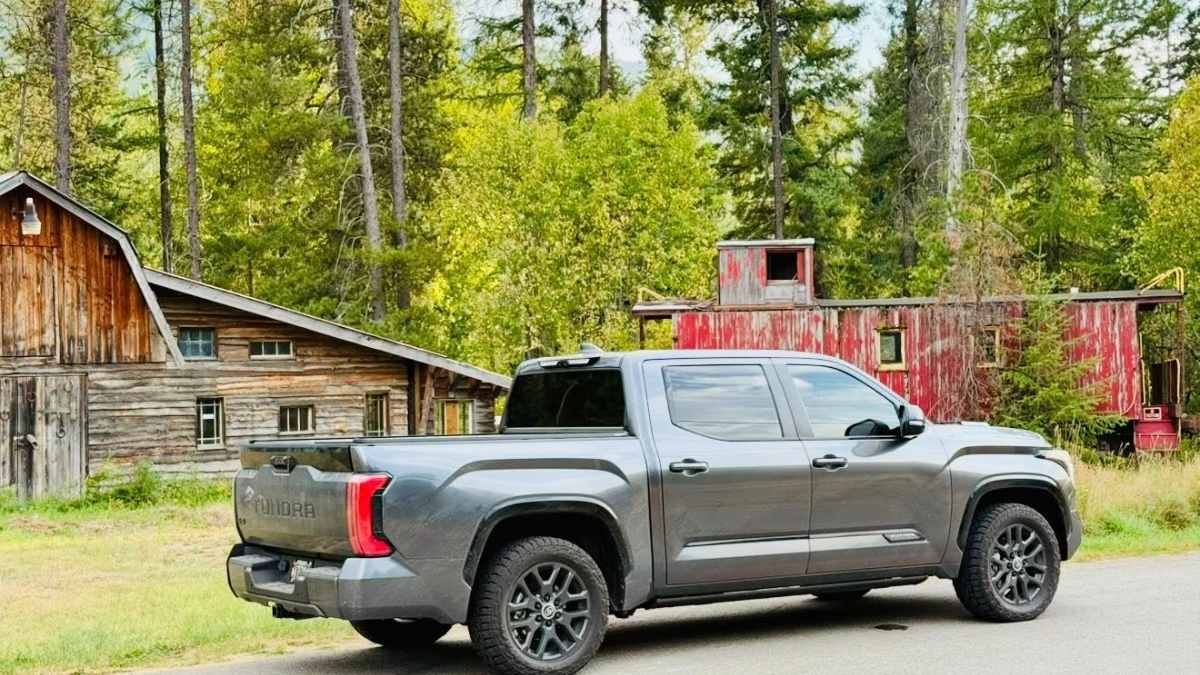
Their stories show the other side of ownership, the side often overlooked when recall headlines take the spotlight. They reveal a pickup pushed through extreme climate, high altitude mountain passes, long stretches of gravel roads, and even impromptu encounters with performance cars on open highways. These accounts highlight the durability of the chassis, the composure of the suspension, and the stamina of the powertrain when used as intended. They remind readers that the true narrative of a truck’s character is written not in isolated incidents but in repeated performance across varied and demanding landscapes.
What stands out most is the clarity of purpose in the tone of these owners. They are not trying to prove anyone wrong. They are simply refusing to let fear dictate how they use their vehicles. Their approach has a refreshing honesty to it, a willingness to accept whatever happens next while still enjoying the present. In that spirit, the ongoing story of the third-generation Tundra becomes far more interesting. It becomes a story about drivers choosing to engage with their trucks, not tiptoe around them. It becomes a reminder that cautious speculation can never replace miles traveled on real roads.
If there is a lesson to take from all of this, it is that the truth of a vehicle emerges only through use. The Tundra is living through a moment defined by worry, yet the people who are putting their trucks through honest, hard miles are discovering something very different from the anxiety that thrives online. Their experiences show that confidence does not require denial of problems, only a willingness to measure a machine by what it actually does. For now, the odometers continue to climb, the stories continue to spread, and the newest Tundra finds itself judged not by prediction but by performance.
Image Sources: Toyota Media Center
Noah Washington is an automotive journalist based in Atlanta, Georgia. He enjoys covering the latest news in the automotive industry and conducting reviews on the latest cars. He has been in the automotive industry since 15 years old and has been featured in prominent automotive news sites. You can reach him on X and LinkedIn for tips and to follow his automotive coverage.
Set Torque News as Preferred Source on Google
Follow us today...