
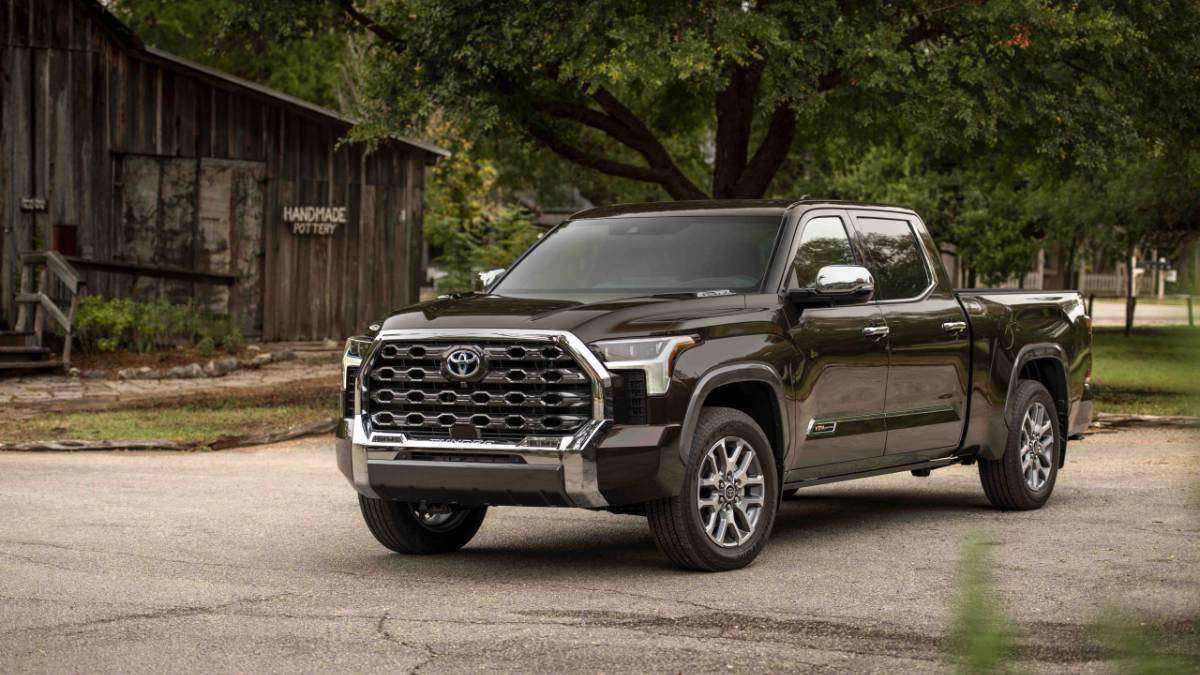

Crisis response is often a tightrope walk over a canyon of lawsuits, shareholders, and angry customers. Yet Toyota seems to be dancing across it with rare composure.
The company’s recent handling of the 2023 Tundra engine recall is shaping up to be less of a corporate fire drill and more of a case study in accountability. While most manufacturers try to downplay defects or hide behind procedural jargon, Toyota’s approach has been refreshingly straightforward: own the problem, communicate the fix, and take care of the customer. It’s the kind of no-nonsense responsibility that used to define the industry’s best names before the era of scripted apologies and press release damage control.
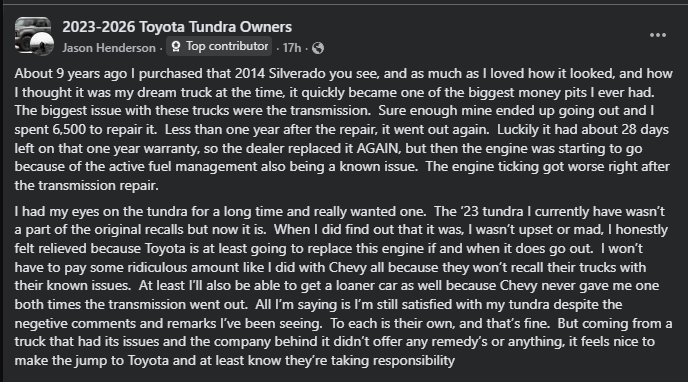
Jason Henderson, a member of the 2023–2026 Toyota Tundra Owners Facebook group, captured this sentiment perfectly in a now widely shared post. His story reads less like a complaint and more like a revelation from a man who’s finally found a brand that treats him as more than a VIN number.
“About 9 years ago, I purchased that 2014 Silverado you see, and as much as I loved how it looked, and how I thought it was my dream truck at the time, it quickly became one of the biggest money pits I ever had. The biggest issue with these trucks was the transmission. Sure enough, mine ended up going out, and I spent $6,500 to repair it. Less than one year after the repair, it went out again. Luckily, it had about 28 days left on that one-year warranty, so the dealer replaced it AGAIN, but then the engine was starting to go because of the active fuel management also being a known issue. The engine ticking got worse right after the transmission repair.
I had my eyes on the tundra for a long time and really wanted one. The ‘23 tundra I currently have wasn’t a part of the original recalls, but now it is. When I did find out that it was, I wasn’t upset or mad; I honestly felt relieved because Toyota is at least going to replace this engine if and when it does go out. I won’t have to pay some ridiculous amount like I did with Chevy, all because they won’t recall their trucks with their known issues. At least I’ll also be able to get a loaner car because Chevy never gave me one both times the transmission went out. All I’m saying is I’m still satisfied with my tundra despite the negative comments and remarks I’ve been seeing. To each is their own, and that’s fine. But coming from a truck that had its issues and the company behind it didn’t offer any remedies or anything, it feels nice to make the jump to Toyota and at least know they’re taking responsibility.”
For context, Toyota filed this recall with the National Highway Traffic Safety Administration on May 30, 2024, covering roughly 98,600 2022–2023 Tundras built between November 2021 and February 2023. The problem stems from the 3.5-liter twin-turbo V6 potentially stalling under certain conditions, a serious issue for a half-ton truck tasked with towing and hauling. Instead of issuing a patchwork fix or a vague software update, Toyota is offering full engine replacements at no cost to the customer. According to NHTSA documents, this wasn’t prompted by legal threats or mounting complaints but by Toyota’s internal review. In other words, they’re solving the problem before it becomes a scandal.
Toyota Tundra: Recall Response
- Toyota has issued a recall (code 25TA14) covering 2022-2024 non-hybrid Tundra trucks and certain 2024 Lexus GX/LX vehicles because machining debris may have been left in the engine during production, which could lead to engine knocking, rough running, a no-start condition or loss of motive power.
- The defect stems from the potential presence of leftover debris in the engine’s production process, affecting the twin-turbo 3.4 L V6 “iForce V35A” engine; Toyota acknowledged this as the root cause.
- Toyota is currently developing a remedy for the issue and has stated that affected owners will be notified starting in early January 2026, when they can bring their vehicles to dealers for free inspection/repair once the fix is ready.
- In parallel, Toyota also announced a separate recall affecting nearly 400,000 Tundras and Sequoia hybrids for a rear-view-camera software fault that could impair rear visibility; the fix involves a free software update at dealerships.
The reaction from owners has been surprising, not for its anger, but for its calm approval. Henderson’s post sparked hundreds of responses, and many echoed his experience. Chris Zack, a self-described “GM family lifer,” wrote, “My Dad retired from GM… the last GM I bought was a brand new ‘07 Escalade EXT. Then I bought my first Toyota in ’17, a ’15 Tundra Platinum. Put over 100k and never went to the shop or had issues.” That’s not marketing, it’s the voice of a customer who’s experienced the full spectrum of American and Japanese engineering philosophies and decided trust matters more than brand loyalty.
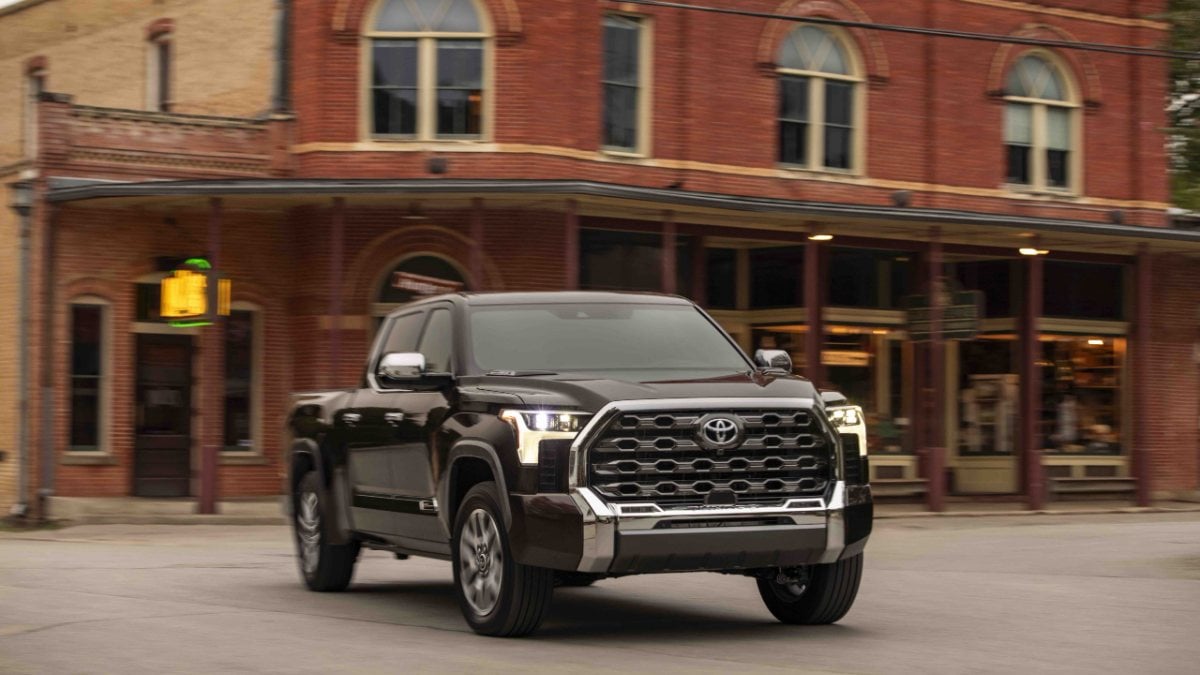
There’s also a refreshing pragmatism among Toyota owners that contrasts sharply with the fear or outrage that usually accompanies a recall notice. One commenter, Paulopaulo Kang-uh, summed up the prevailing sentiment: “Bro, the recall is a GREAT thing! I’m putting 150k on my motor before I get a new one. I’ll have all the improvements up to date when I get it done. Win/win!” That kind of optimism only exists when a company earns it through consistency. It’s not about perfection but about predictability; owners know Toyota will stand behind its product, even when it stumbles.
Critics do exist, of course. A few commenters suggested that Henderson had merely swapped one risky purchase for another, with one remarking, “So you made a poor decision and then didn’t learn anything from it and did it again???” But that sort of reflexive skepticism misses the larger point. What Henderson and others are recognizing isn’t that Toyota builds flawless machines, but that it behaves like a responsible partner when things go wrong. It’s an approach that seems almost quaint in an era when many automakers prefer to litigate rather than communicate.
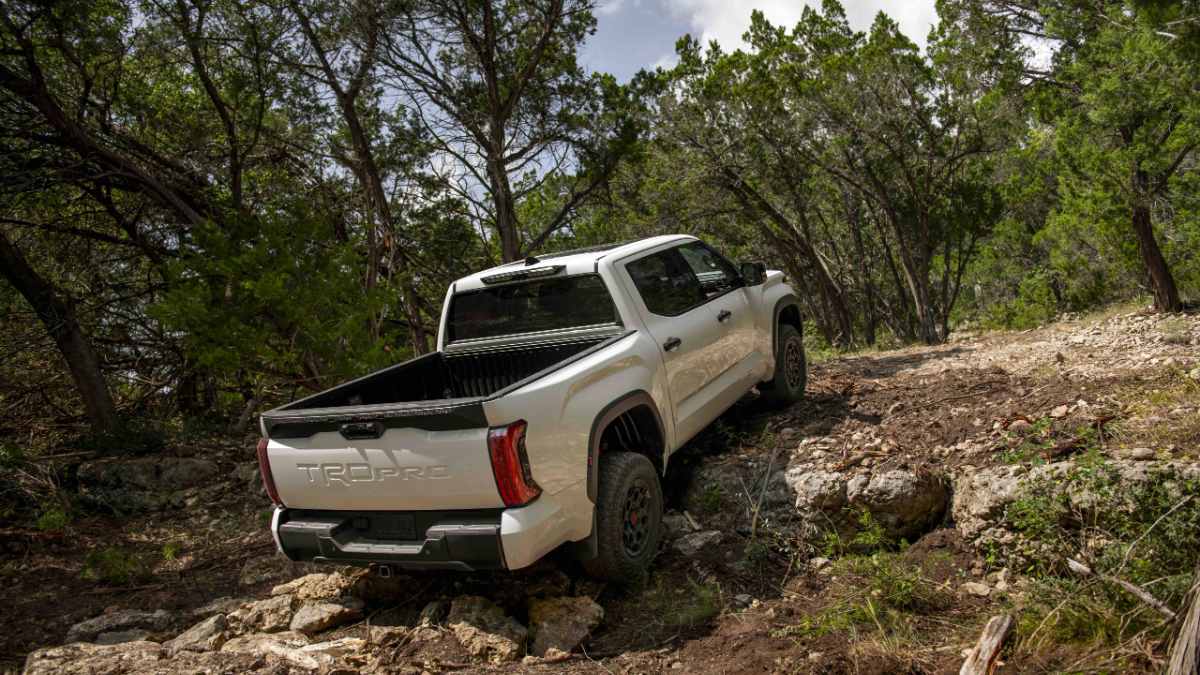
From a technical standpoint, replacing an entire engine rather than attempting a component-level fix is an expensive, labor-intensive decision. It also sends a strong message about the company’s priorities. Toyota’s willingness to expand the recall to include trucks not initially covered, like Henderson’s 2023 model, shows a degree of caution and honesty that most manufacturers simply can’t afford, or won’t risk. Add to that the company’s provision of loaner vehicles and the transparency of its service bulletins, and you have a recall that feels less like an inconvenience and more like an assurance.
What’s happening here is more than a mechanical correction. It’s a cultural one. In an age of corporate minimalism, Toyota is reviving a lost art in the auto industry: customer stewardship. For owners who live by their trucks, who rely on them for work, family, and identity, that kind of trust is currency. Henderson’s post didn’t just describe relief over an engine replacement; it reflected faith restored in a brand that has earned its reputation the hard way, by showing up when it matters.
Image Sources: Toyota Media Center
Noah Washington is an automotive journalist based in Atlanta, Georgia. He enjoys covering the latest news in the automotive industry and conducting reviews on the latest cars. He has been in the automotive industry since 15 years old and has been featured in prominent automotive news sites. You can reach him on X and LinkedIn for tips and to follow his automotive coverage.
Set Torque News as Preferred Source on Google
Follow us today...




Comments
Toyota only cares about…
Permalink
Toyota only cares about those dollars.
Im making the switch to…
Permalink
Im making the switch to toyota as well. I had a 2011 silverado , burnt up transmission at 230,000. The only reason thus truck lasted this long was one, I never towed with it and two I put a chip dongle thing i plugged into the ECM port to disable the garbage AFM tech. Kept my truck in V8 mode at all times, no carbon build up on the valves and it got better mileage. 280$ cheaper than new motor.