
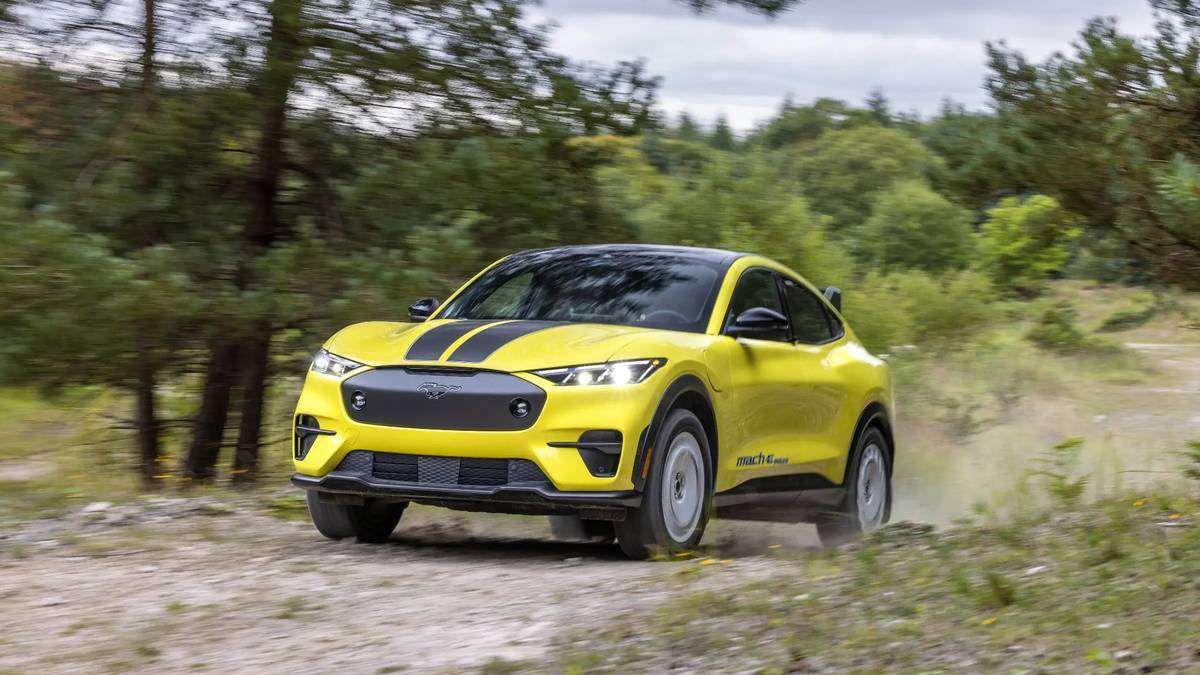

Cold weather has always been a stress test for electric vehicles, but a recent experience from a 2023 Ford Mustang Mach-E GT Performance Edition owner in eastern North Carolina underscores how even relatively mild winter conditions can still expose weak points in daily EV usability.
On a night when temperatures dropped to 18°F, the owner’s Mach-E failed to charge overnight despite being plugged into an outdoor Grizzl-E Level 2 charger and set to charge during off-peak hours. By morning, the car showed no warnings, no fault messages, and no indication, either on the vehicle or in the Ford app, that charging had failed. The charge history simply showed nothing happened.
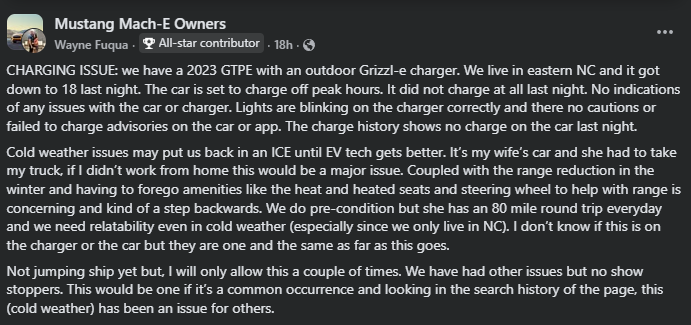
“Charging Issue: We have a 2023 GTPE with an outdoor Grizzl-e charger. We live in eastern NC, and it got down to 18 last night. The car is set to charge during off-peak hours. It did not charge at all last night. No indications of any issues with the car or charger. Lights are blinking on the charger correctly, and there are no cautions or failed to charge advisories on the car or app. The charge history shows no charge on the car last night.
Cold weather issues may put us back in an ICE until EV tech gets better. It’s my wife’s car, and she had to take my truck; if I didn’t work from home, this would be a major issue. Coupled with the range reduction in the winter and having to forego amenities like the heat, heated seats, and steering wheel to help with range is concerning and kind of a step backwards. We do pre-condition, but she has an 80-mile round trip every day, and we need reliability even in cold weather (especially since we only live in NC). I don’t know if this is on the charger or the car, but they are one and the same as far as this goes.
Not jumping ship yet, I will only allow this a couple of times. We have had other issues, but no show stoppers. This would be one if it’s a common occurrence, and looking in the search history of the page, this (cold weather) has been an issue for others.”
The result was immediate disruption. The Mach-E is the owner’s wife’s daily driver with an 80-mile round-trip commute. Instead of driving her own car, she had to take the household’s ICE truck. If the owner hadn’t been working from home, the situation would have escalated from inconvenience to genuine problem.
Ford Mustang Mach-E: Battery Placement & Center of Gravity
- The Mach-E’s crossover profile prioritizes rear-seat space and cargo capacity, moving away from the low rooflines typically associated with performance coupes.
- Steering response is tuned for stability and ease of use, delivering predictable behavior but limited tactile feedback at higher speeds.
- Most vehicle functions are centralized within a large vertical touchscreen, reducing physical controls while increasing reliance on software responsiveness.
- Battery placement beneath the cabin lowers the center of gravity, improving balance while contributing to a firmer ride over sharp road imperfections.
What makes the incident more concerning than a simple charging hiccup is the lack of feedback. The charger appeared normal. The vehicle appeared normal. There were no alerts to explain why charging never initiated. Only after unplugging and plugging the car back in later did charging resume as expected.
That uncertainty is what pushed the owner to question long-term EV viability for their use case. Range reduction in winter is already an accepted compromise, but when charging itself becomes unreliable, and without explanation, the margin for error shrinks quickly. Add in the need to limit cabin heat, heated seats, and steering wheel use to preserve range, and the ownership experience starts to feel like a step backward rather than forward.
Other Mach-E owners were quick to share similar experiences and potential workarounds. Several pointed to scheduling conflicts between the vehicle and third-party chargers. A common theme emerged: letting the charger control off-peak scheduling rather than the car tends to be more reliable. Others suggested allowing charging to begin immediately after plugging in, while the battery is still warm, and relying on departure scheduling for cabin preconditioning instead.
Some owners from much colder climates, including Chicago-area drivers seeing temperatures well below zero, reported no charging issues at all. Their experiences suggest the problem may not be cold itself, but the interaction between vehicle software, charger firmware, wiring, and scheduling logic. In other words, not a single failure point, but a system that lacks robustness when conditions aren’t ideal.
And that’s where the broader concern lies. The Mach-E itself accepted a charge once reconnected, indicating no hardware failure. But a modern vehicle that can silently fail to charge overnight, without warning or explanation, undermines confidence, especially for households that rely on predictable daily transportation.
The owner was careful not to declare EV ownership a failure. “Not jumping ship yet,” he wrote, but added a clear boundary: this can only happen a couple of times before it becomes unacceptable. That sentiment reflects a growing divide between EV capability and EV reliability. Performance, acceleration, and tech features continue to impress. But for many owners, consistency matters more than innovation.
In a state like North Carolina, far from extreme winter territory, an 18°F night shouldn’t feel like an edge case. Until EVs and home charging systems communicate more clearly and fail more transparently, experiences like this will continue to nudge some owners back toward internal combustion, not because EVs can’t work, but because they sometimes don’t, and don’t explain why.
That gap between promise and predictability remains one of the biggest hurdles EVs still need to overcome.
Image Sources: Ford Media Center
Noah Washington is an automotive journalist based in Atlanta, Georgia. He enjoys covering the latest news in the automotive industry and conducting reviews on the latest cars. He has been in the automotive industry since 15 years old and has been featured in prominent automotive news sites. You can reach him on X and LinkedIn for tips and to follow his automotive coverage.
Set Torque News as Preferred Source on Google
Follow us today...


Comments
On the other hand, it's not…
Permalink
On the other hand, it's not really a Mustang, so who cares, right?
Buy a Tesla instead. No…
Permalink
Buy a Tesla instead. No problems as Tesla has advanced software that notifies of any charging errors. Ford has inferior software.
I would suggest not ruling…
Permalink
I would suggest not ruling out the charger as the potential cause. Based on my experience using a Wi-Fi-enabled Grizzl-E Level 2 charger, I have encountered several instances where my EV failed to charge overnight without any errors or warnings. In these cases, the charger simply did not initiate the scheduled session.
Additionally, the Wi-Fi connection on this model has been unreliable and drops out regularly
Needless to say, I would select a different level 2 charger next time.
The author says the charging…
Permalink
The author says the charging was "indoors". The car owner clearly states it was outdoors. Where was the editor?
A charger used during this…
Permalink
A charger used during this event is a lower quality one. I would first look at the charger before blaming the EV car. Search online. A charger should cost $400. Ford makes great EV's.
Wow, such a ridiculous…
Permalink
Wow, such a ridiculous article. Yes, I fell for it and read it. It’s too bad his car didn’t charge once. But it’s silly for someone to say they had to reconsider EV ownership because of one incident. Should the owners of Internal combustion engine powered cars reconsider the ownership every time something goes wrong or not as planned with their cars? It wasn’t even a repeated problem. It was once. Did he take it in to the shop for this or just figured it was good material for an article?
Well, it served it purpose. I did click and read it.