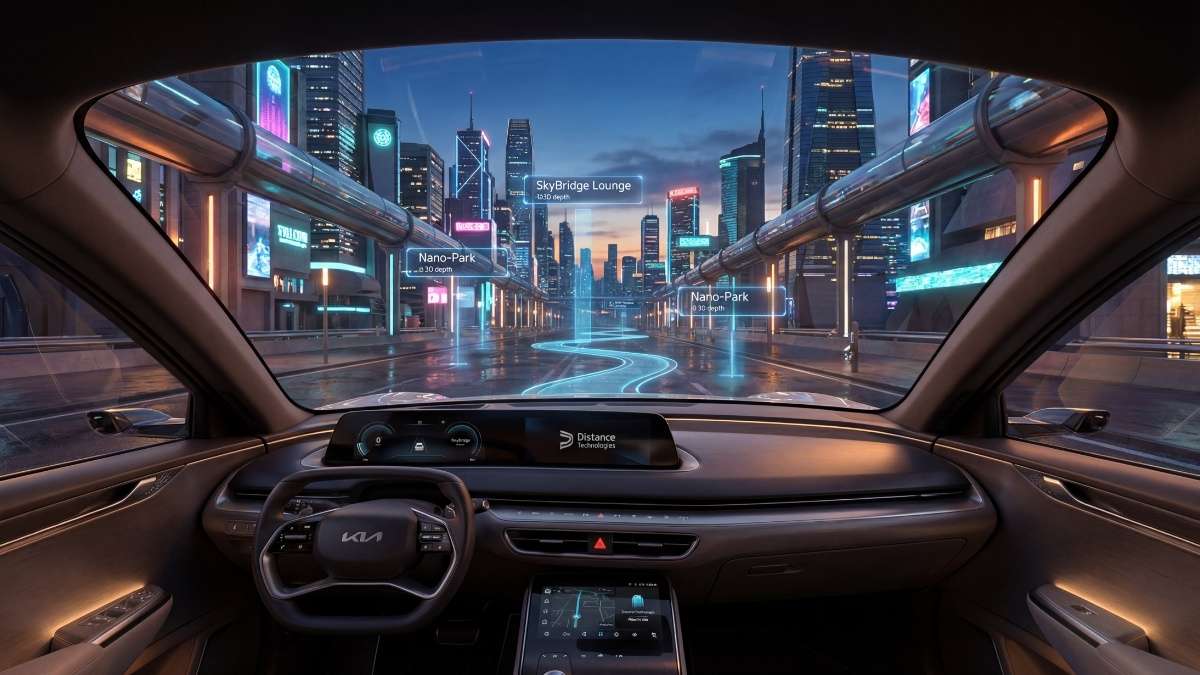

At Milan Design Week, a quiet revolution in automotive interfaces just took a massive leap forward. Kia, a company that has transitioned from a budget brand to a design and technology leader, showcased the Kia Vision Meta Turismo concept. While the car itself is a stunning tribute to Kia’s 80th anniversary, the real star is under the skin - or rather, on the glass. By integrating Distance Technologies’ next-generation panoramic lightfield display, Kia is previewing a world where the windshield isn't just a piece of safety glass, but a spatially aware, infinite-depth portal.
As someone who spends a significant amount of time analyzing the transition to Agentic AI and the evolution of the software-defined vehicle, I believe this lightfield implementation is one of the most critical developments in human-machine interface (HMI) we’ve seen in a decade.
What Makes Distance’s Lightfield Technology Different?
Most current Head-Up Displays (HUDs) are, frankly, disappointing. They are essentially small, flat projections that appear to float a few feet in front of the driver. They suffer from focal mismatch; your eyes have to refocus between the distant road and the nearby virtual image, which leads to eye strain and cognitive load.
Distance Technologies, led by CEO Urho Konttori (who has a deep pedigree in high-end XR), has solved this with computational optics. According to the official collaboration announcement, their lightfield HUD offers "infinite pixel depth." This means the digital content isn’t just a flat layer on the glass; it is rendered with natural spatial depth. If the car wants to highlight a pedestrian 50 feet away, the digital highlight actually appears at a 50-foot depth. Your eyes don't have to hunt for the information; the information exists in the same optical plane as the physical world.
Improving the Driving Experience: Perception vs. Information
The reason a driver will want this isn't just because it looks like something out of Minority Report. It’s about the "natural perception" Kia mentioned in their announcement. In a world moving toward Level 3 and Level 4 autonomous driving, the car needs to communicate what it "sees" to the human occupant to build trust.
With an edge-to-edge lightfield HUD, the car can paint a digital "path" onto the actual asphalt, highlight black ice in a way that looks like it’s on the road surface, or identify navigation turns that look like physical signs standing on the corner. It removes the abstraction of a 2D map. This reduces the "brain tax" of driving, making it safer and significantly more immersive.
We are moving away from "looking at a screen" to "looking through a portal." For those of us who appreciate high-performance EVs like the Audi e-tron GT, the addition of a system that enhances situational awareness without cluttering the cabin with more tablets is a massive win for "human-centered design."

Will the Meta Turismo Become a Production Car?
The Meta Turismo itself is a concept car, and like most concepts shown at Milan Design Week, it serves as a "north star" for design language rather than a direct production blueprint. However, Kia’s history suggests they don't play with technology just for the sake of it. They moved the EV9 concept to production with remarkable fidelity to the original vision.
While we might not see a car called the "Meta Turismo" at a local dealer in Bend, Oregon, next year, the technology inside it is very real. Distance Technologies is already targeting aerospace and defense, where the cost of failure is high and the need for precision is absolute. The fact that they have scaled this for a panoramic automotive windshield indicates the hardware is nearing a level of maturity suitable for high-end consumer vehicles.
The Competitive Landscape: Who Else is Coming?
Kia has the "pole position," but they won't be alone for long. The race for the "Digital Cockpit" is the new horsepower war.
- BMW: BMW has already teased their Panoramic Vision for the "Neue Klasse" vehicles, which uses a dark-coated strip at the bottom of the windshield. It’s impressive, but it’s still essentially a 2D projection. Moving to a true lightfield would be the logical next step for them to maintain their "Ultimate Driving Machine" persona in the digital age.
- Mercedes-Benz: With their "Hyperscreen" currently dominating the dashboard, Mercedes is likely looking for a way to move that information off the dash and into the line of sight to reduce driver distraction.
- Tesla: While Tesla has famously avoided HUDs in favor of a central screen, their push for Full Self-Driving (FSD) makes a lightfield HUD almost mandatory. If the car is making decisions, the driver needs to see the "vector space" the car is navigating. Using the windshield as a see-through portal for visual intelligence fits perfectly with Elon Musk’s vision of a tech-centric future.
I expect we will see the first production implementation of this technology—likely in a premium flagship EV—by 2027 or 2028. The Volvo EX60, which I have been tracking closely, would be a perfect candidate for this kind of safety-focused spatial UI.

The Challenges of Implementation
It isn't all smooth sailing. A panoramic lightfield HUD requires immense computational power to track the driver's eye position and render the lightfield in real-time. This is where the transition to high-performance centralized computing in cars becomes vital. You need a platform like NVIDIA DRIVE or Qualcomm’s Snapdragon Digital Chassis to handle the "computational optics" Distance is talking about.
There is also the "windshield replacement" problem. In a place like Central Oregon, where gravel on the roads is a fact of life, replacing a standard windshield is expensive enough (my replacement windshield for my Audi E-Tron GT was nearly $3K, and for my more advanced Jaguar I-Pace nearly $4K). A windshield that acts as a sophisticated optical element for a lightfield HUD will likely cost as much as a small used car. Insurance companies will have a lot to say about this technology before it hits the mass market. I do think car companies that move to any advanced windshield technology should also use Corning Fusion5 Glass so that these very expensive windshields are also far harder to damage or break.

Why This Matters for the Future of AI
We often talk about AI in terms of LLMs or chatbots, but the real "killer app" for AI is Agentic AI—systems that can navigate the physical world. For an AI agent to coexist with a human driver, it needs a way to communicate its intent.
Distance’s technology bridges the "massive gap between two centuries," as Urho Konttori put it. It turns the car into a "wearable" of sorts—an XR headset you sit inside. This is the ultimate expression of the "Digital Twin" concept I’ve often discussed; the car creates a digital twin of the road and overlays it perfectly onto the physical one.
Wrapping Up
The collaboration between Kia and Distance Technologies marks the beginning of the end for the traditional dashboard. By moving information from a "slab of glass" to a "portal for visual intelligence," Kia is addressing the primary flaw in modern automotive HMI: the distraction of the screen.
The Meta Turismo concept is more than a design exercise; it is a proof of concept for a safer, more intuitive way to interact with our vehicles. While cost and repairability remain significant hurdles, the benefit of "natural perception" and reduced cognitive load for the driver is too great to ignore.
Expect to see "Lightfield Ready" become a major marketing term in the premium automotive segment by the end of the decade. Kia has taken the lead, but the rest of the industry is now officially on notice. The windshield is no longer just for keeping the bugs out; it’s the most important screen you’ll ever own.
Disclosure: Images rendered by Artlist.io
Rob Enderle is a technology analyst at Torque News who covers automotive technology and battery developments. You can learn more about Rob on Wikipedia and follow his articles on TechNewsWord, TGDaily, and TechSpective.
Set Torque News as Preferred Source on Google
Follow us today...