
Ford’s history is full of fast Mustangs. Whether it is the original Shelby GT350, the hard-to-tame S197 Shelby GT1000, or the 1,300-horsepower Code Red, there is a V-8-powered “wild horse” for everyone. Currently, Ford’s pride and joy is the Mustang GTD. It is the most expensive, most exclusive, most track-focused ‘Stang ever made. Motivating it is the 5.2-liter supercharged Predator V-8, which makes 815 horsepower and 664 pound-feet. Or so Ford says.
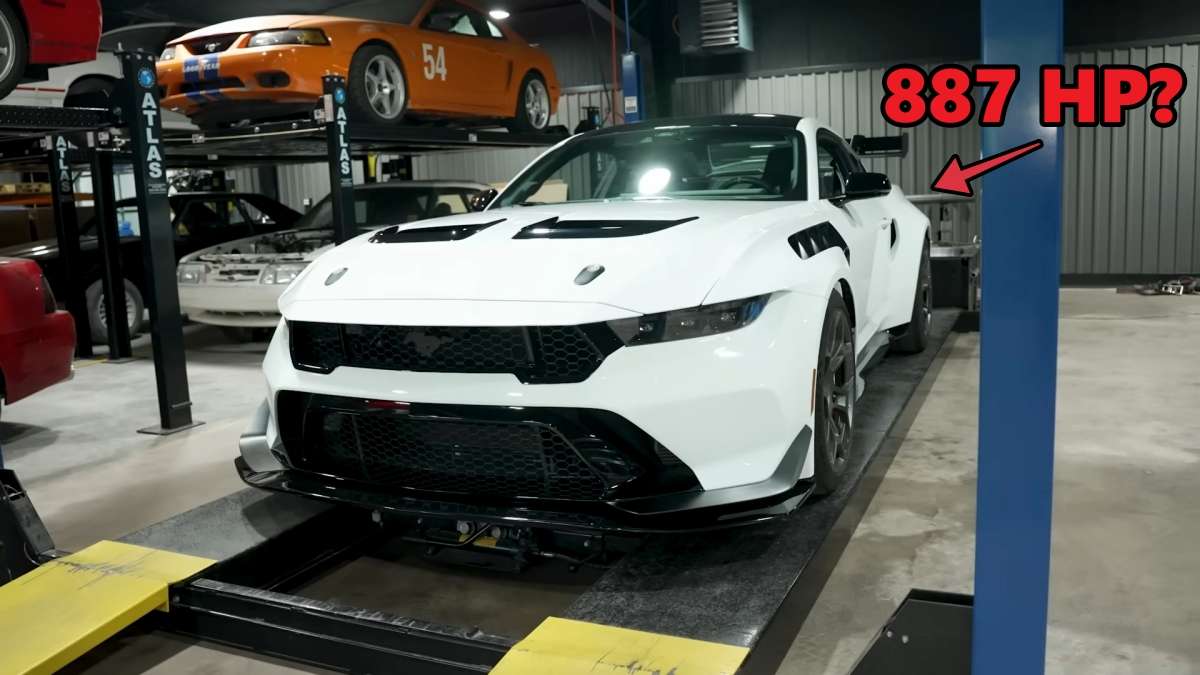
All that goes to the rear wheels through an eight-speed DCT transaxle, which is very similar to the one found on the C8 Corvette ZR1X. So similar, in fact, that Tremec made a manual transmission that can fit both cars. That said, the specialists at Late Mode Restoration (LMR) recently got their hands on one of the Mustang GTDs and strapped it to the dyno to determine how true the 815-horsepower figure is.
Related story: Ford Mustang GTD Sets Record for American Car at Nurburgring Track
That 815-horsepower figure may have been “slightly” underestimated.
When manufacturers report horsepower and torque figures, it is usually at the crankshaft/flywheel. It is generally accepted that the mechanical loss for a rear-wheel-drive vehicle is between 12 and 20 percent, with some claiming 15 percent. These numbers vary depending on the number of moving parts, weight, and other variables. Even the specialists at LMR say that the numbers may differ depending on the type of dyno used and even the individual cars.
In the case of this Ford Mustang GTD, two runs were done back to back, both at fifth gear. Typically, dyno runs are performed at the gear with a 1:1 ratio. For the Tremec transaxle, that’s seventh gear. However, the dyno runs are done in fifth gear.
The first run already proves the Mustang GTD makes more power.

The initial run produces impressive numbers. The graph shows 740 horsepower at 7,100 RPM and 605 pound-feet at 4,600 RPM, at the rear wheels. I used a calculator that gives a rough estimate of the crankshaft horsepower, and according to that, the track-focused Mustang actually makes 872 crankshaft horsepower.
I expected the second run to show worse figures due to heat-soaking, but the GTD’s cooling is meant to work even under high-stress situations like prolonged track sessions. The second run produced 753 rear-wheel horsepower at 7,400 RPM, which is significantly closer to the 7,650-RPM redline. It also means 887 horsepower at the crankshaft.
Peak torque jumped to 609 pound-feet at 4,500 RPM. The most impressive thing is that you are getting nearly 100 percent of peak torque throughout a significant portion of the rev range. But there is more. What if the dyno runs were done at seventh gear? Actually, no. The reason why dyno runs are done at the gear that has a 1:1 ratio (also known as direct drive) is that it provides the most accurate and consistent data. A 1:1 gear ratio doesn’t automatically mean more power. It simply means less parasitic loss.
In theory, less parasitic loss means more power, yes, but if the gear at which the engine makes most power is different from the gear that has the least mechanical loss, that’s not necessarily the case.
The GTD has what it takes to be the most collectible modern-day Ford Mustang.
Ford only planned to make around 1,700 units of the Mustang GTD, but this may change. There are currently over 7,500 applications submitted for the high-performance Ford, and a few lucky individuals, such as Lay Leno, have already gotten their hands on one. For 2025, production was capped at 271 units. It seems that having the ability to dish out $327,960 (the starting MSRP) may not be enough. I suspect many who couldn’t get the GTD brand-new will resort to the used market, and make no mistake, GTDs are bound to pop up for way over MSRP. That’s not counting models like the 2025 special edition GTD Spirit of America that Ford announced.
About the author
Dimitar Angelov has been an automotive journalist since 2014. His passion for cars and motorcycles led him to take up classic car restoration at the Classic Car Museum in Malta. While living there, he also graduated with a Master's in Media and Communications. Aside from Torquenews, his work can also be seen on Topspeed.com, HotCars.com, Motorheads.com, Jalopnik.com, and his own website, Ridereverie.com, where he also includes motorcycle content.
Set Torque News as Preferred Source on Google
Follow us today...