

"Is this a fluke or a fleet-wide failure?
Imagine the 'Stop/Start Unavailable' light flashes and a metallic burning stench fills the air, in your new 2025 Toyota RAV4. It didn't just ruin the new-car smell; now you’re afraid to drive the car. What would you do?
In my ongoing research into Toyota’s reliability shifts for 2026, I recently uncovered a troubling report shared in a prominent online community of Toyota RAV4 enthusiasts. Rachel Lynn, a member of the "Toyota RAV4 Discussion Group 2019-2025 - Gas + Hybrid + Prime," highlighted a growing concern that challenges the "bulletproof" reputation of the world's best-selling SUV.
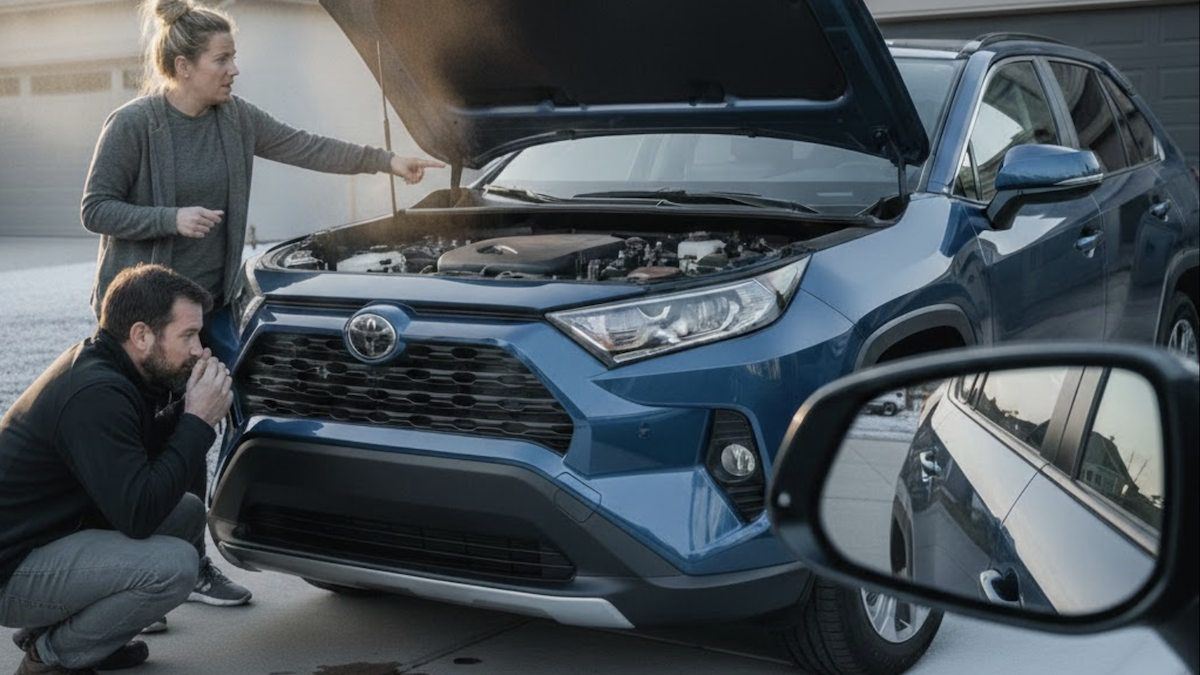
After owning her 2025 RAV4 for just three days, Lynn described a terrifying sequence of events that began with a cryptic dashboard warning and ended with the acrid stench of a mechanical meltdown in her own driveway.
Rachel says, “I just bought my 2025 RAV4 3 days ago from a Toyota dealership, and it’s got only 21k miles on it," Lynn shared. "As I was driving it the other night, the dash said 'stop/start unavailable,' and then when I got home, I idled in my driveway for maybe 30 minutes. When I got out, there was a horrible burning smell... My husband said it smells like when his truck’s transmission slips. I’m scared to drive it now.”
From My View
From my view, this isn't just a simple new-car "break-in" odor; it is a red flag that demands immediate technical scrutiny. In my 30 years of covering the automotive industry, I have learned that when a vehicle with only 21,000 miles emits an acrid, metallic stench that fills a driveway after a short idle, the powertrain's mechanical integrity is likely at risk.
Experts at RepairPal confirm that while some odors are benign, a burning smell in a 2025 Toyota RAV4 is often linked to fluid leaks hitting hot exhaust components or electrical short circuits.
I have documented similar frustrations: Toyota dealers refused to change the oil on a 2025 RAV4 until 10,000 miles, creating a gap in preventive care that can lead to exactly the kind of premature failure Rachel is experiencing.
My Take
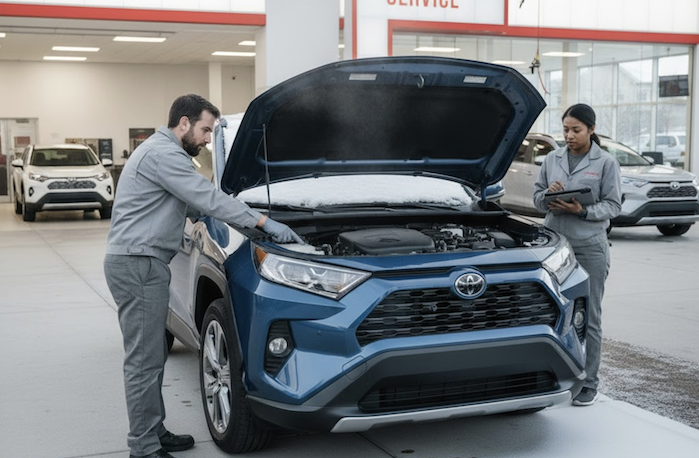
My take on this situation is that we are looking at more than just a software glitch. The "Stop/Start Unavailable" message is often a primary symptom of battery strain or charging system faults, but when paired with a burning smell, it points to a significant mechanical load, such as a seized accessory pulley or an overheating transmission.
Legal experts at Lemon Law Experts have noted that 2025 RAV4 transmission overheating can trigger dashboard warnings and emit a noticeable burning odor due to the vehicle's sealed cooling system.
I recently analyzed a similar case where a 2025 Toyota RAV4 owner lost all confidence after a five-minute dealer service, suggesting that dealership service quality might be slipping just as these new models face their first real-world stress tests.
Don't Trust the Dealer's Inspection Process
The fact that Rachel Lynn only owned this vehicle for three days before this crisis hit is what I call the "Industry Secret" vibe. It suggests a potential failure in the dealership's certified inspection process. When a "new" pre-owned vehicle with 21,000 miles leaves the lot and fails within 72 hours, it raises questions about whether the previous owner traded it in to escape a burgeoning mechanical nightmare.
Check the Clues
I want to highlight the 30-minute idle in the driveway. I know from experience that idling is the ultimate "thermal soak" test. Without the airflow from driving, the engine bay temperatures skyrocket, and the exhaust manifold reaches peak heat. If there is a slow transmission fluid leak or a failing cooling line, that 30-minute window is exactly when the "acrid, metallic stench" would become overwhelming.
First Signs?
Rachel’s husband compared the scent to a slipping transmission. This is critical because, in my experience, the smell of burnt transmission fluid is distinct, bitter, and sharp, unlike the thicker, heavier smell of burning engine oil. Is this an isolated assembly error, or are we seeing the first signs of a 2025 transmission cooling failure?
The "Thermal Soak" Reality vs. Mechanical Failure
In my 30 years of reporting, I have seen many "new car smells," but what Rachel Lynn is describing as an acrid, metallic stench after a 30-minute idle is the classic signature of a Thermal Soak failure.
In 2026, we are seeing a trend where modern, high-efficiency engines like the 2.5-liter Dynamic Force unit in the 2025 RAV4 operate at significantly higher temperatures to reduce emissions. When you stop the vehicle and idle, you lose the "ram air" cooling that occurs while moving, which can cause engine bay temperatures to spike.
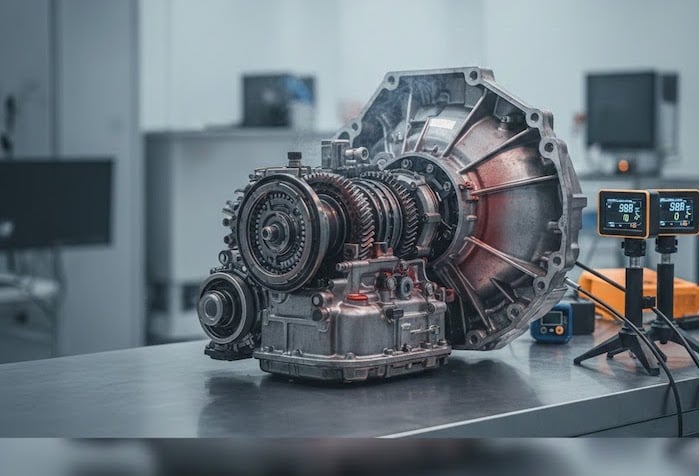
According to reports from Lemon Law Experts, transmission overheating in the 2025 RAV4 can trigger dashboard warnings and emit a noticeable burning odor because the vehicle's sealed system makes it nearly impossible for an owner to monitor fluid levels manually.
This is where the "Expertise" comes in: if that smell reminds a seasoned driver of a "slipping transmission," it is likely that the transmission fluid is reaching its flashpoint due to a faulty cooling loop or a restricted auxiliary cooler.
I have previously warned that Toyota dealers often refuse to change the oil or inspect these systems until 10,000 miles, which is a dangerous policy for a new-generation vehicle showing early signs of distress. Whether it is a "weeping" transmission seal dripping onto the hot exhaust or a software glitch in the Stop/Start system causing an electrical overload, this is not "normal break-in."
If your 2025 RAV4 smells like a truck stop after a short driveway idle, you aren't just smelling paint; you are smelling a potential powertrain failure in the making.
What RAV4 Owners Are Saying
The community is already buzzing with similar anxieties. One Reddit user noted the severity of the situation, stating, "the smell occurs less and less the more miles I put on it," implying that while some off-gassing is normal, persistent smells are not.
Another owner highlighted the vulnerability of the new design, mentioning, "whenever I drive up a steep hill and then have to stop immediately, I get a burnt, clutch-like smell," which reinforces the idea that these vehicles are struggling with heat management under load.
Key Takeaways for My Readers
- Don't Ignore the Dash: A "Stop/Start Unavailable" warning is rarely just about the battery when accompanied by a smell.
- The Sniff Test: Burnt toast or "syrupy" smells usually mean transmission fluid; acrid, thick smoke usually means engine oil.
- Demand a Dye Test: If the dealer says "we found nothing," demand they add UV dye to the fluids and return in 500 miles.
Toyota's Reputation Is On the Line
Toyota's legendary reliability is on the line here. If the 2025 RAV4 is already showing signs of thermal distress at just 21,000 miles, owners need to be proactive rather than waiting for a total breakdown on the highway.
Call to the Community: What say you? Have you smelled something 'hot' in your new-generation RAV4? Tell us in the comments below. Please leave a comment in the Add new comment link below.
Next Up: Toyota Quietly Admits the 'Fixed' RAV4 Hybrid Might Still Have a Major $5,000 Defect. In this investigative report, I dive into why the "Cablegate" corrosion issues might not be as "fixed" as Toyota claims for the 2025 model year.
Denis Flierl is a 14-year Senior Reporter at Torque News and a member of the Rocky Mountain Automotive Press (RMAP) with 30+ years of industry experience. Based in Parker, Colorado, Denis leverages the Rockies' high-altitude terrain as a rigorous testing ground to provide "boots-on-the-ground" analysis for readers across the Rocky Mountain region, California EV corridors, the Northeast, Texas truck markets, and Midwest agricultural zones.
A former professional test driver and consultant for Ford, GM, Ram, Toyota, and Tesla, he delivers data-backed insights on reliability and market shifts. Denis cuts through the noise to provide national audiences with the real-world reporting today’s landscape demands.
Connect with Denis: Find him on LinkedIn, X @DenisFlierl, @WorldsCoolestRides, Facebook, and Instagram.
Photo credit: Denis Flierl via Rachel Lynn /Facebook
Set Torque News as Preferred Source on Google
Follow us today...