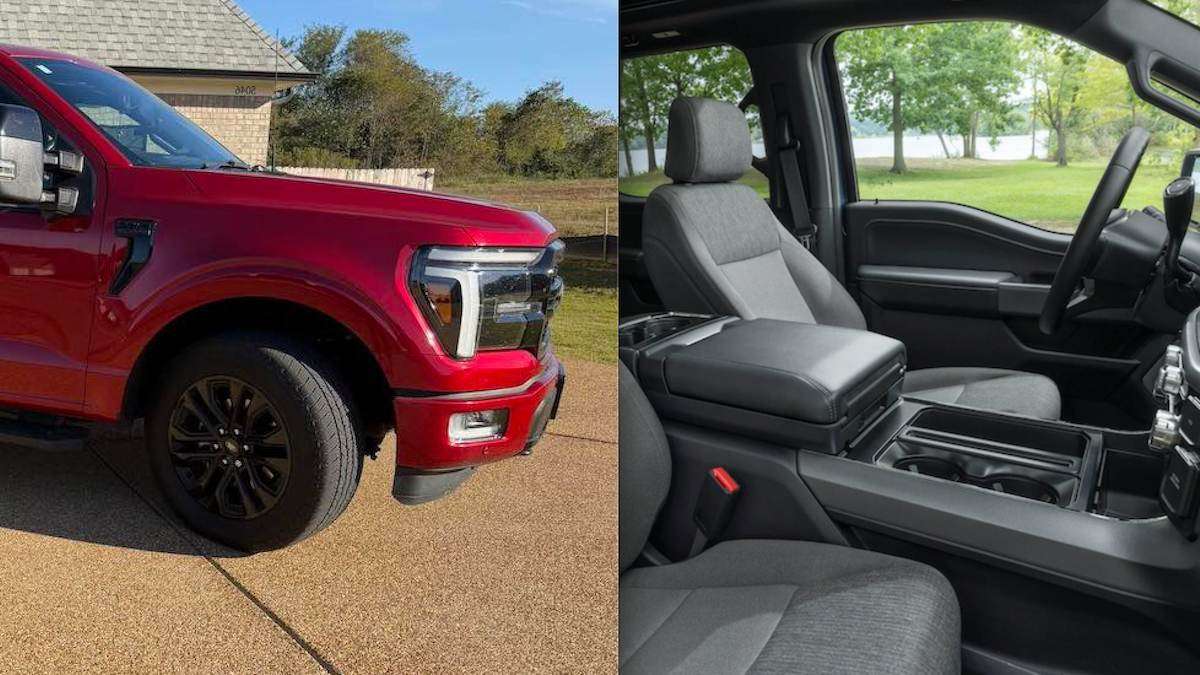

Paul Suarez traded in his GMC Yukon AT4 for a brand new 2024 Ford F-150 Lariat, only to find himself shaking—literally—at highway speeds, a vibration the dealership can't seem to fix. Is this a common issue for the new Ford truck?
Paul Suarez on the Ford F-150 Owners Facebook page says,
"I just got my 2024 Ford F-150 Lariat about a month ago after trading in my GMC Yukon AT4. I wanted to see if anyone else has experienced something similar: when I'm driving at higher speeds (around 75–85 mph), I feel a vibration in the cabin. It's not in the steering wheel, but more like the seats are shaking a bit."
"I've already taken it to the dealership twice, and they performed a road force balance both times, but the issue still feels the same. Has anyone run into this before or found a fix?"
The Stealth Shake:
When a new F-150 owner, especially one who has just made a leap from a rival like GMC, reports a high-speed vibration issue, he's wondering if he should have stayed with GM.
The Ford dealer's immediate—and usually correct—response is to check the tires. The road force balance, which measures radial and lateral runout under simulated load conditions, is the gold standard for diagnosing tire and wheel assemblies.
Yet, as Paul clearly articulated, the dealer performing this procedure twice with no resolution proves that road force balance did not fix the Ford F-150 seat vibration. Why? Because the problem isn't the tire's balance, it's likely the driveshaft's angle, its physical condition, or a severe concentricity error in how the tire assembly mounts to the vehicle.
Steering vs. Seat Vibration
This is the most critical piece of advice experts offer: the location where the vibration is felt dictates the diagnostic path.
- Vibration in the Steering Wheel: Almost always a rotating mass ahead of the cabin. These points directly to the front tires, wheels, rotors, or hub assemblies. A road force balance usually solves this.
- Vibration in the Seats, Floor, or Console: This mass is usually rotating beneath or behind the cabin. These points overwhelmingly point to the driveline components—the driveshaft, axle, and differential—or the rear wheels.
Since Paul's 2024 Lariat has the latter symptom, we must move past the wheels and focus on the driveshaft.
Driveline Geometry
American Trucks gives the following information. The Ford F-150 uses a two-piece driveshaft (common on Crew Cab/longer wheelbase models like the Lariat) or a single aluminum shaft. The key to smooth operation at high speeds is maintaining the correct operating angles of the Universal Joint (U-joint) or Constant Velocity (CV) joint.

When the truck is loaded or even just running at speed, minor manufacturing tolerances or, less commonly, slight assembly errors can cause what is called "driveshaft runout" or "driveline phasing issues." This creates a secondary harmonic vibration that the chassis transmits directly into the floor and seats, becoming highly pronounced around 75–85 mph. This is why we are concerned about the F-150 vibration felt in seats at 80 mph, and the drive shaft angle issues.
What Should F-150 Owners Do Next?
You need to insist that the technician perform these specific, specialized checks:
- Driveshaft Runout Measurement: The driveshaft must be physically checked for lateral runout (bent or imperfectly straight) using a dial indicator while rotated. This is a crucial check for any high-speed vibration. We need to answer the question: Is my 2024 F-150 driveshaft runout causing high-speed shimmy? If it exceeds 0.015 inches, the shaft should be replaced.
- Pinion Angle Verification: The angle of the differential pinion (the gear connecting the driveshaft to the axle) must be correctly phased with the transmission output shaft angle. On a long wheelbase truck, even a one-degree deviation can cause resonance. This is a complex fix, often requiring shims, which leads us to consider advanced Ford F-150 pinion-angle shimming for lifted trucks, even if your Lariat is stock, as the principles of correction remain the same.
- Center Bearing Inspection (Two-Piece Shafts Only): If the Lariat has a two-piece driveshaft, the carrier bearing that supports the shaft's middle section may be defective, misaligned, or improperly torqued, allowing excessive movement.
The Wheel Factor
The source of high-speed vibration can often be traced back to the wheels, moving past simple balance issues to problems with hub centricity.
Recommendation: Demand that the technician inspect and clean both the back of the wheel mounting surface and the hub mounting surface before remounting. Ensure the lug nuts are torqued in a star pattern to the exact factory specification.
What the Community is Saying
Paul's experience highlights a common frustration in the truck community: repeatedly receiving the same unsuccessful fix. We often see similar reports on forums from owners of new half-ton trucks who experience a high-speed "drone" or "buzz" that is difficult to isolate. The consensus is always the same: if the steering is smooth, stop chasing the balance weights and start inspecting the driveline joints and angles.
Tony Traska - I had the same problem with my 2020 XLT. I took it back multiple times, and they did all the testing and said nothing was wrong. The problem persisted. I complained, and they gave me an extended warranty, but the tire issue never went away. I learned to live with it.
Fast forward to last month. Hit 70k miles, got new tires, can run that thing over 100 mph. No vibration. It's the junk tires Ford puts on their new cars. It was my tires the whole time.
Further Reading and Ford F-150 Context
Does the Ford F-150 have issues with fit and finish? According to Brian, who recently bought a 2025 Ford F-150, it has serious problems that have him scratching his head. How can a new pickup have such issues? Check out Brian's unbelievable story.
In The End
Paul's issue is not a subjective complaint; it's a measurable engineering fault. You've established that the standard, low-effort fix (road force balance) has failed. Now you need to arm yourself with knowledge and insist that the dealership elevate the diagnosis from tire specialist to driveline specialist.
Key Question for F-150 Owners
If you experienced a persistent, high-speed vibration on your new truck, what was the most unusual or unexpected repair that finally solved the problem? Let us know in the comments below!
I'm Denis Flierl, a Senior Torque News Reporter since 2012, bringing over 30 years of automotive expertise to every story. My career began with a consulting role for every major car brand, followed by years as a freelance journalist test-driving new vehicles—equipping me with a wealth of insider knowledge. I specialize in delivering the latest auto news, sharing compelling owner stories, and providing expert, up-to-date analysis to keep you fully informed.
Follow me on X @DenisFlierl, @WorldsCoolestRides, Facebook, and Instagram
Photo credit: Denis Flierl via Paul Suarez
Set Torque News as Preferred Source on Google
Follow us today...