
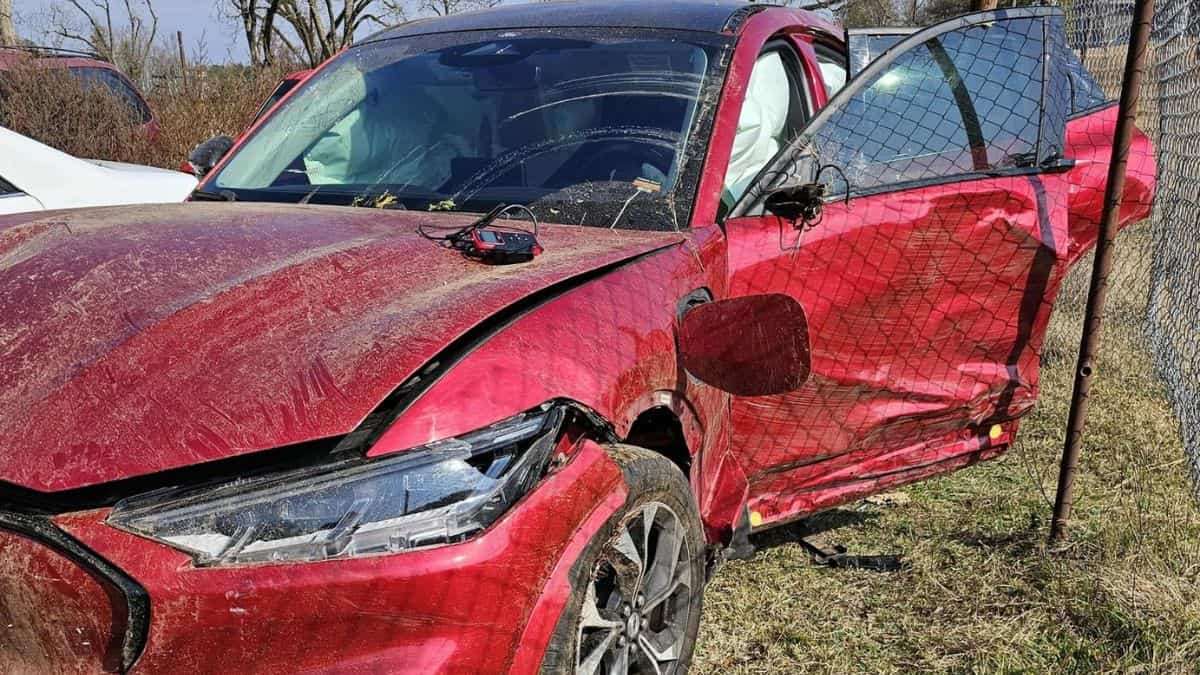

Every once in a while, a social media post sneaks past your defenses. It does not yell. It does not exaggerate. It just sits there, almost casually, while carrying the emotional weight of something that could have ended very differently. This was one of those posts. A wrecked Ford Mustang Mach E. Bent metal. A quiet sense of finality. And a sentence that made me stop scrolling and actually lean closer to the screen. Not because it was shocking, but because it was restrained in a way that only real experience allows. This was not a debate about EVs. This was not theory. This was reality, arriving without warning on a foggy morning.
“Wellllllllllll if you get in a wreck, it holds up. Only two cracked ribs. Good job on safety Ford. Literally saved my life." Thank God.
That is the entire post from Eric Taylor Sanford, which he wrote on Mustang Mach-E Owners open group on Facebook. No dramatic buildup. No attempt to convince anyone of anything. Just facts, presented in a way that feels almost unsettling because of how calm they are. Two cracked ribs. Saved my life. Those words usually do not share space. But here they are, sitting under photos of a Mustang Mach E that clearly absorbed a violent impact.
Eric later added context in the comments that made the situation even more sobering. It was a solo accident. Foggy morning. He did not see a curve coming. Three trees and an embankment later, the vehicle was destroyed. He was still here to type about it. That is not a controlled crash test. That is unchecked real world chaos colliding with engineering.
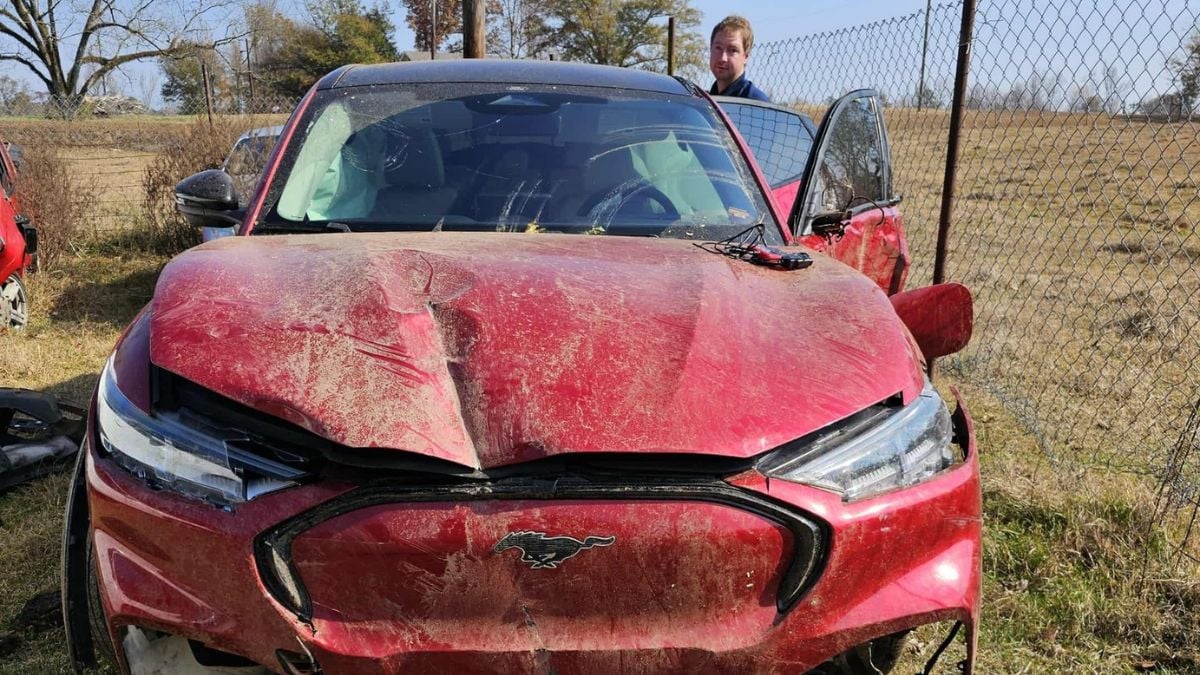
What happened next in the comments is what makes this story worth your time.
Phil Pereira wrote, “This would make me want another.” That reaction is fascinating because it runs against human instinct. After a crash, a vehicle often becomes instantly unlikeable. It becomes a symbol of what went wrong. Yet Eric replied that he had already found another one, a gray GT line. That is not denial. That is confidence earned under pressure.
Daniel Enriquez added a perspective that shifted the discussion from one person to an entire household. “The main reason I bought two of them as daily drivers. Everyone in the family is safer.” Two Mach Es. Daily drivers. That is not casual ownership. That is a decision rooted in trust, built not on hype, but on outcomes.
Daniel Duncan brought in an angle many American buyers quietly respect. “Even though Im American, I look at Euro NCAP safety ratings if they sell it in the EU, tend to trust them more. As you unfortunately had to find out, it's rated VERY highly there.” Euro NCAP testing is demanding and unforgiving. Vehicles that perform well there tend to do so because of real structural strength, not clever messaging.
Ashley Jade summed it up with blunt clarity. “They’re rlly built to take the punch of the accident. most mach es in accidents tend to be totaled out BUT the passengers are the safest they can be.” That sentence matters. A totaled car is not a failure if the people inside walk away.
Christy Semmont added another layer of credibility. “Same here! It saved me too. Drunk driver hit me. Yours is worse. It’s totaled… sorry, glad you’re ok.” At that point, this is no longer a single story. It is a pattern.
Why the Mustang Mach-E Absorbs Impact So Well
So what is actually happening when a Mustang Mach E meets something solid at speed?
Start with physics. The battery pack sits low in the chassis, lowering the center of gravity and improving stability. That reduces rollover risk and keeps the vehicle predictable when conditions suddenly change. Add to that a rigid passenger cell, reinforced roof pillars, and crumple zones designed to absorb energy progressively instead of transferring it directly to occupants.
Weight also plays a role. Electric vehicles carry mass differently than traditional cars. When managed correctly, that mass helps dissipate force. Several commenters referenced collisions with animals or fixed objects where the vehicle looked destroyed, but the occupants were protected.
This is also why many Mach-Es are declared total losses after severe accidents. That outcome is often misunderstood. The vehicle did not fail. It completed its job.
The Broader Mach-E Story Beyond the Crash
Stories like this do not exist in a vacuum. They intersect with how the Mustang Mach E fits into the broader market and ownership experience. Despite an uneven EV landscape, the Mach E has quietly shown resilience, recently defying broader industry trends by posting solid October deliveries, a signal that trust and word of mouth still matter more than headlines.
But ownership is not without friction. Some Mach E drivers have shared moments that feel almost surreal, like when a Ford service tech was confused because an owner drove his Mustang Mach E home without a key fob, highlighting how EV ownership can still collide with legacy systems.
Others have dealt with more serious interruptions, such as when a 2022 Mustang Mach E owner reported his car would not move due to a parking brake fault, turning a normal day into a sudden logistical puzzle.
These issues matter. They shape trust. But stories like Eric’s change how those frustrations are weighed.
Why People Still Choose the Mach-E
Design and feel also play a role in that trust. Some owners who came from high performance luxury SUVs have been surprised by how solid and intentional the Mach E feels. One driver who traded a BMW X5 M for a Mustang Mach E talked about Ford’s rear design choices and how planted the vehicle feels on the road.
Long term daily use adds another layer of insight. A 2023 Mach E Premium owner who used the vehicle daily for 18 months shared detailed thoughts on Ford’s climate controls and touchscreen behavior, offering a rare look at how these systems age in real life.
And then there are the mileage stories. When someone says buying a 2022 Ford Mustang Mach E was the best decision they ever made after hitting 250000 miles, it reframes durability conversations entirely.
The Emotional Core of Safety
One comment in Eric’s thread quietly captured why posts like this resonate so deeply. “And I was really worried about what happens in a crash. Glad you are all right and you made me a little less worried.” Fear thrives where experience is missing. Real stories close that gap.
There is also a moral here that goes beyond vehicles. Cars are replaceable. People are not. That truth helps us become better drivers and better decision makers. Fog does not announce itself. Curves arrive faster than expected. Humility saves lives long before airbags deploy.
Eric did not set out to teach anyone a lesson. He just shared what happened. And in doing so, he reminded a lot of people what safety actually looks like when theory meets reality.
How Electric Vehicle Crash Safety Differs From Gas-Powered Vehicles
One thing we did not really unpack is how an electric vehicle like the Mustang Mach E behaves differently in a crash compared to a traditional gas powered SUV. EVs do not have a large engine block up front, which changes how impact energy is managed. Instead of a heavy engine shifting backward toward the cabin, engineers can design larger and more predictable crumple zones. In the Mach E, this means more space for energy absorption before forces reach the passenger compartment, which helps explain why occupants often walk away even when the vehicle looks destroyed.
Another overlooked difference is how EV battery packs are protected. Despite fears about battery damage, the pack is usually encased in reinforced structures designed to resist intrusion. In real world crashes, this often means the battery stays intact even when exterior components fail. For drivers reading Eric’s story, this helps clarify why walking away from severe impacts in EVs is becoming more common and why crash outcomes do not always match visual damage.
Insurance, Total Loss Decisions, and What Owners Should Expect After a Crash
Another important area to explore is what happens after the accident, especially when a vehicle like the Mustang Mach E is declared a total loss. Many owners are surprised to learn that EVs can be written off more quickly than gas vehicles, not because they are less safe, but because repair complexity and part costs add up fast. High voltage components, structural battery enclosures, and calibration requirements often push repair estimates beyond insurance thresholds.
For readers, understanding this ahead of time can reduce stress if the worst happens. A totaled vehicle does not mean the safety systems failed. In many cases, it means the vehicle protected you so effectively that repairing it no longer makes financial sense. Knowing how insurance companies evaluate EV repairs helps owners make better coverage decisions and mentally prepare for what comes after the accident scene.
How Owner Communities Shape Real World Knowledge and Confidence
One area that quietly shapes buying decisions but rarely gets analyzed is the role of owner communities. The Mustang Mach E group where Eric shared his experience did more than offer sympathy. It provided confirmation, shared similar stories, and reduced fear for other owners reading silently. These groups function as real time knowledge networks, often surfacing patterns long before official reports do.
For potential buyers, this matters. Reading dozens of comments from people who walked away from serious crashes creates a different kind of confidence than reading a five star safety rating. It humanizes the data. It also encourages owners to drive with a mindset rooted in awareness rather than overconfidence. In that sense, communities do not just share information. They actively shape how people relate to their vehicles and to risk itself.
What This Story About The Mustang Mach-E's Durability Leaves Us With
The unexpected takeaway here is not that the Mustang Mach-E is flawless. It is not. The takeaway is that thoughtful engineering, strict testing, and real world validation still matter in an era dominated by screens and features.
This was not a commercial. It was a human moment. And those moments carry more weight than any brochure ever could.
Now I want to hear from you.
Have you experienced a serious accident in an electric vehicle, and did it change how you think about EV safety?
When choosing your next vehicle, do real owner crash stories influence you more than official safety ratings?
Share your experience in the comments below. Someone reading may need it more than you realize.
Armen Hareyan is the founder and Editor-in-Chief of Torque News. He founded TorqueNews.com in 2010, which since then has been publishing expert news and analysis about the automotive industry. He can be reached at Torque News Twitter, Linkedin, and Youtube. He has more than a decade of expertise in the automotive industry with a special interest in Tesla and electric vehicles.
Set Torque News as Preferred Source on Google
Follow us today...


Comments
I'm always SO glad to hear…
Permalink
I'm always SO glad to hear that people are okay - first and foremost - but it really puts my mind at ease every single time I see one of these wreck posts. These things are like tanks, it's amazing how well the Mustang Mach-Es hold up!!
So sorry your Mustang Mach-E…
Permalink
So sorry your Mustang Mach-E is heading out to pasture. But I am so glad the Lord protected you so well!!