
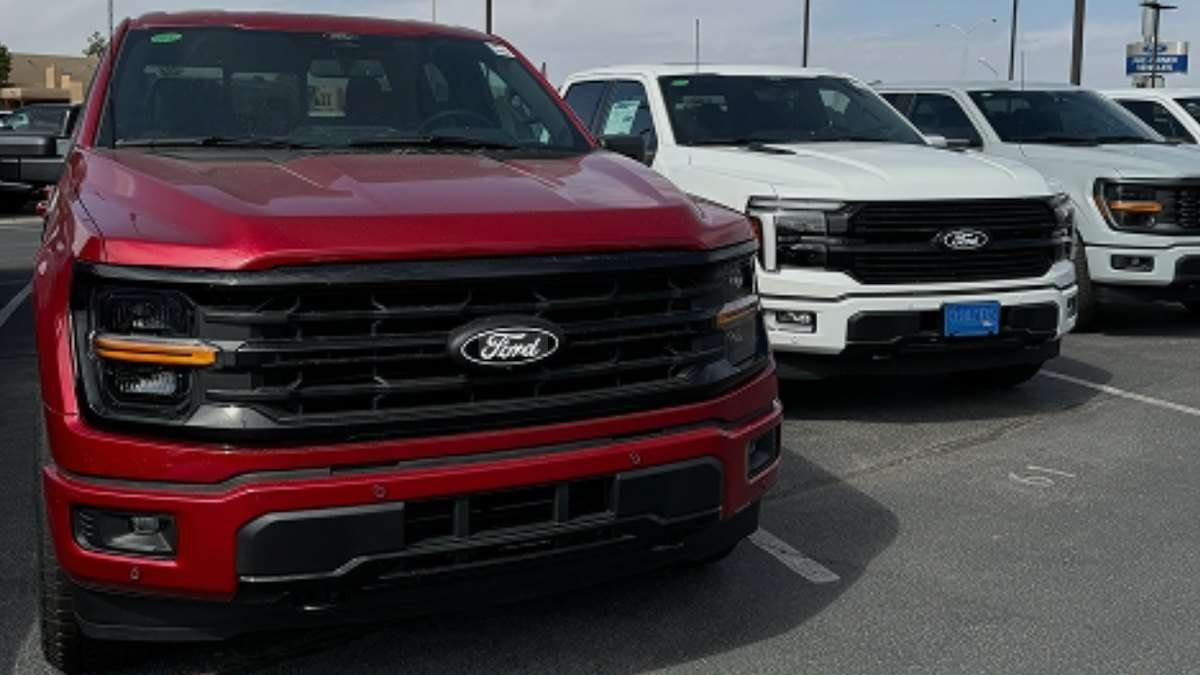

Is the legendary "Built Ford Tough" slogan dying after just two years, or is your $50,000 investment actually a ticking time bomb?
Imagine a loyal truck owner standing over a high-mileage engine that outlasted its newer, $50,000 counterparts, only to realize that modern engineering might be working against the consumer. It is a sobering reality when a decade-old pickup feels like a safer bet than a brand-new showroom model currently plagued by early mechanical failures.
In a recent post shared in a Facebook community of Ford truck enthusiasts, Brendon Lindsey highlighted growing concerns about the reliability of modern Ford F-150 trucks and the steep costs of staying on the road.
"I’m honestly blown away by the current state of vehicle reliability. People are buying $50,000 trucks only to have to replace their engines within two years. It feels like Ford has engineered these things to fail. My 2013 F-150 has 245k miles, and while I’m staring down $8k–$12k in repairs, reading about newer trucks failing makes me realize we’re all getting a raw deal. I want to cut my losses, but why would I drop $30k on a 2015–2017 F-150 5.0 when it could easily hit me with a $4,000 repair bill a week after I buy it?"
The Brutal Reality of Modern Truck Longevity
After thirty years in the automotive industry, I have seen the Ford F-150 evolve from a simple workhorse into a rolling supercomputer, but this technological leap has come at a steep price in terms of long-term dependability. While Ford remains a sales leader, the growing chorus of owners facing catastrophic engine issues within the first 24 months suggests a disturbing shift in manufacturing priorities.
According to data from the Lemon Law Experts, many current-generation owners are reporting significant defects in engine components, specifically noting that manufacturing flaws in connecting rods and bearings can lead to internal engine damage and unexpected stalling.
In my 14 years of reporting, the stories I hear from guys like Brendon are becoming the rule rather than the exception. I previously reported on a similar frustration where an F-150 owner faced serious buyer's remorse just one year in, struggling with a transmission that slips and an underpowered oil-burning engine that left him owing more than the truck was worth. This "negative equity" trap is a nightmare for anyone trying to maintain a reliable daily driver.
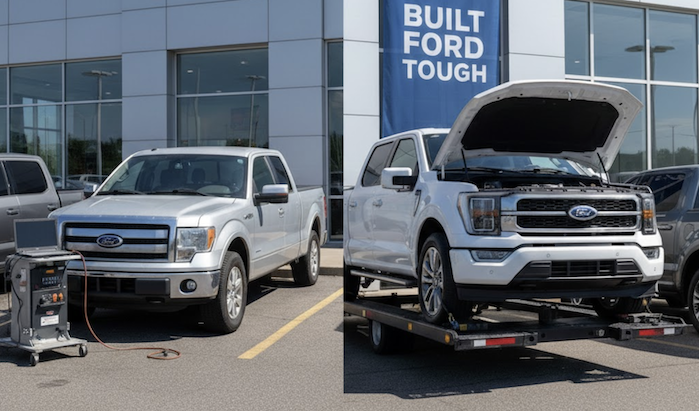
Why New $50K Truck Owners Are "Getting the Shaft."
The complexity of the modern Ford F-150 powertrain often introduces points of failure that simply did not exist in the simpler V8 models of the past. Expert analysis from Zubie highlights that even routine components have become liabilities, reporting that ignition coil failure due to spark plug gap and head gasket oil leaks remain the top repair problems for the F-150 lineup. These "nuisance" repairs quickly escalate into multi-thousand-dollar invoices once the factory warranty expires.
When you look at the best years for a used Ford F-150, I often point people toward the 2015-2017 window, yet as Brendon correctly identified, even those "golden era" trucks are hitting a wall. In my recent investigation into dealership service, a Ford F-150 owner fought a $1,500 bill for snapped turbo bolts during a warranty repair, turning a standard fix into a financial nightmare. It seems the safety net of a warranty is only as good as the dealer's willingness to honor it.
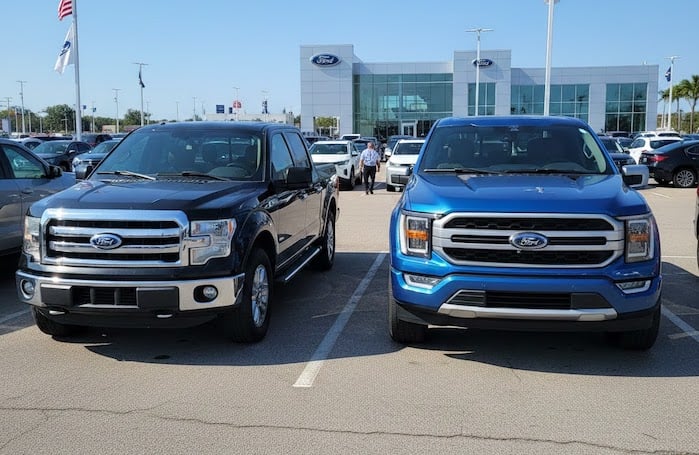
The "Engineered to Fail" Sentiment
Is Ford truly engineering these trucks to fail? As a senior reporter with years of grease under my fingernails, I don't believe there is a secret room where engineers plot a truck's demise. However, there is a clear trend toward "planned obsolescence" driven by strict emissions standards and fuel economy mandates.
To hit those numbers, Ford uses thinner oils, higher turbo pressures, and lighter materials. The 5.0L V8 Coyote engine, once the gold standard for durability, has seen changes in cylinder liner technology and oiling systems that have led to increased oil consumption and, in newer iterations, occasional catastrophic failure.
When you combine these tight tolerances with a global supply chain that sometimes prioritizes speed over component longevity, you get the "shaft" that Brendon is describing. The frustration stems from the lack of a "safe" move. Buying a new truck feels like a gamble, and buying a used truck feels like inheriting someone else's expensive problem. This creates a paralysis for the average blue-collar worker who needs a reliable tool for work, not a luxury gadget that lives at the dealership service bay.
What Ford F-150 Owners Are Saying
The sentiment on the ground is even more frustrated than the official reports suggest. One user on Reddit noted the severity of the situation regarding the newer cooling systems, stating, "The 10R80 has a lot of recalls. The pre-2023 2.7 and 3.0 were just recalled for engine failures caused by brittle valve parts. You can find lots of sad Ford/Lincoln owners exhausted with battling the dealership to fix things," which you can read in the full discussion here.
Another owner highlighted the vulnerability of the new design and the lack of quality assurance, mentioning, "I’ve ordered 3 new 2024 F-150’s this year and rejected all 3 due to missing parts on backorder, panel fit and gaps, paint and body defects that can’t be corrected without repainting or replacing parts on a brand new truck," found in this Reddit thread.
Solutions and Recommendations
If you find yourself in Brendon’s shoes, facing a massive repair bill on a high-mileage truck, do not panic and rush into a new $800-a-month payment. Here is my breakdown of how to handle this dilemma:
1. Perform a Blackstone Oil Analysis: Before spending $10,000 on a rebuilt engine, spend $40 on an oil analysis. This will tell you if there is metal debris in your engine, giving you a clear picture of its internal health.
2. The "Used" Sweet Spot: If you must buy used, target the 2015-2017 5.0L models, but ensure the transmission's lead frame has been addressed. These trucks avoid the complex "wet belt" oil pump systems found in some newer Ford engines.
3. Warranty is Mandatory: If you buy a Ford truck made after 2018, do not leave the lot without a Ford Protect Extended Service Plan (ESP). Avoid third-party warranties; only the factory-backed ESP ensures you won't be fighting for every dime when a turbo blows.
4. Maintenance as Insurance: Forget the manual's "normal" service interval. Change your oil every 5,000 miles and your transmission fluid every 40,000 miles. Heat and dirty oil are the two biggest killers of the 10-speed transmission.
Key Takeaways for F-150 Owners
- Vetting the 5.0L Coyote: While legendary, newer versions have been reported to have oil consumption issues; always check for TSBs (Technical Service Bulletins) before buying used.
- The Transmission Trap: The 10-speed automatic (10R80) is prone to harsh shifting; ensure the latest PCM software updates have been flashed.
- Repair vs. Replace: If your high-mileage truck needs $10k in work, compare that to the $1,200/month payment of a new truck that might still end up in the shop.
- Pre-Purchase Inspections: Never buy a 2015-2023 F-150 without a borescope inspection of the cylinders and a lead frame test on the transmission.
- Fluid Changes Matter: Disregard the "lifetime fluid" claims for transmissions and differentials; regular changes are the only way to reach 200,000 miles.
A Wake-Up Call
The frustration felt by high-mileage owners like Brendon is a wake-up call for the industry. When a driver with 245,000 miles of loyalty is too afraid to buy the newer version of his own truck, Ford has a massive problem. We are seeing a shift where "new" no longer guarantees "reliable," leaving many of us to wonder if the best F-150 we will ever own is the one already sitting in our driveway. The "raw deal" isn't just about the money; it is about the loss of peace of mind that used to come with buying an American icon.
It's Your Turn: Have you faced a major engine or transmission failure on a newer F-150, or is your high-mileage veteran still outperforming the new guys? Let me know in the comments below.
Next Up: Is the 2025 Ford F-150 5.0L V8 Actually a Step Down? One owner loves the tech but misses the "oomph." From effortless EcoBoost torque to a "lazy" V8, see why this upgrade feels like a power downgrade in my full report.
Denis Flierl is a Senior Reporter at Torque News with over 30 years of hands-on experience in the automotive industry. Having served as a professional test driver and industry consultant for major automakers such as Chevrolet, Ford, Toyota, Honda, and Tesla, Denis provides a "boots-on-the-ground" perspective that goes beyond standard reporting. Since joining Torque News in 2012, he has specialized in cutting through market noise to deliver data-backed analysis and real-world owner stories. His work focuses on navigating the transition to EVs and the shifting automotive market.
Have a tip or question for Denis? > Engage with him directly on LinkedIn for industry analysis, or follow his latest updates on X @DenisFlierl and @WorldsCoolestRides. You can also find his latest car features on Facebook and Instagram.
Photo credit: Denis Flierl via Ford
Set Torque News as Preferred Source on Google
Follow us today...







Comments
After 254k miles on gas…
Permalink
After 254k miles on gas engine ?
I have a 2016 Ford F150 with…
Permalink
I have a 2016 Ford F150 with a 5 L engine. Always took care of it and never abused it, never towed with it. 66k miles on it and the transmission is having issues. Looks like it's a lead frame issue. Seriously considering just selling it and not buying another Ford and going to a Toyota.
Bottom line. $70,000 is too much for a disposable vehicle.
I have a 2016 Explorer XLT 3…
Permalink
I have a 2016 Explorer XLT 3.5L. I was left and still is in total shock when I needed a new water pump at 83,000 miles. First I read the water pump goes out at average 120,000 miles! The real shock was the cost, over $2300 to replace! It also said to replace timing too. U-tube showed average 18 more or less hours to fix essentially tearing down the top half of engine just to get to the pump. To say I was upset is an understatement. Ford and not I should have paid for labor due to their design! Pump and the timing chain only cost a couple hundred. So over $2000 in labor for $200 in parts. Yes, I question if I'll ever buy another Explorer XLT. Also I've had more recalls on 2016 than previous 3 Explorers.